Facts
The appellant, a company manufacturing graphite electrodes and operating captive power units, challenged an order of the Income Tax Appellate Tribunal (ITAT) for the Assessment Year 2001-02
Source reference: para. 1-2The assessee had claimed a deduction under Section 80-IA for captive power consumption valued at Karnataka State Electricity Board (KSEB) rates and a deduction under Section 80HHC for export profits, while excluding 100% of such export profits from book profits under Section 115JB
Source reference: para. 2The Assessing Officer (AO) rejected the KSEB pricing (excluding electricity duty), reduced Section 80HHC profits by the Section 80-IA deduction, allowed only an 80% exclusion of export profits from book profits, and treated sales tax remission as revenue income
Source reference: para. 2The CIT(A) and ITAT largely upheld these findings, leading to the present appeal
Source reference: para. 3Issues
1. Whether the transfer price of power for Section 80-IA purposes should include the electricity duty component charged by the State Electricity Board to industrial consumers.
Source reference: para. 4(a)2. Whether deductions allowed under Section 80-IA must be reduced from the business profits eligible for deduction under Section 80HHC.
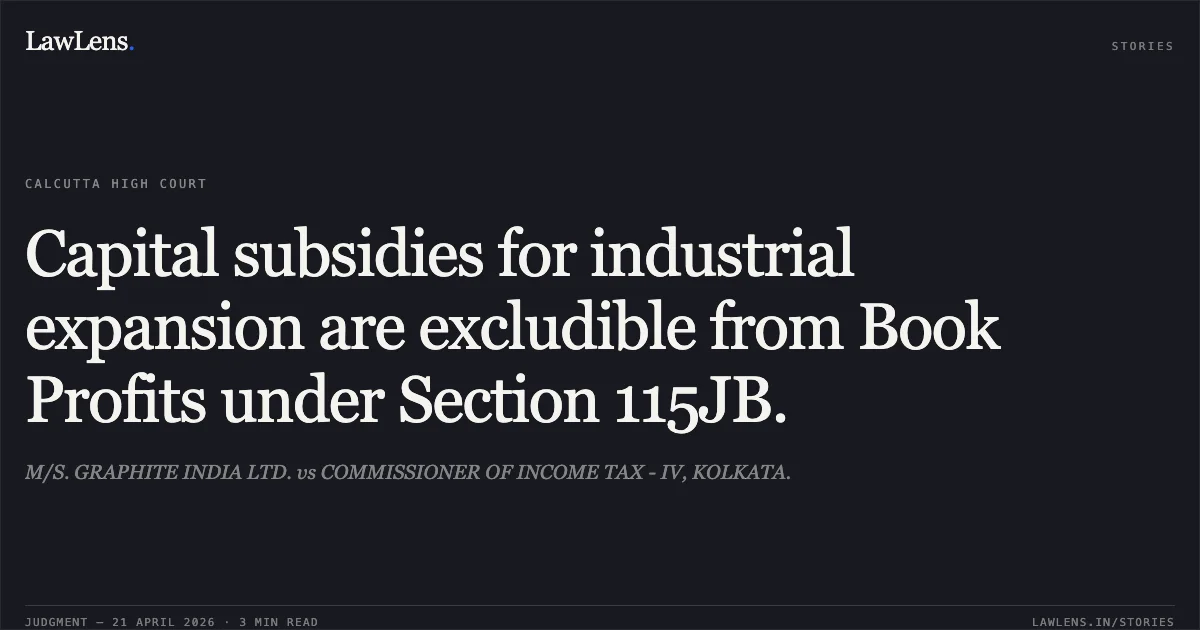
Source reference: para. 4(b)3. Whether, for computing book profits under Section 115JB, 100% of export profits computed under Section 80HHC(3) should be excluded instead of the phased-down percentage (80%).
Source reference: para. 4(c)4. Whether sales tax remission granted for industrial expansion in backward areas constitutes a capital receipt or revenue income.
Source reference: para. 4(d)5. Whether such sales tax incentives can be excluded from the computation of book profits under Section 115JB.
Source reference: para. 4(e)Law Applied
The court applied Section 80-IA, Section 80HHC, and Section 115JB of the Income Tax Act, 1961.
Source reference: no citationIt relied on the Supreme Court’s ruling in CIT v. Jindal Steel and Power Ltd. [460 ITR 162 (SC)], which established that the "market value" of power for Section 80-IA is the rate charged by the State Electricity Board (SEB) to consumers, including statutory components like duty
Source reference: para. 7-8Regarding the interaction between Section 80-IA and 80HHC, it followed Shital Fibers Ltd. v. CIT [(2020) 476 ITR 309 (SC)]
Source reference: para. 9For Section 115JB, it applied Ajanta Pharma Ltd. v. CIT [194 Taxman 358 (SC)], holding Section 115JB to be a self-contained code where the 80HHC(1B) phase-out does not apply
Source reference: para. 10Finally, it applied the "purpose test" from CIT v. Ponni Sugars [(2008) 174 Taxman 87] and PCIT v. Ankit Metal & Power Ltd. [109 taxmann.com 93 (Cal)] to determine the capital nature of subsidies
Source reference: para. 11-12Reasoning
Regarding the transfer price of power, the Court reasoned that market value represents the price an industrial consumer would pay the SEB, which necessarily includes electricity duty; therefore, the ITAT erred in deducting the duty component
Source reference: para. 7-8On the second issue, the Court held that Section 80-IA deductions do not reduce the eligibility of business profits for Section 80HHC, as settled by binding precedent
Source reference: para. 9For book profit computation under Section 115JB, the Court observed that Explanation (iv) refers to "profits eligible for deduction," which implies the full amount determined under Section 80HHC(3)/(3A) regardless of the restricted deduction actually allowed in the tax computation
Source reference: para. 10Addressing the sales tax remission, the Court applied the "purpose test," noting the incentive was linked to fixed capital investment for units in backward areas, thereby qualifying it as a capital receipt
Source reference: para. 11Consequently, since such receipts do not constitute "income" under Section 2(24), they must be excluded from book profits under Section 115JB
Source reference: para. 12Holding
The High Court allowed the appeal, answering all substantial questions of law in the negative and in favor of the assessee
It held that: (i) electricity duty is part of the transfer price for Section 80-IA; (ii) Section 80-IA deductions do not reduce Section 80HHC eligible profits; (iii) 100% of export profits are excludable from book profits under Section 115JB; and (iv) sales tax incentives for backward area expansion are capital receipts excludable from both regular income and book profits
Source reference: para. 8-12Acts & Sections Cited
6 provisions across 1 statute referred to in this judgment. Linked provisions open on LawLens.
Income Tax Act, 19616
Original Court PDF
M/S. GRAPHITE INDIA LTD.vsCOMMISSIONER OF INCOME TAX - IV, KOLKATA.
Click to open original judgment
Original judgment, available to read, download and summarize on LawLens.in


