Facts
The petitioner’s husband, Vinod Kumar Joshi, a Senior Technician (Electrical) in the Railways, died on 08.04.2023 due to electrocution while rectifying a fault on an 11 KV HT line.
Source reference: p.1-2Despite requesting a power shutdown, the line remained live, causing him to fall from a utility pole.
Source reference: p.1-2, 9The Department admitted it was a workplace accident but unilaterally calculated compensation at ₹10,16,700/-, which was accepted by the Adjudicatory Authority in W.C. Case No. 15/2023(D) without providing the basis for the computation or a hearing to the petitioner.
Source reference: p.2The petitioner sought enhancement, alleging negligence and vicarious liability.
Source reference: p.3Issues
1. Whether the determination of compensation without quantification or a hearing is justified under Section 4(1)(a) read with Section 5 of the Employees Compensation Act, 1923, and whether the petitioner is entitled to damages.
Source reference: p.2, Issue i2. Whether adopting the Railway Authority's calculation without an opportunity for the claimant to be heard constitutes a violation of natural justice.
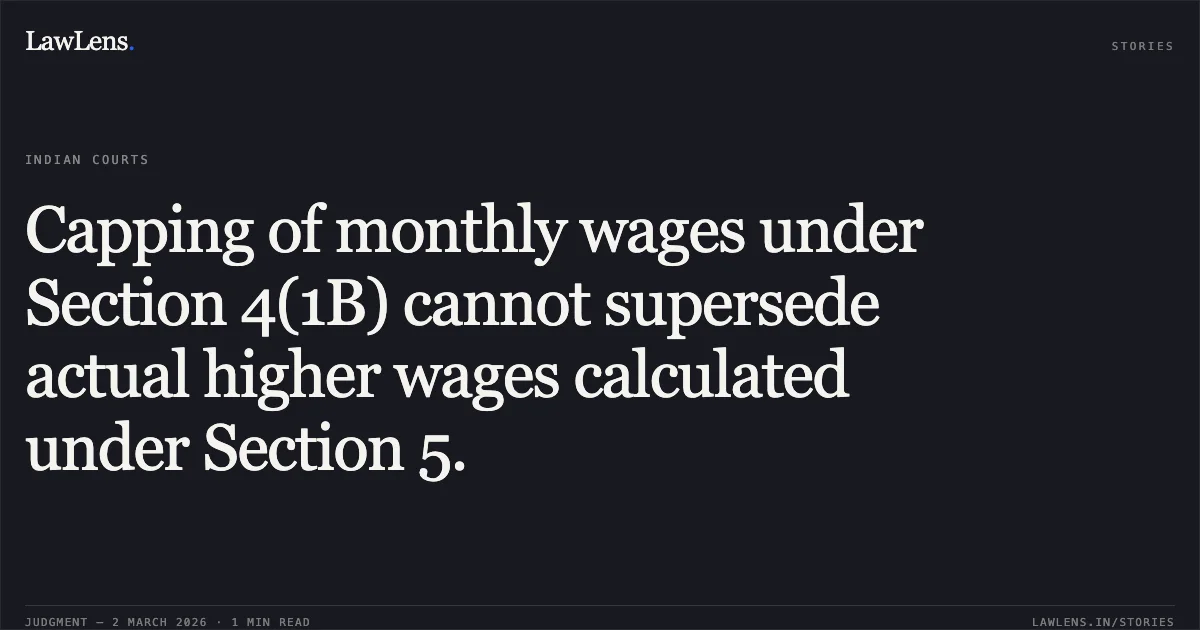
Source reference: p.2, Issue ii3. Whether the Government notification capping "monthly wages" under Section 4(1B) supersedes the calculation method prescribed in Section 5 of the Act.
Source reference: p.3, Issue iiiLaw Applied
The court applied Section 4(1)(a) and Section 5 of the Employees Compensation Act, 1923, which dictate that compensation for death equals 50% of the monthly wages multiplied by the age-related "relevant factor" found in Schedule IV.
Source reference: p.4-5It relied on the "multiplier method" established in Susamma Thomas and Lata Wadhwa for ensuring "just" compensation.
Source reference: p.7-8The doctrine of vicarious liability for state-committed torts and public law remedies under Article 226 was drawn from Chairman, Railway Board v. Chandrima Das and Vidyawati.
Source reference: p.8-10The court also invoked the principle of "Purposive Construction" and "Harmonious Construction" to ensure subordinate legislation (notifications) does not render statutory provisions (Section 5) otiose.
Source reference: p.17-19Reasoning
The Court found the Department's calculation of ₹10,16,700/- erroneous, as the deceased's actual salary was ₹39,900/-, which, when processed through the statutory formula (50% of wage × 135.56 factor), results in ₹27,04,422/-.
Source reference: p.5-7The Court reasoned that the Act is beneficial legislation; therefore, any interpretation must favor the workman.
Source reference: p.8It held the State vicariously liable because the death resulted from the failure of other employees to ensure a power shutdown, constituting a tortuous act.
Source reference: p.9-10Regarding the wage cap, the Court ruled that the ₹15,000/- notification under Section 4(1B) serves only as a minimum benchmark for social security; it cannot be used to suppress the actual "monthly wages" calculated under Section 5 if the actual wages are higher.
Source reference: p.24-25Finally, the Court determined that the lack of a pre-decisional hearing violated audi alteram partem, as the petitioner was denied the chance to present mitigating factors for damages.
Source reference: p.12-15Holding
The Court allowed the writ petition, holding that statutory compensation must be calculated based on actual wages under Section 5, and that notifications cannot override the statute.
It ordered the Commissioner to re-determine compensation (using the deceased's real salary) and consider additional "damages" for the tortuous negligence within four months.
Source reference: p.25-26The Court directed the respondents to pay 12% annual interest from the date of death on the enhanced amount and awarded a "conventional figure" of ₹1,00,000/- for the infringement of natural justice.
Source reference: p.25-26Acts & Sections Cited
2 provisions across 2 statutes referred to in this judgment. Each provision opens on LawLens.
Railways Act, 19891
General Clauses Act, 18971
Original Court PDF
Sarita Devi v. Union of India and 3 others Writ - C No. 44795 of 2025
Click to open original judgment
Original judgment, available to read, download and summarize on LawLens.in