Facts
The claimants—widow, three minor children and mother of deceased Sarabjit Singh—filed a claim petition under Section 166 of the Motor Vehicles Act, 1988, arising from the deceased’s death in a motor accident caused by the rash and negligent driving of Jeep No. WB-02-D-7468 by respondent No.1. The vehicle was owned by respondent No.2 and insured with respondent No.3.
Source reference: paras. 4–8The Motor Accident Claims Tribunal, Jalandhar, held that both the jeep driver and the deceased, who was riding a scooter with two pillion riders, were negligent. It assessed compensation at Rs.2,40,000/-, deducted 20% for contributory negligence, and awarded Rs.1,92,000/- with interest at 9% per annum.
Source reference: paras. 4–8The claimants appealed seeking enhancement, contending that the deceased’s income, future prospects, multiplier and conventional heads had been incorrectly assessed.
Source reference: paras. 1–3They also sought to produce an income-tax return showing annual income of Rs.55,000/-. The application for additional evidence under Order 41 Rule 27 CPC was dismissed because the return could not be verified in the absence of a PAN number and the claimants had not exercised due diligence before the Tribunal.
Source reference: paras. 1–3Issues
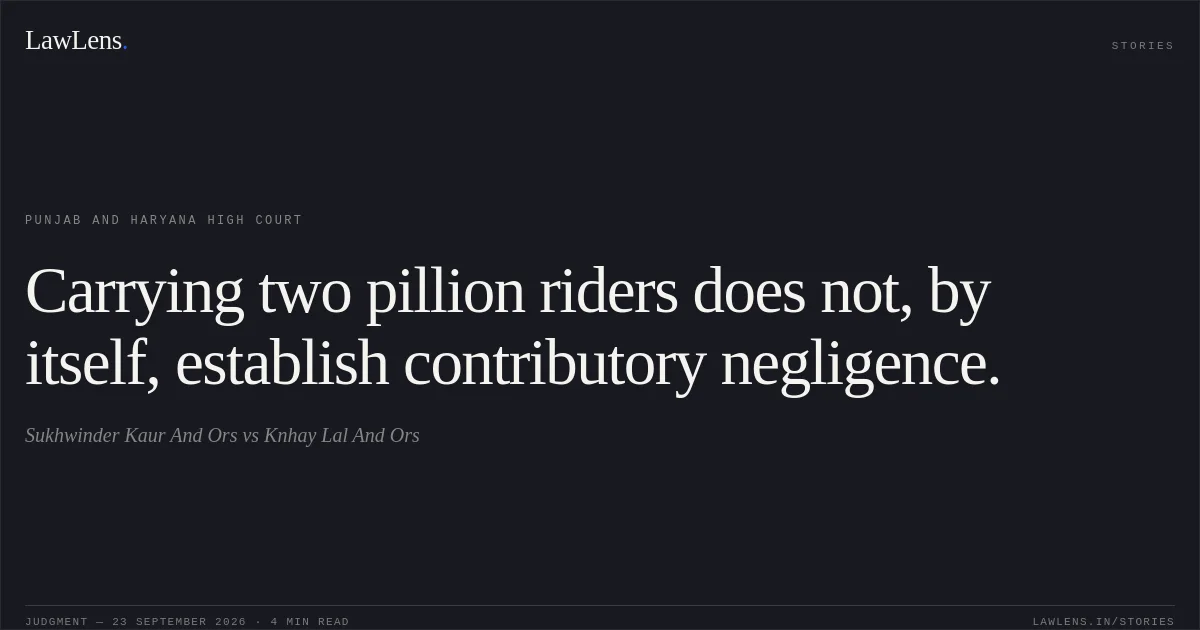
1. Whether the deceased’s carrying of two pillion riders on the scooter, by itself, established contributory negligence warranting deduction from the compensation?
Source reference: paras. 10–122. Whether the Tribunal had correctly assessed the deceased’s income at Rs.2,000/- per month, or whether his income required reassessment considering his occupation as a car mechanic?
Source reference: paras. 13–153. Whether the claimants were entitled to addition for future prospects, deduction based on the number of dependants, and application of multiplier 17?
Source reference: paras. 16–174. Whether compensation was payable under loss of consortium, loss of estate, funeral expenses, and parental or filial consortium?
Source reference: paras. 17–195. Whether the claimants were entitled to produce the income-tax return as additional evidence at the appellate stage?
Source reference: paras. 1–3Law Applied
The Court applied Section 166 of the Motor Vehicles Act, 1988, governing claims for compensation arising from motor accidents, and considered Section 128 concerning the number of persons permitted on a two-wheeler.
Source reference: no citationRelying on Devi Singh v. Vikram Singh , 2008 ACJ 393, and Krishan @ Chanda @ Chandi Ram v. Deepak , the Court held that carrying two pillion riders does not, ipso facto, establish contributory negligence unless it is proved that the overloading contributed to the accident.
Source reference: para. 12For assessment of compensation, the Court applied Sarla Verma v. Delhi Transport Corporation , 2009 (6) SCC 121, regarding deductions for personal expenses and the multiplier; National Insurance Co. Ltd. v. Pranay Sethi , (2017) 16 SCC 680, regarding future prospects and conventional heads; Magma General Insurance Co. Ltd. v. Nanu Ram , 2018 (4) RCR (Civil) 333, and United India Insurance Co. Ltd. v. Satinder Kaur , (2021) 11 SCC 780, regarding parental and filial consortium.
Source reference: paras. 13–18It also relied on Chandra alias Chander alias Chanda Ram v. Mukesh Kumar Yadav , (2022) 1 SCC 198, and Chameli Devi v. Jivrali Mian , 2019 (5) RCR (Civil) 884, for reasonable assessment of income where documentary proof is unavailable, and on Sadhana Tomar v. Ashok Kushwaha , 2025 LiveLaw (SC) 309, regarding dependency of a parent upon a deceased child.
Source reference: paras. 13–18The application for additional evidence was governed by Order 41 Rule 27 CPC, which requires a party to establish circumstances justifying production of evidence at the appellate stage.
Source reference: paras. 1–3Reasoning
The Court held that the Tribunal had inferred contributory negligence solely from the fact that three persons were travelling on the scooter, without evidence that the two pillion riders contributed to the accident.
Source reference: para. 12Applying Devi Singh and Krishan , it reversed the finding of contributory negligence and held respondent No.1 solely responsible for the accident.
Source reference: para. 12On income, the Court found that the deceased was a trained car mechanic running a repair workshop and therefore could not be treated as an unskilled labourer.
Source reference: paras. 14–15In the absence of reliable documentary proof, it reasonably assessed his income at Rs.4,000/- per month.
Source reference: paras. 14–15Since he was 30 years old, 40% was added for future prospects, resulting in a monthly income of Rs.5,600/-.
Source reference: para. 16As there were six dependants, one-fourth was deducted towards personal expenses. The resulting monthly dependency of Rs.4,200/- was annualised and multiplied by 17, producing a loss of dependency of Rs.8,56,800/-.
Source reference: para. 17The Court additionally awarded Rs.70,000/- to the widow under conventional heads and Rs.40,000/- each to the four children and the deceased’s father for parental and filial consortium.
Source reference: paras. 18–19The income-tax return was not admitted because it was unverifiable without a PAN number and the claimants had failed to show due diligence in not producing it before the Tribunal.
Source reference: para. 3Holding
The appeal was partly allowed with costs.
The Court set aside the finding of contributory negligence and held that the accident resulted from the rash and negligent driving of respondent No.1.
Source reference: para. 12Total compensation was enhanced from Rs.1,92,000/- to Rs.11,27,000/-, comprising Rs.8,56,800/- for loss of dependency and compensation under conventional and consortium heads.
Source reference: paras. 18–20The enhanced amount of Rs.9,35,000/-, together with interest at 9% per annum from 1 June 2000 until realization, was made payable by respondents No.1 to 3 jointly and severally.
Source reference: para. 20Rs.1,00,000/- each, with proportionate interest, was directed to be paid to claimants No.2 to 5 and proforma respondent No.4, with the balance payable to the widow.
Source reference: para. 20The application for additional evidence was dismissed, and the Insurance Company was directed to comply with the Supreme Court’s directions concerning electronic transmission and implementation of the judgment.
Source reference: paras. 1–3, 21–22Acts & Sections Cited
2 provisions across 1 statute referred to in this judgment. Each provision opens on LawLens.
Motor Vehicles Act, 19882
Original Court PDF
Sukhwinder Kaur And OrsvsKnhay Lal And Ors
Click to open original judgment
Original judgment, available to read, download and summarize on LawLens.in