Facts
An FIR (No. 96/2016) was registered involving several offenses including the Unlawful Activities (Prevention) Act (UAPA).
Source reference: p. 1-2The investigation identified two groups of accused: 11 living individuals against whom no UAPA offenses were established, and 4 deceased individuals against whom UAPA offenses (Sections 13, 20, 38) were found.
Source reference: p. 2The investigating agency filed separate charge sheets: one before the Principal Sessions Judge, Kulgam for the living accused, and another before the Special NIA Court for the deceased.
Source reference: p. 3The Special NIA Court recorded that proceedings against the 4 deceased stood abated.
Source reference: p. 2However, the Sessions Judge transferred the case of the 11 living accused to the Special NIA Court, arguing they must be tried together under Section 223 Cr.P.C.
Source reference: p. 3The Special NIA Court disagreed, citing Section 20 of the NIA Act to transfer the case back; following a jurisdictional "tossing" of the file, the Sessions Judge made this reference to the High Court.
Source reference: p. 4Issues
1. Whether a Special NIA Court retains jurisdiction to try a case when no scheduled offenses (UAPA) are established against the surviving accused.
Source reference: p. 5-62. Whether the Special Judge (Designated under NIA) has the statutory power to transfer a case to a regular criminal court when scheduled offenses are absent.
Source reference: p. 6Law Applied
The court primarily applied Section 20 of the National Investigation Agency (NIA) Act, 2008, which mandates that if a Special Court, after taking cognizance, opines that an offense is not triable by it, it shall transfer the case to a court having jurisdiction under the Code of Criminal Procedure.
Source reference: p. 6The court further considered Section 14 of the NIA Act, which grants the Special Court jurisdiction over non-scheduled offenses only if the accused is also charged with a scheduled offense in the same trial.
Source reference: p. 6The court also noted the principle of "transactional trial" under Section 223 of the Cr.P.C. but subordinated it to the jurisdictional mandates of the NIA Act.
Source reference: p. 3, 6-7Reasoning
The Court reasoned that while Section 14 of the NIA Act allows for the trial of connected offenses, this power is contingent upon the existence of a charge for a "scheduled offense".
Source reference: p. 6In this instance, since the only accused facing UAPA charges had died before the charge sheet was filed, the proceedings against them abated, leaving no surviving accused charged with a scheduled offense.
Source reference: p. 5Consequently, Section 14 could not be invoked to retain the case in the Special Court.
Source reference: p. 6The Court emphasized that Section 20 of the NIA Act provides a clear mechanism for transferring cases to regular courts when the Special Court finds the offenses are not triable by it.
Source reference: p. 6The High Court criticized the Sessions Judge for misappreciating the legal position, noting that the abatement of UAPA charges meant the inquiry was now limited to regular penal offenses, which fall under the jurisdiction of the Sessions Court.
Source reference: p. 7Holding
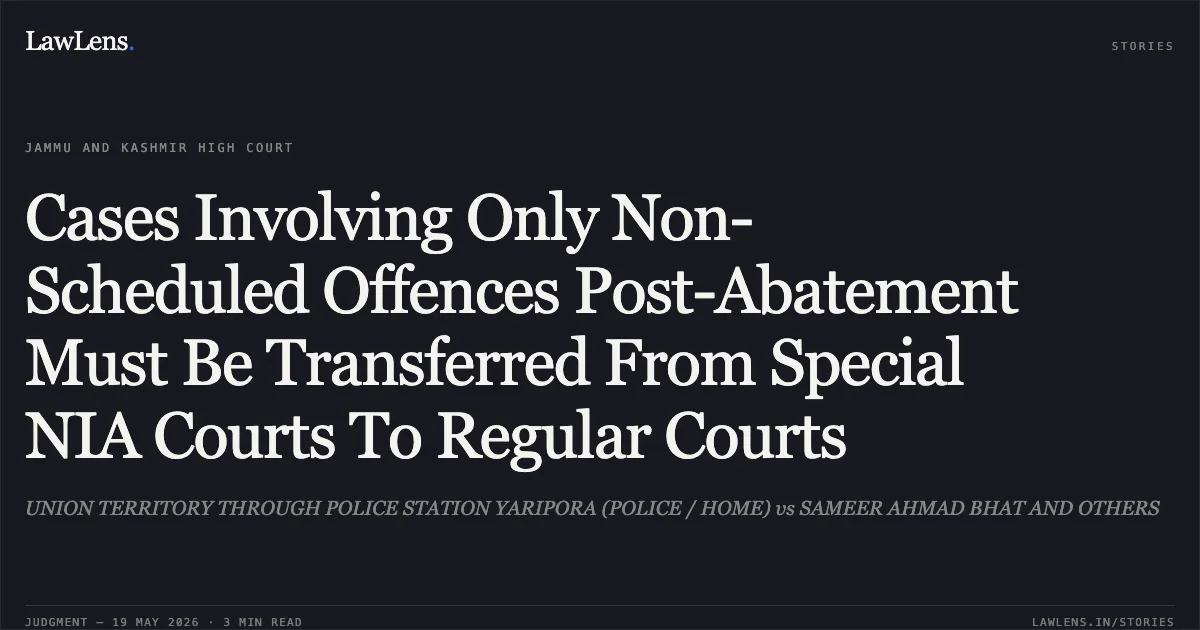
The Court answered the reference by holding that the Special NIA Court correctly exercised its power under Section 20 of the NIA Act to transfer the case back to the regular court.
The High Court held that as no UAPA offenses were established against the surviving accused, the Special Court lacked jurisdiction.
Source reference: p. 6The reference was returned with a direct order to the Principal Sessions Judge, Kulgam, to accept the transfer and proceed with the trial in accordance with the law.
Source reference: p. 7Acts & Sections Cited
9 provisions across 4 statutes referred to in this judgment. Each provision opens on LawLens.
Arms Act, 19592
Unlawful Activities (Prevention) Act, 19673
Code of Criminal Procedure, 19732
National Investigation Agency Act, 20082
Original Court PDF
UNION TERRITORY THROUGH POLICE STATION YARIPORA (POLICE / HOME)vsSAMEER AHMAD BHAT AND OTHERS
Click to open original judgment
Original judgment, available to read, download and summarize on LawLens.in