Facts
Respondent No. 2 alleged that the petitioners had attempted to dispossess her, disconnected her water supply, and later closed a pathway between their houses.
Source reference: p. 3–6A civil suit concerning the dispute was pending, and an interim status quo order had been made.
Source reference: p. 3–6She further alleged that the petitioners abused her by referring to her caste.
Source reference: p. 3–6Following investigation, police filed a charge sheet alleging offences under Sections 504 and 506 IPC and provisions of the SC/ST (Prevention of Atrocities) Act.
Source reference: p. 3–6The petitioners sought to quash the proceedings under Section 482 CrPC, contending that the allegations were omnibus, the alleged caste abuse was not said to have occurred within public view, and the criminal case arose from the civil dispute.
Source reference: p. 3–6The respondent No. 2 did not appear at the hearing.
Source reference: p. 5Issues
1. Whether the charge-sheet material disclosed the essential ingredients of offences under Sections 3(1)(r) and 3(1)(s) of the SC/ST Act, particularly the requirement that the alleged insult or caste-based abuse occur in a place within public view.
Source reference: p. 7–182. Whether the allegations disclosed the ingredients of offences under Sections 504 and 506 IPC, or whether continuation of the proceedings would amount to an abuse of process given the pending civil dispute and the nature of the allegations.
Source reference: p. 18–24Law Applied
Section 482 CrPC permits the High Court to quash proceedings where, even accepting the allegations at face value, the essential ingredients of an offence are absent or continuation of the proceedings would amount to an abuse of process.
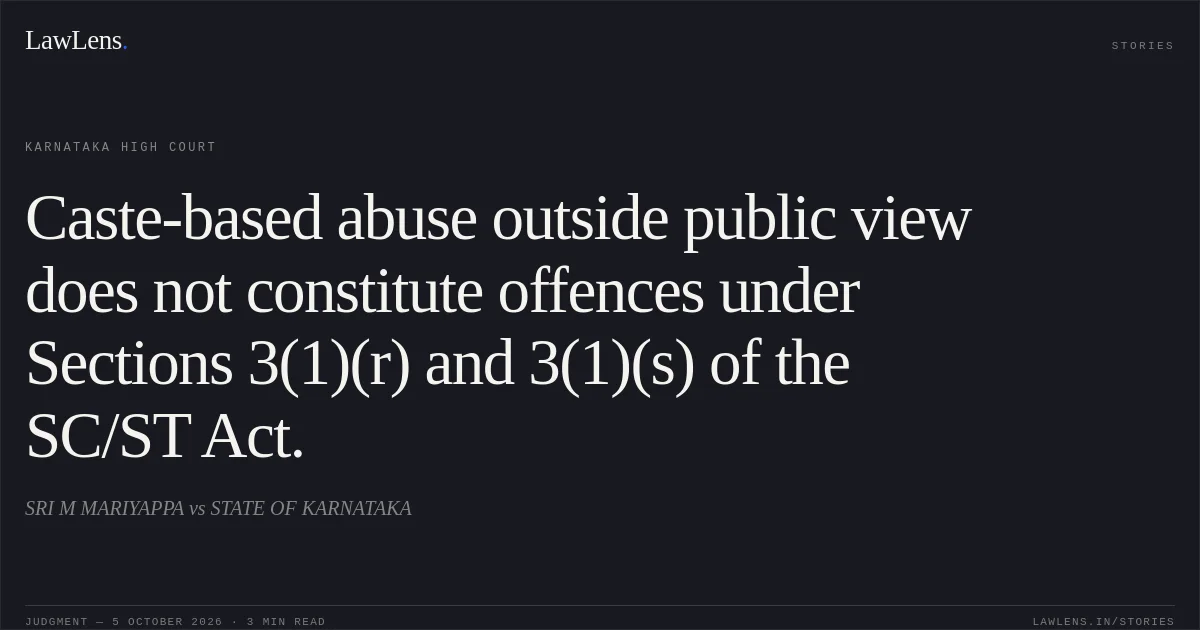
Source reference: p. 22–24Under Sections 3(1)(r) and 3(1)(s) of the SC/ST Act, intentional insult or intimidation with intent to humiliate, or caste-name abuse, must occur in a place “within public view”; a private place may qualify only if members of the public can witness or hear the conduct (Swaran Singh v. State, Hitesh Verma v. State of Uttarakhand, and Karuppudayar v. State).
Source reference: p. 9–13Section 504 IPC requires an intentional insult, accompanied by the intention or knowledge that it is likely to provoke a breach of the peace or another offence; mere abuse or rudeness is insufficient (Mohd. Wajid v. State of U.P. and B.V. Ram Kumar v. State of Telangana).
Source reference: p. 18–20In assessing a claim that proceedings are vexatious or retaliatory, the court may consider the surrounding circumstances and investigation materials, while avoiding a trial of the evidence (Mahmood Ali v. State of U.P.).
Source reference: p. 21–24Reasoning
The Court found that the complaint and charge-sheet materials did not identify a specific incident of caste abuse occurring in a place within public view.
Source reference: p. 7–18Even assuming the alleged caste abuse occurred, the necessary public-view ingredient was not established.
Source reference: p. 7–18The materials also contained only omnibus allegations that the petitioners closed the pathway, without facts showing the intentional insult and requisite likelihood of provocation required by Section 504 IPC; the Court additionally found no sufficient basis in the charge-sheet materials for the alleged IPC offences.
Source reference: p. 18–21Considering the pending civil suit and the surrounding circumstances, the Court concluded that the complaint sought to give a criminal character to the parties’ civil dispute and that continuing the prosecution would be an abuse of process.
Source reference: p. 20–24Holding
Even assuming the alleged caste abuse occurred, the necessary public-view ingredient was not established.
The Court concluded that the complaint sought to give a criminal character to the parties’ civil dispute and that continuing the prosecution would be an abuse of process.
Source reference: p. 20–24The Court allowed the petition and quashed the proceedings in Spl.C. No. 994/2023, arising from Crime No. 49/2022, against the petitioners for the offences specified in the order.
Source reference: p. 25Acts & Sections Cited
6 provisions across 3 statutes referred to in this judgment. Each provision opens on LawLens.
Code of Criminal Procedure, 19731
Indian Penal Code, 18604
Scheduled Castes and the Scheduled Tribes (Prevention of Atrocities) Act, 19891
Original Court PDF
SRI M MARIYAPPAvsSTATE OF KARNATAKA
Click to open original judgment
Original judgment, available to read, download and summarize on LawLens.in