Facts
The land was recorded in the petitioner’s name in an ROR published on 17 December 1987.
Source reference: pp. 2–5The petitioner’s brother, opposite party No. 5, claimed to have purchased the land in 1984 and challenged the mutation order in Mutation Appeal No. 23 of 2016, alleging that the petitioner had obtained the mutation using a purported consent letter. The Sub-Collector condoned the delay and set aside the mutation order; the Board of Revenue dismissed the petitioner’s revision. The petitioner challenged both orders, contending that the delay had been condoned without notice and that fraud had not been established
Source reference: pp. 2–5Issues
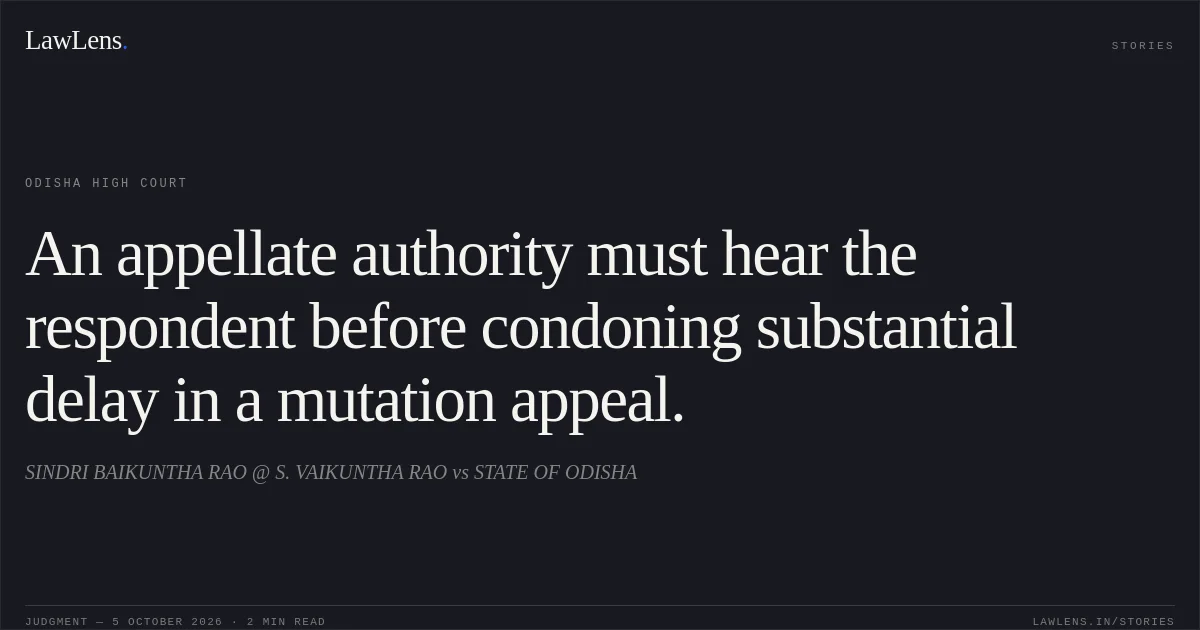
Whether the appellate authority could condone the substantial delay in filing the mutation appeal without giving the petitioner an opportunity to be heard.
Source reference: pp. 5–6, 9Whether the revisional authority properly exercised its jurisdiction in accepting an allegation of fraud without a reasoned finding that fraud had been pleaded and proved.
Source reference: pp. 6–8, 11Law Applied
Section 32 of the Orissa Survey and Settlement Act empowers the Board of Revenue to call for and revise proceedings where a subordinate officer has exercised or failed to exercise jurisdiction, or has contravened an express provision of law resulting in a serious miscarriage of justice; the Board must hear the parties if they attend.
Source reference: p. 7The principles of natural justice require an affected party to be given an opportunity of hearing. Fraud must be specifically pleaded and proved and cannot be presumed from an allegation alone.
Source reference: p. 8The revisional authority referred to S.P. Chengalvaraya Naidu v. Jagannath, (1994) 1 SCC 1, concerning substantial justice and technicalities, but the High Court found that reliance on an unproved allegation of fraud did not justify the authority’s decision.
Source reference: pp. 6–7Reasoning
The appellate authority condoned a delay of about 30 years without issuing notice to the petitioner and gave no reasons for doing so, despite the need to assess whether the delay had been adequately explained.
Source reference: p. 6The revisional authority did not address that procedural defect; instead, it accepted the allegation of fraud as established, although the appellate order had not made a finding of fraud and the allegation had not been proved.
Source reference: pp. 6–8These errors amounted to a failure to properly examine the subordinate authority’s exercise of jurisdiction under Section 32 and resulted in a violation of natural justice.
Source reference: pp. 7–8Holding
The High Court allowed the writ petition and set aside both the appellate and revisional orders.
It remitted the matter to the appellate authority to decide the question of limitation first, after hearing both parties and issuing a reasoned order. The parties were directed to appear before that authority on 12 October 2026.
Source reference: p. 8Acts & Sections Cited
2 provisions across 2 statutes referred to in this judgment. Linked provisions open on LawLens.
Orissa Land Reforms Act, 19601
Orissa Survey and Settlement Act, 19581
Original Court PDF
SINDRI BAIKUNTHA RAO @ S. VAIKUNTHA RAOvsSTATE OF ODISHA
Click to open original judgment
Original judgment, available to read, download and summarize on LawLens.in