Facts
The complainant alleged that on 4 December 2015, while returning home on a motorcycle with his mother, the applicants stopped him near a dargah, abused him by reference to his caste, assaulted him, and threatened him.
Source reference: paras. 2–5An FIR was registered under Sections 143, 323, 504 and 506(2) of the IPC and Section 3(1)(x) of the SC/ST (Prevention of Atrocities) Act, 1989.
Source reference: paras. 2–5The applicants sought quashing under Section 482 CrPC.
Source reference: paras. 2–5At the hearing, they did not press their challenge to the IPC offences; the application proceeded only in relation to the Atrocities Act offence.
Source reference: paras. 2–5The complainant, though served, did not appear.
Source reference: para. 1Issues
Whether the FIR and investigation papers disclosed the essential ingredients of an offence under Section 3(1)(x) of the Atrocities Act, particularly that the alleged insult or intimidation occurred “within public view”.
Source reference: paras. 7.1, 8Whether the Atrocities Act allegation should be quashed under Section 482 CrPC, while leaving the IPC proceedings unaffected.
Source reference: paras. 7.1, 8.4–9Law Applied
Section 3(1)(x) of the Atrocities Act, as applicable to the case, criminalised intentional insult or intimidation of a member of a Scheduled Caste or Scheduled Tribe, with intent to humiliate, in a place within public view.
Source reference: para. 8Under Section 482 CrPC, the High Court may quash proceedings where, even accepting the allegations and supporting material at face value, the essential ingredients of an offence are not made out; the illustrative categories in State of Haryana v. Bhajan Lal, AIR 1992 SC 604, include cases where the allegations or uncontroverted material disclose no offence.
Source reference: paras. 7, 7.1The Court also relied on Gorige Pentaiah v. State of A.P., (2008) 12 SCC 531, concerning the need to plead the basic ingredients of Section 3(1)(x), and Hutu Ansari @ Futu Ansar v. State of Jharkhand, 2025 (0) AIJEL-SC 75033, in relation to the public-view requirement.
Source reference: paras. 8.1–8.3Reasoning
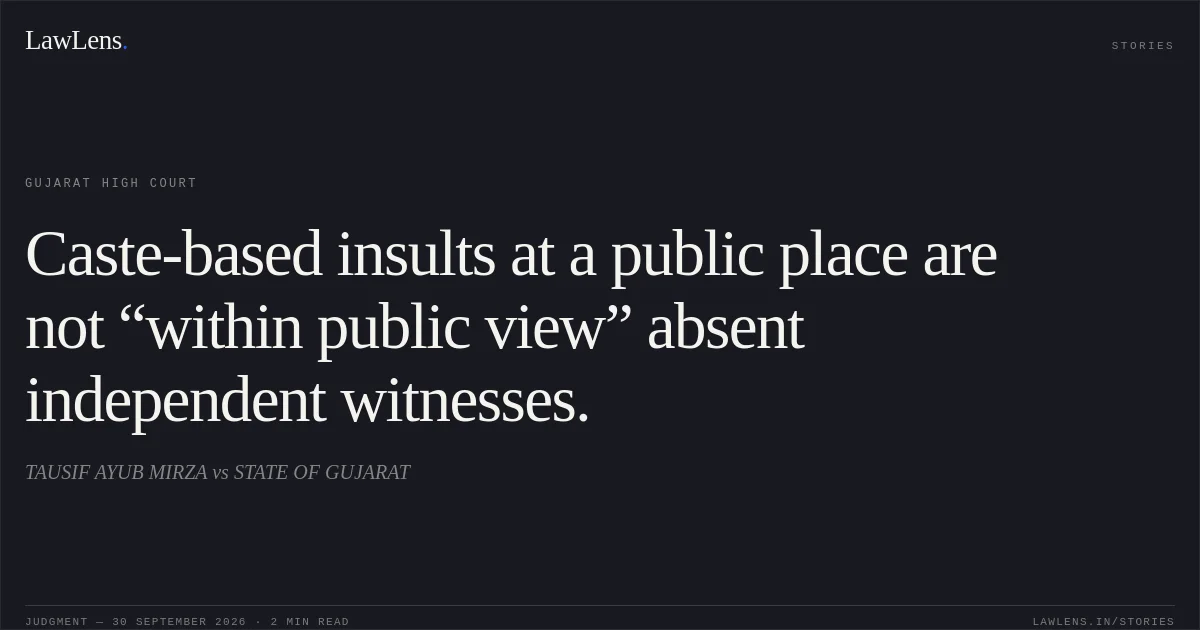
Although the alleged incident occurred near a dargah—a public place—the Court distinguished a public place from a place within public view.
Source reference: para. 8It found that neither the FIR nor the investigation papers showed that any independent member of the public witnessed the alleged caste-related utterances, and concluded that the public-view ingredient was therefore not established.
Source reference: para. 8The Court also noted that the complaint did not state that the applicants were not members of a Scheduled Caste or Scheduled Tribe, or that they acted with the requisite intent to humiliate the complainant.
Source reference: para. 8.2.1On that basis, it held that the Atrocities Act allegation fell within the categories identified in Bhajan Lal for quashing.
Source reference: para. 8.4Holding
The application was allowed in part.
The FIR and consequential proceedings were quashed only insofar as they related to the offence under Section 3(1)(x) of the Atrocities Act.
Source reference: paras. 9–9.1The IPC proceedings were not quashed and were to continue without being influenced by the Court’s observations on the Atrocities Act offence.
Source reference: paras. 9–9.1Acts & Sections Cited
8 provisions across 3 statutes referred to in this judgment. Each provision opens on LawLens.
Code of Criminal Procedure, 19733
Indian Penal Code, 18604
Scheduled Castes and the Scheduled Tribes (Prevention of Atrocities) Act, 19891
Original Court PDF
TAUSIF AYUB MIRZAvsSTATE OF GUJARAT
Click to open original judgment
Original judgment, available to read, download and summarize on LawLens.in