Facts
The complainant alleged that she lent the accused ₹3,90,000 and received a cheque for that amount, which was dishonoured for insufficient funds.
Source reference: para. 2, 6–8The cheque stated “Rupees Three Lakh Ninety only” in words but ₹3,90,000 in figures.
Source reference: para. 2, 6–8The complainant’s statutory notice demanded ₹3,90,000.
Source reference: para. 2, 6–8The Trial Court convicted the accused under Section 138 of the Negotiable Instruments Act, 1881 (NI Act), but the Appellate Court set aside the conviction, holding that the notice demanded an amount different from the cheque amount.
Source reference: para. 2, 6–8The complainant sought leave to appeal against that decision.
Source reference: para. 2, 6–8Issues
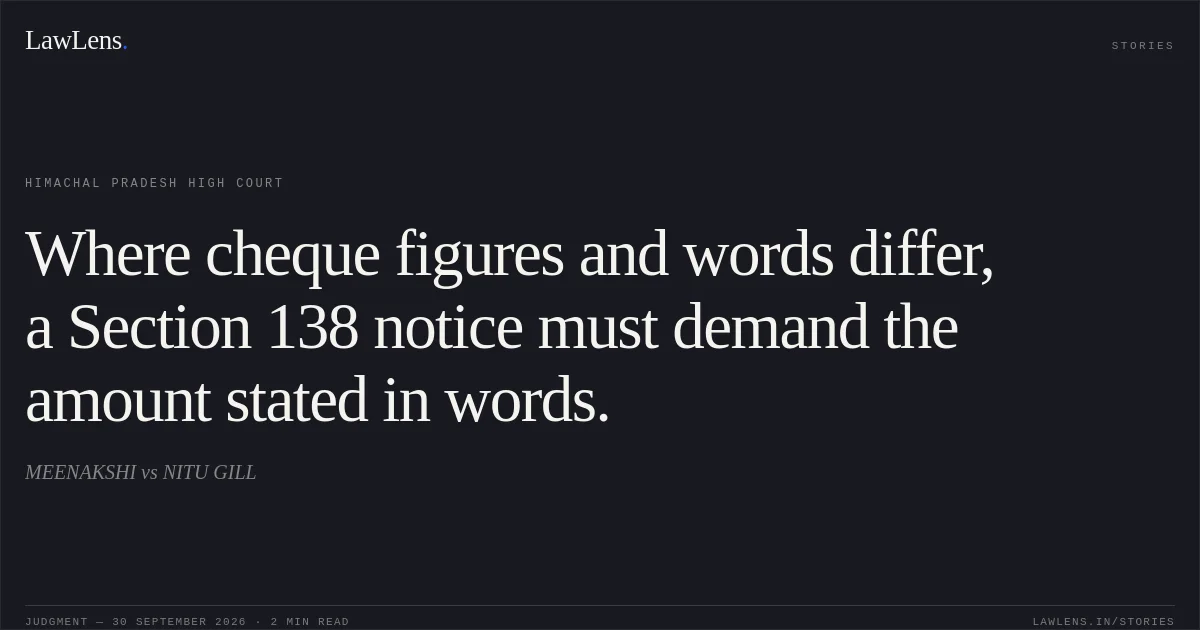
Whether, under Section 18 of the NI Act, the amount stated in words governed where the cheque’s written amount differed from its amount in figures.
Source reference: para. 7, 11Whether the statutory notice was invalid because it demanded ₹3,90,000, rather than the amount stated in words on the cheque.
Source reference: para. 12–14Whether the complainant had made out a case for leave to appeal against the Appellate Court’s decision.
Source reference: para. 17–19Law Applied
Section 18 of the NI Act provides that where the amount payable on a negotiable instrument is stated differently in words and figures, the amount stated in words governs.
Source reference: para. 11Under Section 138 and its proviso, the demand notice must seek payment of the cheque amount.
Source reference: para. 13In *Suman Sethi v. Ajay K. Churiwal*, (2000) 2 SCC 380, the Supreme Court held that a notice must demand the “said amount”—that is, the cheque amount—and that failure to make that demand renders the notice legally deficient.
Source reference: para. 13The Court did not accept the contrary approach in *Nitesh Yadav v. State*, 2025 DHC 1580, or *Shyam Sunder Soni v. State of Rajasthan*, 2022 Cri LJ 1769.
Source reference: para. 15–16Reasoning
Applying Section 18, the Court treated “Rupees Three Lakh Ninety only” as the cheque amount, namely ₹3,00,090, and not ₹3,90,000.
Source reference: para. 11Because the notice demanded ₹3,90,000, it did not demand the amount legally payable under the cheque.
Source reference: para. 12–14Applying *Suman Sethi*, the Court held that the discrepancy made the notice invalid and therefore supported the Appellate Court’s decision.
Source reference: para. 12–14It declined to follow the cited contrary decisions, reasoning that the statutory rule required the notice to demand the amount stated in words.
Source reference: para. 15–16Holding
The High Court held that the notice was invalid because it demanded an amount different from the cheque amount as determined under Section 18 of the NI Act.
It found no basis to grant leave to appeal, dismissed the leave application, and consequently disposed of the appeal.
Source reference: para. 17–20Acts & Sections Cited
3 provisions across 2 statutes referred to in this judgment. Each provision opens on LawLens.
Negotiable Instruments Act, 18812
Code of Criminal Procedure, 19731
Original Court PDF
MEENAKSHIvsNITU GILL
Click to open original judgment
Original judgment, available to read, download and summarize on LawLens.in