Facts
The petitioners held management positions (Director, CEO, etc.) at Trans World Radio India, while the respondents were employed as safai karamcharis.
Source reference: p. 1-2Following disciplinary proceedings and the dismissal of Respondent No. 2 for misconduct, the respondents filed a complaint on 29.02.2008 under Section 200 Cr.P.C.
Source reference: p. 2They alleged that between June 2007 and January 2008, the petitioners used caste-based slurs such as ‘Bhan’ and ‘Cham’ and pressured them to convert to Christianity.
Source reference: p. 2, 12-13A police enquiry report dated 27.05.2008 found these allegations unsubstantiated, noting that earlier complaints to the police focused on religious conversion rather than caste remarks.
Source reference: p. 2-3Despite this, the Additional Sessions Judge, via an order dated 22.03.2012, directed the framing of charges under Section 3(1)(x) of the SC/ST Act, holding that the "public view" requirement was a matter of evidence for trial.
Source reference: p. 3, 6The petitioners moved the High Court under Section 482 Cr.P.C. to quash this order.
Source reference: p. 1Issues
1. Whether the essential ingredients of Section 3(1)(x) of the SC/ST Act, specifically the requirement of the act occurring "within public view," were prima facie disclosed in the complaint.
Source reference: p. 11, para 282. Whether the Trial Court erred in framing charges when the alleged incidents occurred inside private offices without the presence of independent public members.
Source reference: p. 14, 18-19Law Applied
The Court applied Section 3(1)(x) (pre-2015 amendment) of the Scheduled Castes and Scheduled Tribes (Prevention of Atrocities) Act, 1989, which requires that an intentional insult to a member of the SC/ST community must occur in "any place within public view".
Source reference: p. 13-14It relied on the Supreme Court’s interpretation in Swaran Singh v. State, which distinguished between a "public place" and a "place within public view," clarifying that even a private place (like a lawn or office) can be within public view if independent members of the public can see or hear the act.
Source reference: p. 15-16The Court further applied the precedents of Hitesh Verma v. State of Uttarakhand and Ramesh Chandra Vaishya v. State of U.P., which established that acts occurring within the four walls of a building without the presence of independent witnesses do not satisfy the "public view" requirement.
Source reference: p. 14, 16-17Reasoning
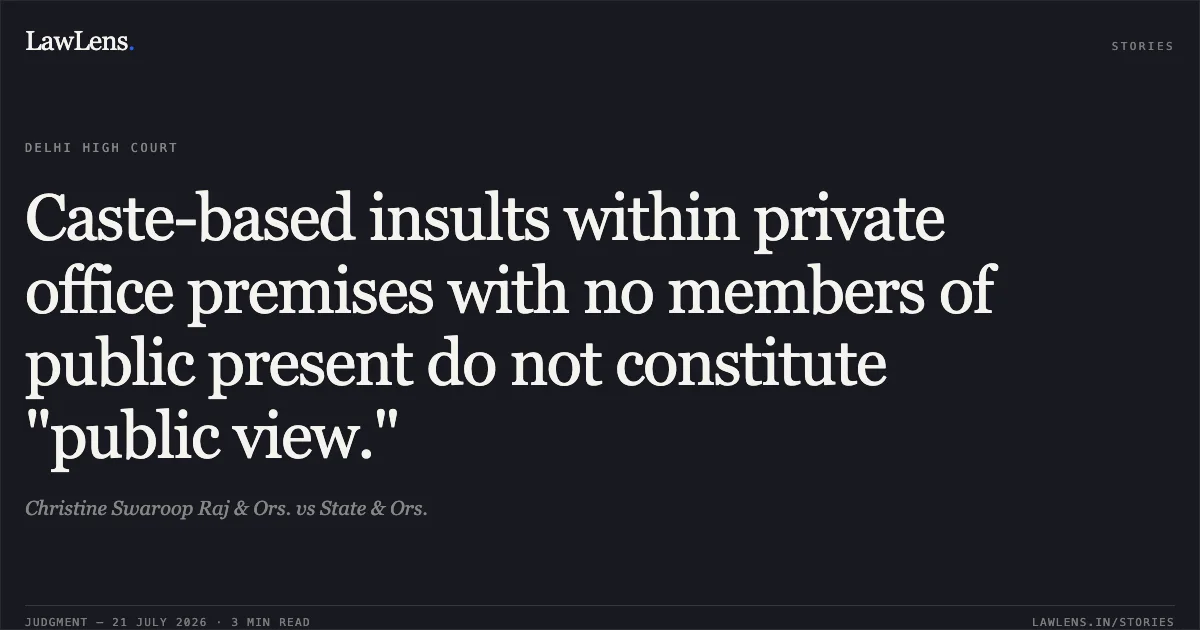
The Court analyzed the complaint dated 29.02.2008 and observed that all alleged caste-based slurs occurred inside the private offices of the petitioners.
Source reference: p. 12, 18The Court noted that the statutory ingredient "within public view" is mandatory and cannot be dispensed with.
Source reference: p. 14Applying the Hitesh Verma doctrine, the Court found that since the complaint lacked any averment regarding the presence of independent members of the public or strangers during the alleged incidents, the "public view" criterion was not met.
Source reference: p. 18, para 36The Court rejected the Trial Court's approach of leaving this to trial, stating that while a "mini-trial" is prohibited at the stage of framing charges, the Court must still ensure that the foundational legal ingredients of the offence are present in the record.
Source reference: p. 18, para 37-38The Court concluded that even if the allegations were taken at face value, the legal threshold for an offence under Section 3(1)(x) was absent because the insults were private communications within an office setting.
Source reference: p. 19Holding
The Court held that the essential ingredient of the offence being committed "within public view" was not prima facie disclosed.
The High Court allowed the petition and set aside the impugned order dated 22.03.2012 to the extent that it directed the framing of charges under Section 3(1)(x) of the SC/ST Act; the matter was remanded to the Trial Court to consider afresh whether charges should be framed under relevant sections of the Indian Penal Code, 1860, based on the same facts.
Source reference: p. 19, para 40, 41Acts & Sections Cited
14 provisions across 3 statutes referred to in this judgment. Each provision opens on LawLens.
Code of Criminal Procedure, 19736
Scheduled Castes and the Scheduled Tribes (Prevention of Atrocities) Act, 19891
Indian Penal Code, 18607
Original Court PDF
Christine Swaroop Raj & Ors.vsState & Ors.
Click to open original judgment
Original judgment, available to read, download and summarize on LawLens.in


