Facts
The appellants challenged their conviction for offenses under Sections 323 and 504 of the IPC and Sections 3(v) and 3(x) of the SC/ST (POA) Act.
Source reference: p. 2The complainant (P.W.3), a member of the Scheduled Caste community, alleged that the appellants encroached on his government-settled land, demolished boundary ridges, used caste-based slurs in a filthy manner, and physically assaulted him.
Source reference: p. 2The incident purportedly occurred on June 28, 2009.
Source reference: p. 2Initially three appellants were involved, but the case against Md. Kyam abated following his death.
Source reference: p. 1The trial court convicted the remaining two appellants on February 21, 2019.
Source reference: p. 1Issues
1. Whether the prosecution proved the essential ingredients of Section 3(v) and 3(x) of the SC/ST (POA) Act, specifically regarding public view and dispossession.
Source reference: p. 5, 62. Whether the uncorroborated testimony of the complainant (P.W.3) was sufficient to sustain a conviction in light of an admitted land dispute.
Source reference: p. 5, 63. Whether the caste identity of the victim was legally established beyond his oral statement.
Source reference: p. 5, 6Law Applied
Scheduled Castes and the Scheduled Tribes (Prevention of Atrocities) Act, 1989, specifically Section 3(1)(v) (wrongful dispossession/interference with land) and Section 3(1)(x) (intentional insult or intimidation in any place within public view).
Source reference: p. 2Sections 323 and 504 of the Indian Penal Code regarding voluntarily causing hurt and intentional insult to provoke breach of peace.
Source reference: p. 2Principles of criminal jurisprudence requiring proof of caste status and independent corroboration in the presence of an underlying civil/land dispute.
Source reference: p. 6Reasoning
The court noted that the Investigating Officer (P.W.5) admitted the existence of a land dispute and a lack of independent witnesses.
Source reference: p. 4, 5While the complainant (P.W.3) alleged abuse and assault, the court observed that he was the sole eyewitness and his testimony lacked corroboration.
Source reference: p. 5P.W.1 and P.W.2 were deemed hearsay and interested witnesses (brothers of the complainant).
Source reference: p. 5Regarding the SC/ST Act charges, the court found Section 3(v) inapplicable as there was no evidence of dispossession, merely a boundary dispute between neighboring landholders.
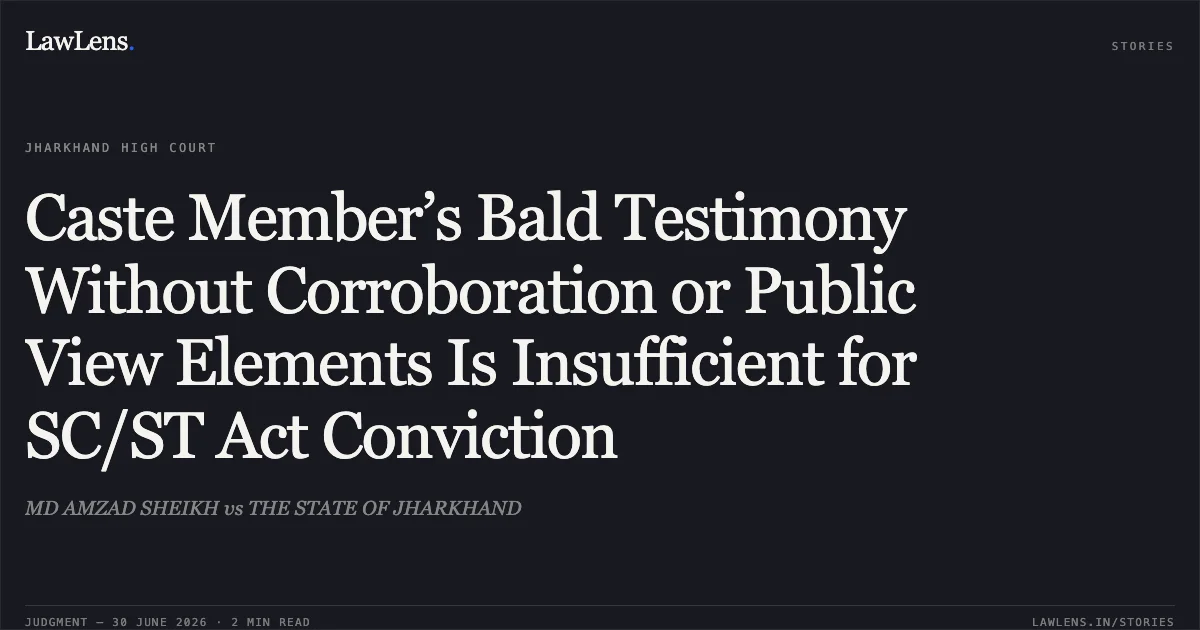
Source reference: p. 6There was no documentary evidence to prove the victim’s caste status other than a bald oral statement, which the court found contrary to law.
Source reference: p. 5-6The court held that since the incident did not occur within "public view" and was essentially civil in nature, the criminal convictions could not stand.
Source reference: p. 5, 6Holding
The High Court held that the materials on record were insufficient for conviction as the ingredients of the SC/ST Act were missing and the oral testimonies were untrustworthy.
The High Court allowed the appeal and set aside the judgment of conviction and order of sentence dated 21.02.2019; the appellants were discharged from the liability of their bail bonds.
Source reference: p. 6, 7Acts & Sections Cited
6 provisions across 3 statutes referred to in this judgment. Each provision opens on LawLens.
Indian Penal Code, 18603
Scheduled Castes and the Scheduled Tribes (Prevention of Atrocities) Act, 19891
Code of Criminal Procedure, 19732
Original Court PDF
MD AMZAD SHEIKHvsTHE STATE OF JHARKHAND
Click to open original judgment
Original judgment, available to read, download and summarize on LawLens.in