Facts
The applicant was engaged as a casual labourer by the respondents in 1997
Source reference: p. 3From January 1, 2006, the applicant’s services were shifted under private service providers (contractors) for housekeeping work
Source reference: p. 4, para 3.1The applicant approached the Tribunal in OA 137/2020 seeking temporary status and regularization based on the Madras High Court judgment in the Rita Mary case (W.P. No. 16733/2009).
Source reference: p. 4, para 3.2-3.3Following a direction from the Tribunal to consider his representation, the respondents issued an impugned speaking order on September 17, 2020, rejecting the claim on the grounds that he was engaged after the 1993 Scheme was issued and was currently a contract employee
Source reference: p. 4, para 3.2-3.3The applicant challenged this rejection in the present OA.
Source reference: no citationIssues
1. Whether the applicant is entitled to the benefit of "Temporary Status" and regularization under the Casual Labourers (Grant of Temporary Status and Regularisation) Scheme, 1993
Source reference: p. 4, para 3.22. Whether the applicant is covered by the Part-Time Casual Labourers Regularisation Scheme CBIC 2020 formulated pursuant to the Rita Mary case
Source reference: p. 5, para 3.3; p. 8, para 9Law Applied
The court applied the Casual Labourers (Grant of Temporary Status and Regularisation) Scheme of Government of India, 1993, which was a one-time measure for labourers in service as of September 10, 1993
Source reference: p. 4, para 3.2It relied on the Part-Time Casual Labourers Regularisation Scheme CBIC 2020, which is a specific, non-precedential scheme applicable only to parties involved in the Rita Mary batch of litigation
Source reference: p. 5, para 3.3; p. 7, para 8the court applied the landmark principle from State of Karnataka v. Umadevi, which prohibits "backdoor entries" into public employment and mandates that regularization cannot occur in the absence of sanctioned posts or contrary to recruitment rules
Source reference: p. 5, para 3.3; p. 9, para 12Reasoning
The Tribunal found that the applicant failed to meet the eligibility criteria for the 1993 Scheme because his engagement commenced in 1997, whereas the scheme was a one-time measure for those employed in 1993
Source reference: p. 4, para 3.2Regarding the Rita Mary case, the Tribunal noted that the resulting 2020 Scheme was a judgment in personam, restricted exclusively to the 23 petitioners/respondents named in those specific Writ Petitions; since the applicant was not a party to those proceedings, he could not claim parity
Source reference: p. 5, para 3.3; p. 8, para 11Crucially, the Tribunal observed that since 2006, the applicant had been working under a private contractor, thereby severing the master-servant relationship with the Department; he was thus no longer a "casual labourer" of the respondents
Source reference: p. 4, para 3.1; p. 8, para 10Following the Sekar Vs. UoI precedent (OA 1150/2023), the Tribunal reasoned that any direction for regularization would violate the constitutional mandate for transparent public recruitment
Source reference: p. 9, para 12Holding
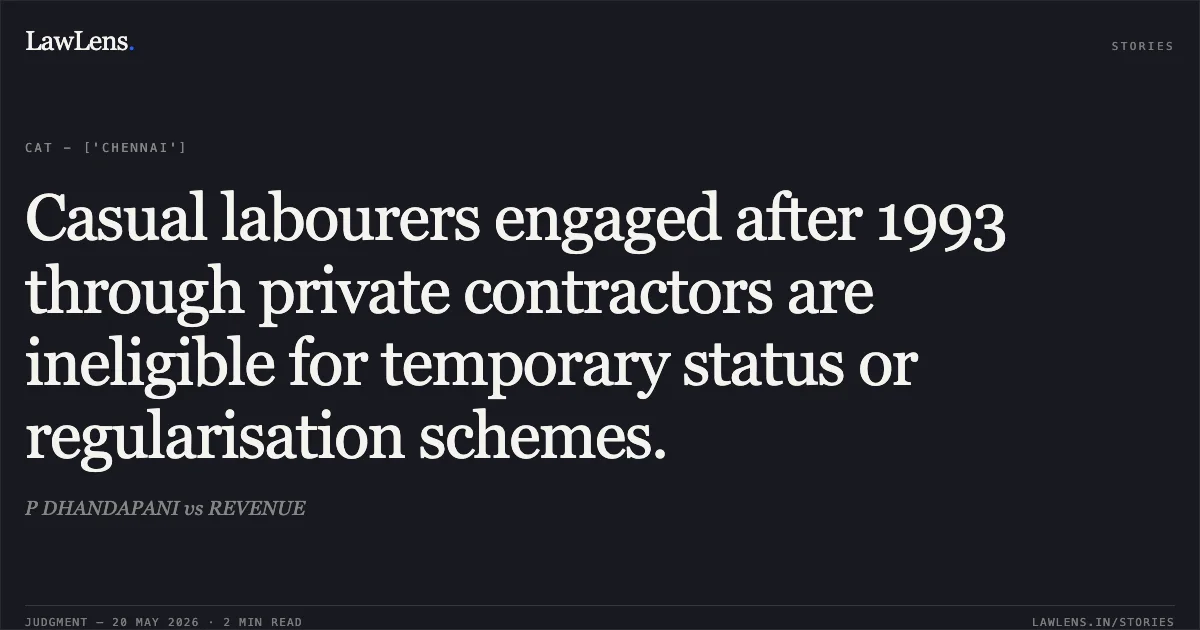
The Tribunal held that the applicant had no vested right to regularization and was not covered by the 1993 or 2020 Schemes
The OA was dismissed as being devoid of merits. No order as to costs was made
Source reference: p. 9, para 13; p. 9, para 7; p. 9Acts & Sections Cited
1 provisions across 1 statute referred to in this judgment. Linked provisions open on LawLens.
Constitution of India1
Original Court PDF
P DHANDAPANIvsREVENUE
Click to open original judgment
Original judgment, available to read, download and summarize on LawLens.in


