Facts
The applicant, a former Safaiwala, filed OA No. 213/2014 challenging the non-review of her suspension. On 03.11.2023, the Tribunal quashed the suspension and directed the respondents to treat the period from 28.12.2013 to 22.01.2016 as duty with full pay and allowances within three months
Source reference: para 1.1Despite the order being communicated on 11.01.2024, the respondents failed to comply or appeal the decision
Source reference: para 1.2Consequently, the applicant filed a Contempt Petition (CP) on 11.08.2025 with a four-month delay, filing the present Miscellaneous Application (MA) for condonation of that delay
Source reference: para 4The respondents objected, arguing the Tribunal lacks the power to condone delay beyond the one-year limitation prescribed under Section 20 of the Contempt of Courts Act, 1971
Source reference: para 1.4Issues
1. Whether the Tribunal has the power to condone delay in filing a Contempt Petition under the Administrative Tribunals Act, 1985
Source reference: para 22. Whether the applicant demonstrated "sufficient cause" for the four-month delay in filing the present contempt proceedings
Source reference: para 4Law Applied
The Tribunal applied Rule 22 of the Central Administrative Tribunal (Contempt of Courts) Rules, 1992, which mandates that for matters not specifically provided for in the Contempt Rules, the procedure prescribed in the Administrative Tribunals Act (ATA), 1985, applies mutatis mutandis
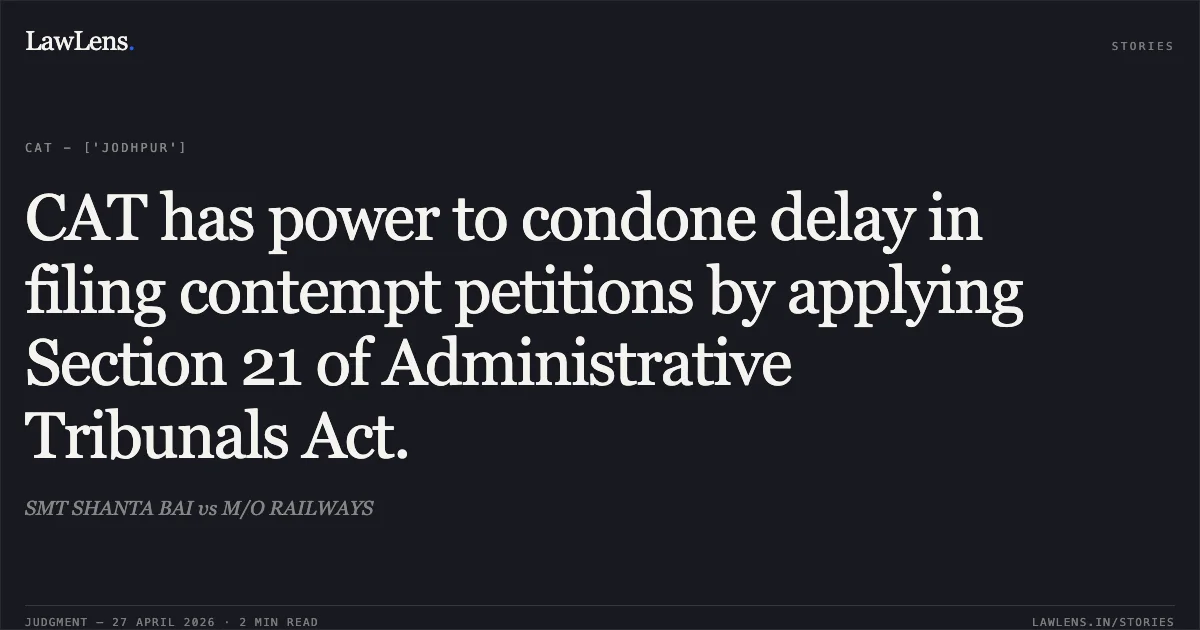
Source reference: para 2It specifically relied on Section 21 of the ATA, 1985, which governs limitation and specifically sub-section (3) which empowers the Tribunal to admit applications after the limitation period if "sufficient cause" is shown
Source reference: para 2Regarding substantive contempt law, it considered Section 20 of the Contempt of Courts Act, 1971, alongside the precedents of Pallav Sheth v. Custodian and Maheshwar Peri v. High Court of Judicature at Allahabad
Source reference: para 1.4, 2Reasoning
The Tribunal rejected the respondents' technical objection that the one-year limit under Section 20 of the Contempt of Courts Act is absolute and bars the Tribunal's jurisdiction to condone delay. The Bench reasoned that because the CAT (Contempt of Courts) Rules do not explicitly address limitation procedures, the enabling provisions of Section 21 of the ATA, 1985, must apply mutatis mutandis
Source reference: para 2The court noted that Section 21(3) provides an express statutory power to condone delay upon satisfaction of sufficient cause, thereby distinguishing it from the limitations cited in the respondents' precedents
Source reference: para 2Applying this to the facts, the Tribunal observed that the applicant had been diligently pursuing her case and that the respondents had neither complied with nor challenged the original order of 03.11.2023
Source reference: para 3The court held that a government organization cannot be permitted to ignore a judicial verdict without valid reason, and found the four-month delay to be reasonably explained
Source reference: para 4Holding
The Tribunal allowed the Miscellaneous Application, condoning the four-month delay in filing the Contempt Petition
It held that the Tribunal possesses the power to condone delay in contempt matters under Section 21(3) of the ATA, 1985
Source reference: para 2The respondents were granted a final three months to comply with the original order dated 03.11.2023, with a warning that failure to do so would result in proceedings against erring officers under the 1992 Rules. The Contempt Petition was listed for 25.05.2026
Source reference: para 5, 6Acts & Sections Cited
4 provisions across 2 statutes referred to in this judgment. Each provision opens on LawLens.
Administrative Tribunals Act, 19852
Contempt of Courts Act, 19712
Original Court PDF
SMT SHANTA BAIvsM/O RAILWAYS
Click to open original judgment
Original judgment, available to read, download and summarize on LawLens.in