01Facts
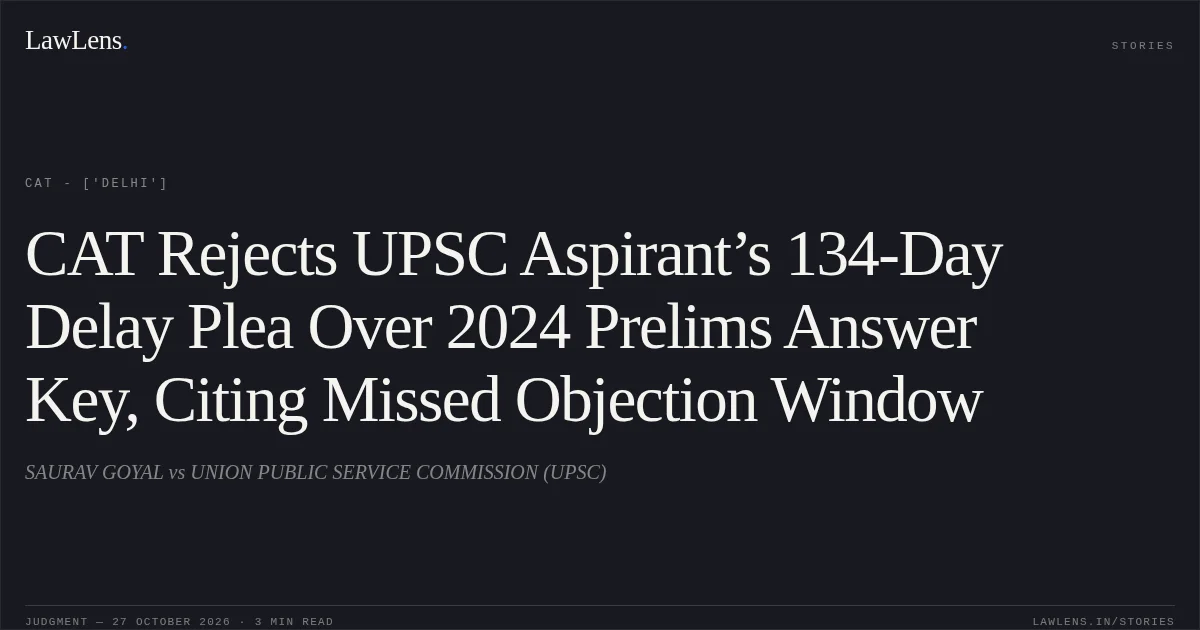
The applicant sought condonation of a 134-day delay in filing an Original Application challenging the UPSC’s final answer to Question 15, Set C, in General Studies Paper I of the Civil Services (Preliminary) Examination, 2024.
pp. 2–5The UPSC had keyed option (c), “Both 1 and 2”; the applicant, who had selected option (b), “2 only”, contended that Article 112(1) of the Constitution identifies the President as the authority who causes the Annual Financial Statement to be laid before Parliament, while Article 113(3) supports statement 2.
pp. 2–5He claimed that two additional marks would raise his score from 86.6 to 88.6, above the stated cut-off of 87.98, and sought consequential relief, including a one-time opportunity to appear directly in a subsequent Civil Services Main Examination.
pp. 2–5He stated that he applied under the RTI Act on 20 June 2025 for examination records and received them in July 2025.
p. 6The respondents opposed condonation, relying on the applicant’s failure to object within the prescribed answer-key challenge period and submitting that an RTI application did not extend limitation.
pp. 11–12The Tribunal dismissed the condonation application at the admission stage.
pp. 18–1902Issues
i.Whether the applicant had shown sufficient cause to condone the 134-day delay in filing the O.A.
pp. 13, 18–19ii.Whether the RTI application and subsequent receipt of examination records justified the delay or revived the cause of action.
pp. 18–1903Law Applied
The Tribunal applied the principle that a delayed proceeding requires a satisfactory explanation, supported by material, to establish sufficient cause; the applicant bears the burden of making out that case.
pp. 18–19It also applied the settled rule that a later RTI request or successive representations do not, by themselves, extend limitation or create a fresh cause of action in respect of an earlier dispute.
p. 19The Tribunal referred to Kanpur University v. Samir Gupta, Ran Vijay Singh v. State of Uttar Pradesh and Shubham Pal v. Staff Selection Commission in its discussion of judicial review of answer keys, noting that interference may be warranted where an answer is demonstrably incorrect, but not merely because another interpretation is arguable.
pp. 11, 15–17Articles 112 and 113 of the Constitution were relied on by the applicant in challenging the answer key.
pp. 4–604Reasoning
The Tribunal treated the limitation question as distinct from the merits of the answer-key challenge.
p. 13The applicant’s cause of action, as pleaded, arose when he was declared unsuccessful in the 2024 Preliminary Examination; he had an opportunity to challenge the answer key within the prescribed period but did not use it.
p. 18The Tribunal found no material showing that he had made a timely representation that remained pending, and held that the later RTI application and receipt of records did not establish sufficient cause or revive the earlier cause of action.
pp. 18–19Although the order discusses answer-key review, it did not determine the merits of this applicant’s challenge; its operative decision concerned condonation of delay.
pp. 13–1805Holding
The Tribunal held that the applicant had not provided a satisfactory, evidence-supported explanation for the 134-day delay.
p. 19It dismissed M.A. No. 5374/2026 at the admission stage, with no order as to costs.
p. 19The requested answer-key correction and consequential examination relief were not granted; the order did not adjudicate those claims on their merits.
p. 19Original Court PDF
SAURAV GOYALvsUNION PUBLIC SERVICE COMMISSION (UPSC)
Click to open original judgment
Original judgment, available to read, download and summarize on LawLens.in