01Facts
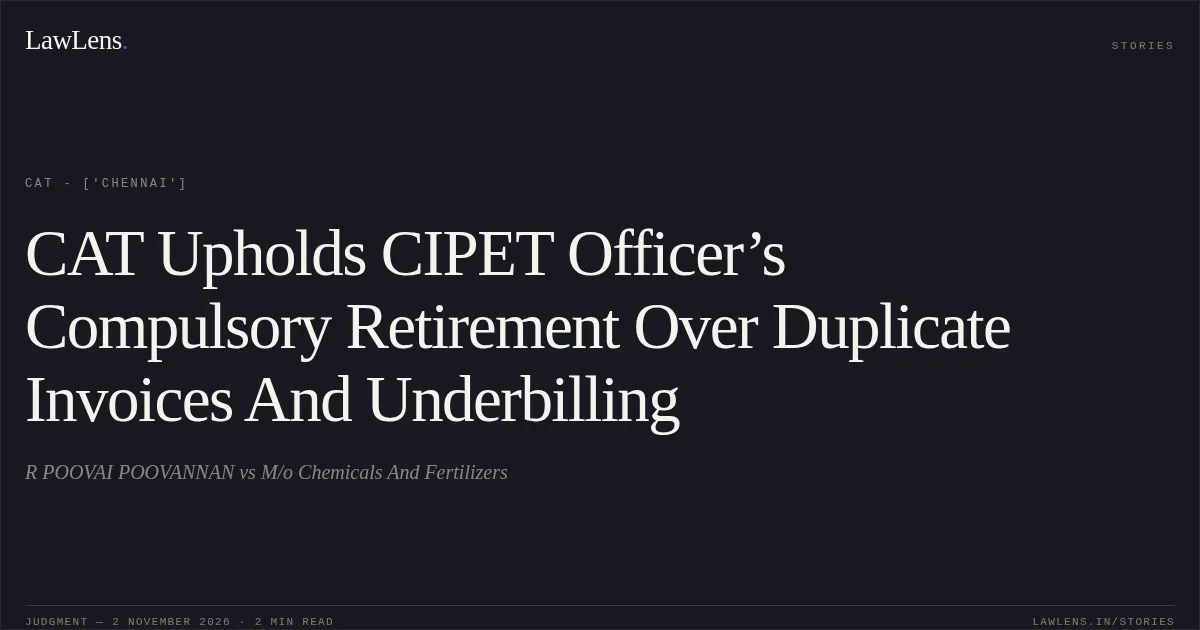
The applicant, a Technical Officer at CIPET, faced four disciplinary charges concerning duplicate invoices, alleged under-invoicing of inspection work, deficient record-keeping, and misconduct.
¶ 20–23The Inquiry Officer found all charges proved; the Disciplinary Authority imposed compulsory retirement, and the Appellate Authority rejected the applicant’s appeal.
¶ 20–23The applicant challenged both orders, alleging evidentiary and procedural defects, bias, delay, and failure to consider his defence.
¶ 2–8The respondents maintained that the findings were supported by the inquiry record and that the proceedings complied with applicable rules.
¶ 9–1602Issues
i.1. Whether the disciplinary and appellate orders were vitiated by procedural unfairness, violation of natural justice, or other legal infirmity.
¶ 21–23, 31ii.2. Whether the Tribunal could interfere with the findings on the charges or the penalty of compulsory retirement in the circumstances of the case.
¶ 27–3003Law Applied
The Tribunal applied the CIPET Conduct and Disciplinary Rules read with the CCS (CCA) Rules, and referred to the CCS (Conduct) Rules, 1964, as governing the disciplinary allegations and proceedings.
¶ 20–22It relied on State of U.P. v. Raj Kishore Yadav, (2006) 5 SCC 673, and Union of India v. Upendra Singh, (1994) 3 SCC 357, for the principle that judicial review in disciplinary matters is limited and does not ordinarily permit a court or tribunal to reappreciate the truth of charges or substitute its view for that of the disciplinary authorities.
¶ 27–28It also applied B.C. Chaturvedi v. Union of India, (1995) 6 SCC 749: the disciplinary and appellate authorities are the primary fact-finding bodies, and a reviewing court or tribunal ordinarily cannot substitute its own conclusion on penalty, subject to intervention where the punishment shocks the conscience.
¶ 29Provisions in the judgment · 2
Indian Evidence Act, 1872 Section 63
Bar Council of India Training Rule,1995 Section 15
04Reasoning
The Tribunal found that the applicant had participated in the inquiry and received a reasonable opportunity to defend himself; it also found that the inquiry and subsequent decision-making complied with the applicable procedure and principles of natural justice.
¶ 21–23The Inquiry Officer’s findings were supported by the materials on record, and the Disciplinary and Appellate Authorities had considered the evidence and the applicant’s representations.
¶ 22–23, 31Applying the limited-review principles in the cited authorities, the Tribunal declined to reassess the evidence or replace the authorities’ findings, finding no procedural irregularity, perversity, or other recognised ground for intervention.
¶ 27–3105Holding
The Tribunal held that the applicant had not established any illegality, procedural irregularity, violation of natural justice, or perversity in the impugned orders.
¶ 31It dismissed the Original Application and made no order as to costs.
¶ 32Original Court PDF
R POOVAI POOVANNANvsM/o Chemicals And Fertilizers
Click to open original judgment
Original judgment, available to read, download and summarize on LawLens.in