01Facts
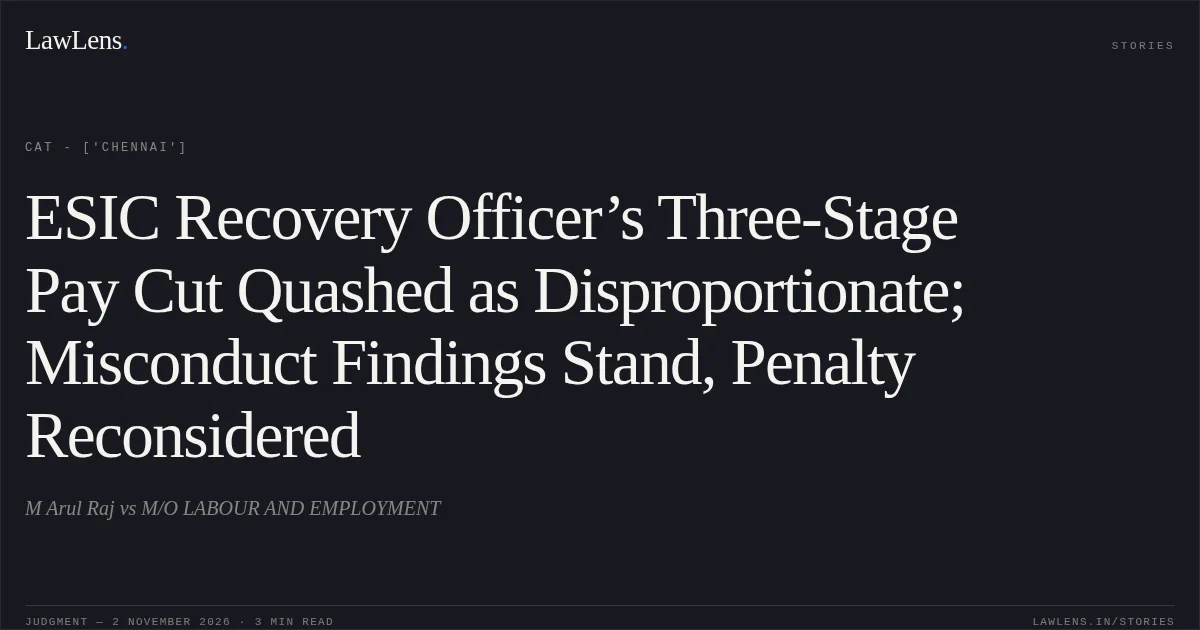
The applicant, an ESIC Deputy Director who had served as Recovery Officer, challenged a major-penalty order dated 12 December 2024.
pp. 3–6Following an inquiry into 11 articles of charge concerning his recovery-related actions, the Inquiry Officer found Articles III and IX proved and Article II partly proved; the Disciplinary Authority disagreed with some other findings and ultimately imposed reduction by three stages in the time scale of pay for three years, with consequential postponement of future increments
pp. 3–6, 12–18, 20–23The applicant challenged the proceedings and penalty on, among other grounds, quasi-judicial immunity, procedural and jurisdictional defects, delay, non-supply of CVC advice, and disproportionality
pp. 6–11The Tribunal rejected the challenges to the findings and proceedings but considered whether the penalty warranted interference
pp. 24–3002Issues
i.1. Whether the applicant’s functions as Recovery Officer immunised him from disciplinary proceedings, and whether the disciplinary findings or proceedings were otherwise legally unsustainable.
pp. 24–29ii.2. Whether the penalty imposed was so disproportionate to the misconduct found proved that it warranted judicial interference.
pp. 27–3603Law Applied
Under Union of India v. K.K. Dhawan, disciplinary action may be taken against an officer performing quasi-judicial functions where the conduct involves, for example, culpable negligence, breach of prescribed conditions, improper motive, or conduct unbecoming of a public servant; the nature of the function alone does not confer absolute immunity.
pp. 23–25, 30–31Under B.C. Chaturvedi v. Union of India and Naresh Chandra Bhardwaj v. Bank of India, the choice of penalty lies primarily with the disciplinary authority, but a court or tribunal may interfere where the punishment is shockingly disproportionate; ordinarily, the matter should then be remitted to the authority to reconsider the penalty rather than the court prescribing one.
pp. 27–29Union of India v. R.K. Sharma confirms that interference is confined to extreme cases showing perversity or irrationality, not mere disagreement with the penalty.
pp. 29–30The Tribunal also relied on Amresh Shrivastava v. State of Madhya Pradesh concerning the distinction between a wrongful order and conduct warranting disciplinary action.
pp. 30–31Provisions in the judgment · 2 · Linked ones open on LawLens
Administrative Tribunals Act, 1985 Section 19
Indian Penal Code, 1860 Section 77
04Reasoning
The Tribunal held that the allegations concerned compliance with recovery procedures, the inclusion of damages in an auction notice, the handling of the defaulter’s business, and appointment of a receiver—not merely the correctness of a quasi-judicial determination.
pp. 24–27The applicant therefore had no blanket immunity, and the Tribunal found no sufficient basis to set aside the disciplinary findings or proceedings; it also found no established prejudice from delay and noted that the CVC advice had been supplied with the penalty order.
pp. 24–27However, considering the nature of the misconduct found proved, the absence of an allegation of misappropriation or mala fides, and the applicant’s “Very Good” and “Excellent” APAR record, it concluded that the penalty was excessive and disproportionate.
pp. 27–28, 30–3605Holding
The Original Application was partly allowed.
pp. 32–33The Tribunal quashed the penalty order dated 12 December 2024 and remitted the matter to the competent Disciplinary Authority for reconsideration of the quantum of punishment alone, without reopening the findings in the disciplinary proceedings.
pp. 32–33The authority was directed to complete the reconsideration within two months of receiving a certified copy of the order; there was no order as to costs.
pp. 32–33The accompanying miscellaneous application was closed.
p. 32Original Court PDF
M Arul RajvsM/O LABOUR AND EMPLOYMENT
Click to open original judgment
Original judgment, available to read, download and summarize on LawLens.in