Facts
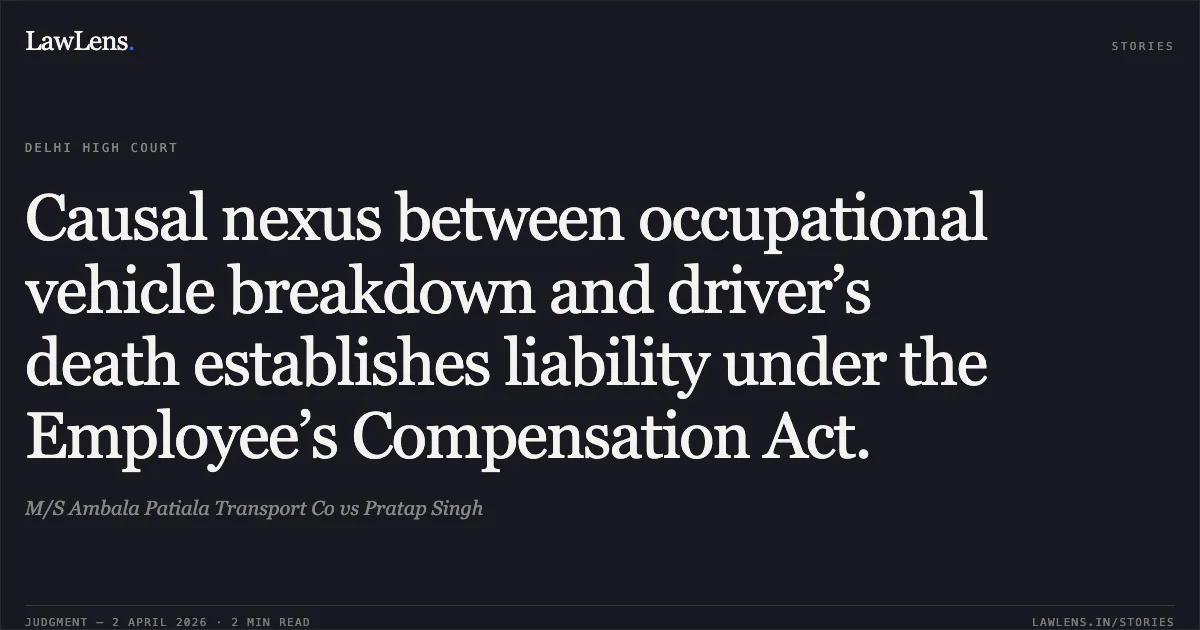
The appellant employer challenged an award dated 21.05.2015 passed by the Commissioner under the Employee’s Compensation Act, 1923 (EC Act), which granted Rs. 3,94,120 plus 12% interest to the parents of the deceased, Balbir Singh
Source reference: p. 1The deceased, a driver for the appellant, was on an occupational trip from Delhi to Kolkata when his truck broke down in Aligarh
Source reference: p. 2He remained with the vehicle for 13 days under work pressure, fell ill, and was eventually moved to a hospital in Burdwan by his brother, where he died on 20.03.2006 from "encephalopathy"
Source reference: p. 2-3The employer denied ownership of the vehicle and the existence of an employment relationship, further arguing that the medical history was improbable
Source reference: p. 3Issues
1. Whether an employer-employee relationship existed despite the appellant’s denial of vehicle ownership
Source reference: p. 3 / para. 62. Whether the death of the deceased arose "out of and in the course of employment" establishing a causal nexus between the work and the injury
Source reference: p. 4 / para. 103. Whether the findings of fact by the Commissioner warrant interference under the limited scope of Section 30 of the EC Act
Source reference: p. 6 / para. 11Law Applied
The court applied Section 3 of the Employee's Compensation Act, 1923, regarding an employer's liability for compensation for injuries arising out of and in the course of employment
Source reference: p. 1It relied on Param Pal Singh v. National Insurance Company and Another, which established that "personal injury" includes death resulting from the stress and strain of long-distance driving, creating a causal connection to employment
Source reference: p. 5It further applied the principles from Mackinnon Mackenzie & Co. (P) Ltd. v. Ibrahim Mahmmed Issak, defining "in the course of employment" as work incidental to duty and "arising out of employment" as a risk incidental to the service
Source reference: p. 5-6Reasoning
The Court observed that the employer admitted to operating a transport business on the Delhi-Kolkata circuit, and mere denial of truck ownership did not absolve liability since the employer admitted to hiring third-party trucks for its business
Source reference: para. 6The Court credited the testimonies of three witnesses—the deceased’s brother, a mechanic, and a fellow driver—who established that the deceased was performing an occupational trip under the appellant's instructions when the vehicle failed
Source reference: para. 7-8Applying the Param Pal Singh precedent, the Court reasoned that the deceased remained unattended for 13 days with the broken-down vehicle, leading to a deterioration of health (encephalopathy) due to factors incidental to his duty
Source reference: para. 10The Court found that this "untoward mishap" during a work-related journey satisfied the requirement of a causal nexus between employment and death
Source reference: para. 10Under Section 30 of the EC Act, the Court held it would not interfere with these well-supported findings of fact
Source reference: para. 11Holding
The Court dismissed the appeal, holding that the deceased died due to an occupational hazard arising out of and in the course of his employment
It upheld the Commissioner's award and directed the appellant to release the remaining 50% of the awarded amount to the claimant within two weeks
Source reference: para. 12-13All pending applications were closed
Source reference: para. 14Acts & Sections Cited
2 provisions across 1 statute referred to in this judgment. Linked provisions open on LawLens.
Employee2
Original Court PDF
M/S Ambala Patiala Transport CovsPratap Singh
Click to open original judgment
Original judgment, available to read, download and summarize on LawLens.in