Facts
The appellant, an advocate since 1998, provided a legal opinion to Canara Bank in 2015 regarding a property offered as security
Source reference: p. 5Following a dispute where the Bank alleged a portion of the land had been alienated prior to the opinion, the Bank removed the appellant from its panel
Source reference: p. 6Under RBI Circulars (dated 16.03.2009), the Bank forwarded his name to the Indian Banks’ Association (IBA), which included him in a "Caution List" titled “Third Party Entities Involved in Fraud,” citing "Wrong Legal Opinion and Negligence"
Source reference: p. 6The appellant challenged this in the Allahabad High Court, which dismissed the writ petition stating the IBA is not "State" under Article 12
Source reference: p. 2Issues
1. Whether a writ petition under Article 226 is maintainable against the IBA for inclusion in a Caution List
Source reference: p. 8 / para. 9.12. Whether the inclusion of an advocate’s name in the Caution List is a mere administrative measure or an infringement of constitutional rights
Source reference: p. 8 / para. 9.23. Whether allegations of professional misconduct/negligence by an advocate fall within the exclusive jurisdiction of the Bar Councils under the Advocates Act, 1961
Source reference: p. 8 / para. 9.3Law Applied
The Court applied Article 226 of the Constitution, emphasizing that the "function test" (performing public duties) determines maintainability rather than the formal "State" status under Article 12, citing Andi Mukta and S. Shobha v. Muthoot Finance Ltd.
Source reference: p. 10, 11Section 35-A of the Banking Regulation Act regarding RBI's power to issue directions, noting these are for "fraud" prevention, not professional negligence
Source reference: p. 14, 18The Advocates Act, 1961 (specifically Sections 35, 36, and 38), which establishes the Bar Council of India (BCI) and State Bar Councils as the exclusive regulatory and disciplinary bodies for the legal profession under the principle of "peer review" and self-regulation
Source reference: p. 24-27Reasoning
The Court reasoned that while a bank can terminate a contract, industry-wide "blacklisting" via a Caution List impacts the fundamental right to practice a profession under Article 19(1)(g), thus attracting Article 226
Source reference: p. 9, 12The Court analyzed RBI Circulars and concluded that the Caution List is intended only for cases of "fraud, dishonesty, or criminality," not "professional negligence" or "errors of judgment"
Source reference: p. 3, 20The Court found the IBA's action illegal because it usurped the disciplinary powers of the Bar Councils; under the Advocates Act, only statutory bodies have the jurisdiction to adjudicate professional misconduct
Source reference: p. 26Parallel adjudicatory mechanisms by banks are excluded as they undermine the independence of the Bar
Source reference: p. 24, 28Holding
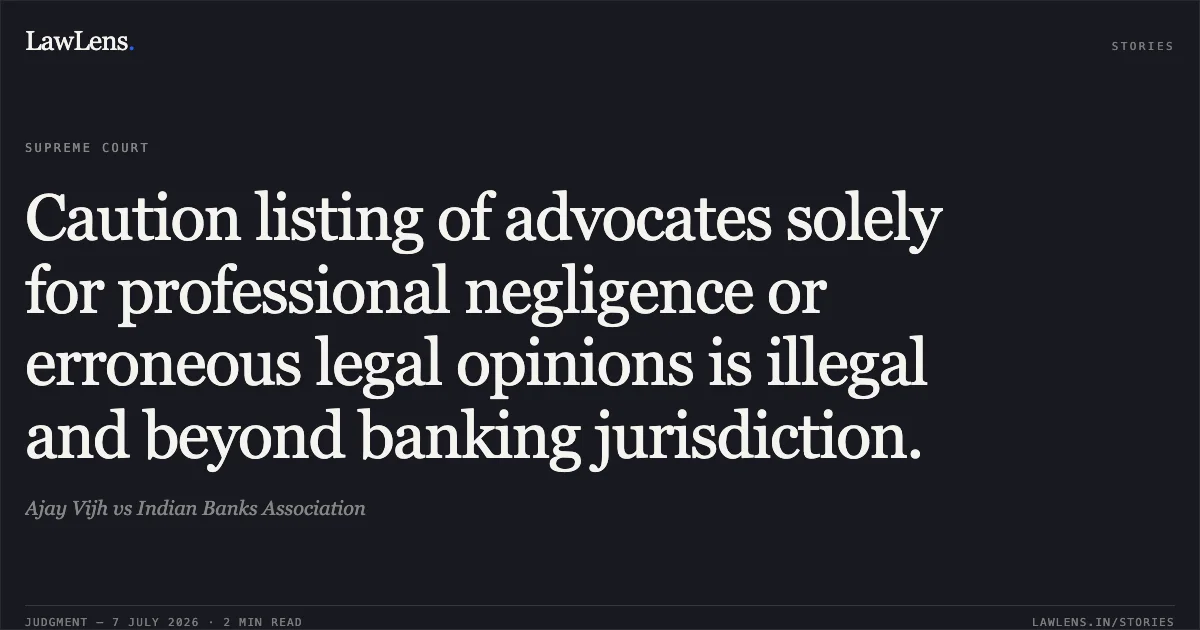
The Court held that (1) the writ petition is maintainable as the IBA performs a public function affecting legal rights; (2) inclusion in the Caution List for negligence is unsustainable in law; and (3) disciplinary control over advocates belongs exclusively to the Bar Councils
The Supreme Court allowed the appeal and set aside the High Court’s judgment, directed the immediate removal of the appellant's name from the Caution List, and directed the BCI to conduct a performance audit of its disciplinary mechanisms and to institutionalize Continuing Legal Education (CLE)
Source reference: p. 40, 35, 39-40Acts & Sections Cited
1 provisions across 1 statute referred to in this judgment. Each provision opens on LawLens.
Advocates Act, 19611
Original Court PDF
Ajay VijhvsIndian Banks Association
Click to open original judgment
Original judgment, available to read, download and summarize on LawLens.in