Facts
The deceased, Shri Shravan Suryavanshi @ Sarvan Tamre, was arrested on 18 January 2024 in connection with an offence under Section 34(2) of the Chhattisgarh Excise Act, 1915, involving six litres of raw Mahua liquor valued at ₹1,200.
Source reference: para. 5He was remanded to custody and lodged in Central Jail, Bilaspur. After deterioration in his health, he was shifted to CIMS Hospital on 21 January 2024, where he died on 22 January 2024.
Source reference: para. 5The post-mortem revealed multiple antemortem injuries, including an occipital scalp laceration, contusions, swelling and bleeding, and attributed the death to cardio-respiratory arrest resulting from complications arising from a head injury caused by a hard and blunt object.
Source reference: paras. 5–6A judicial inquiry under Section 176 of the Code of Criminal Procedure, 1973, was conducted and its report dated 22 July 2024 opined that the death appeared to have resulted from complications caused by the head injury.
Source reference: para. 7The deceased’s wife and daughters approached the High Court seeking investigation, prosecution of the responsible officials and ₹50 lakh compensation. The High Court held that the deceased had suffered custodial violence but awarded only ₹1 lakh and issued no direction for registration of an FIR or investigation.
Source reference: para. 8The petitioners challenged that decision before the Supreme Court.
Source reference: paras. 3–4, 10Issues
1. Whether, after finding that the deceased had died as a result of custodial violence, the High Court erred in failing to direct registration of an FIR and an effective investigation into the custodial death.
Source reference: paras. 10, 14–192. Whether the compensation of ₹1 lakh awarded by the High Court was inadequate and whether further interim compensation was warranted for the violation of the deceased’s fundamental rights.
Source reference: paras. 10, 21–223. Whether the investigation should be entrusted to the Central Bureau of Investigation in view of the conduct and inaction of the State authorities.
Source reference: para. 18Law Applied
The Court applied the constitutional public-law remedy under Articles 21 and 226 of the Constitution, under which the State may be directed to pay exemplary compensation for the violation of the right to life and personal liberty, independently of private-law damages or criminal prosecution.
Source reference: para. 8It applied Section 176 of the Code of Criminal Procedure, 1973, governing inquiries into custodial deaths, and held that the existence of such an inquiry does not dispense with the duty to register and investigate a cognizable offence disclosed by the available material.
Source reference: paras. 7, 14–19The Court further applied the principle that the State bears responsibility for the safety and protection of persons in its custody and must ensure an effective, impartial and prompt investigation where custodial violence or death is alleged.
Source reference: paras. 18, 21–22Reasoning
The medical evidence disclosed multiple antemortem injuries, including a recent head laceration and older contusions, while the post-mortem attributed death to complications from a hard and blunt-force head injury.
Source reference: paras. 5–6, 16–17These circumstances, coupled with the deceased’s uninterrupted custody, clearly warranted registration of a criminal case and a thorough investigation.
Source reference: no citationThe State’s assertion that no FIR could be registered because the Section 176 inquiry report had not been received was rejected as false and reprehensible: the report had been submitted on 22 July 2024 and was available on the record before the High Court.
Source reference: paras. 14–15The Court also noted the inconsistency between the jail medical report, which attributed death to alcoholic withdrawal and delirium tremens without mentioning any injury, and the post-mortem report recording multiple external injuries and head-trauma-related death.
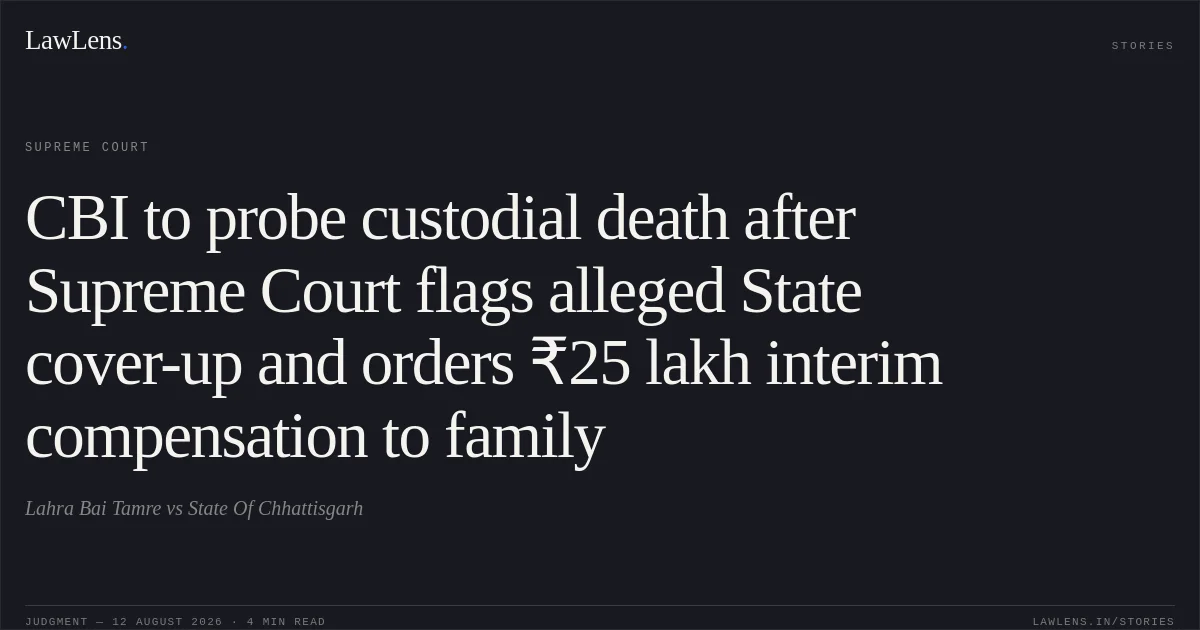
Source reference: para. 16The omission to place the post-mortem report before the High Court and the failure to act on the judicial inquiry demonstrated a possible cover-up and justified transferring the investigation to the CBI.
Source reference: paras. 16–18Since the State did not dispute the High Court’s finding that the deceased was the family’s sole breadwinner and died unnaturally due to violence in custody, the award of ₹1 lakh was considered wholly inadequate, warranting substantial interim compensation.
Source reference: paras. 21–22Holding
The Supreme Court held that the circumstances required an independent criminal investigation into the custodial death and directed the Director, CBI, to forthwith register a regular criminal case and entrust it to a senior officer for expeditious investigation.
The investigation was directed to examine not only the custodial violence but also the failure of State officials to act upon the judicial inquiry report.
Source reference: para. 19The Director General of Police, Chhattisgarh, was ordered to transmit the complete records to the CBI within one week.
Source reference: para. 20As an interim measure, the State was directed to pay ₹25 lakh to the petitioners, into the bank account of petitioner no. 1, within four weeks; the final quantum of compensation was reserved for determination in the pending proceedings.
Source reference: para. 22The matter was listed for further consideration on 13 October 2026.
Source reference: para. 24Acts & Sections Cited
1 provisions across 1 statute referred to in this judgment. Each provision opens on LawLens.
Code of Criminal Procedure, 19731
Original Court PDF
Lahra Bai TamrevsState Of Chhattisgarh
Click to open original judgment
Original judgment, available to read, download and summarize on LawLens.in