Facts
The petitioner, a pharmaceutical company registered under the CGST/BGST Acts, challenged proceedings concerning the financial year 2017–18.
Source reference: p. 4The Department alleged that the petitioner had suppressed taxable turnover and thereby short-paid GST of ₹5,10,00,146, comprising equal CGST and SGST components, invoking Section 74(1) of the CGST/BGST Acts.
Source reference: p. 4The proceedings originated from data received from the Assistant Audit Officer, DGA (Central), Lucknow.
Source reference: p. 5A show-cause notice dated 12 July 2024 was issued, followed by a demand order dated 13 November 2024 under Section 74(9), confirming tax, interest and penalty of ₹5,82,78,320.
Source reference: pp. 2–4The petitioner had submitted a reply and participated in the adjudication proceedings.
Source reference: pp. 5–6, 14–18Issues
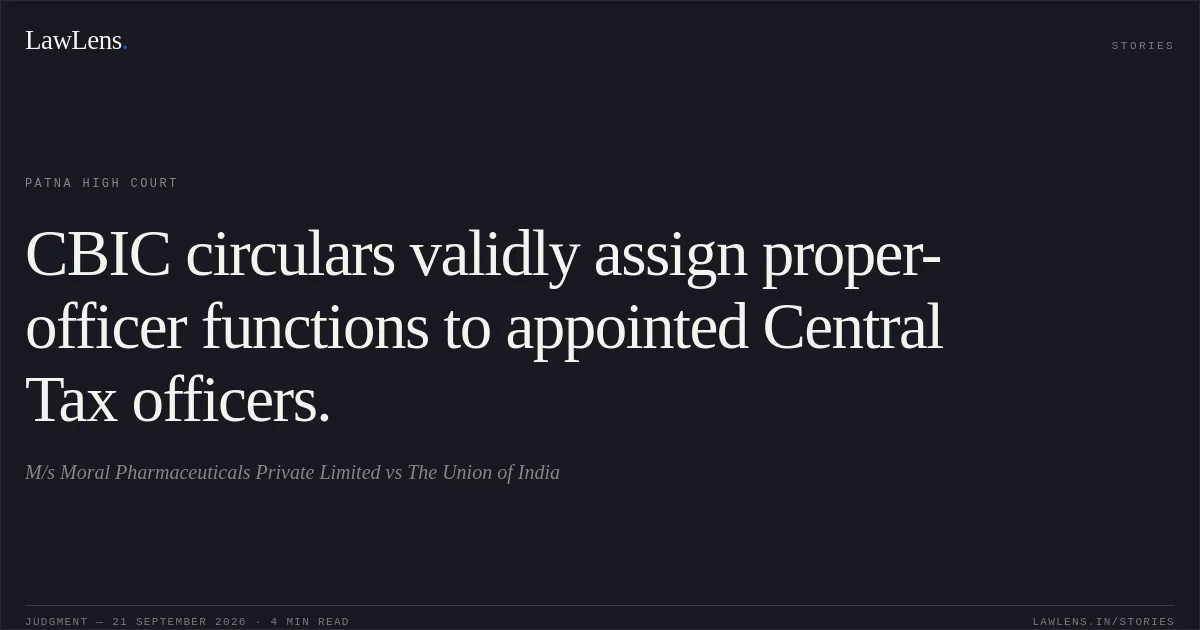
1. Whether the CBIC Circulars dated 5 July 2017, 9 February 2018 and 12 March 2022 validly assigned functions of the “proper officer” to Central Tax officers for proceedings under Sections 73 and 74 of the CGST Act.
Source reference: pp. 6–142. Whether the show-cause notice and demand order were invalid for want of proper authority, digital signature, compliance with the statutory preconditions under Section 74, or adherence to the relevant departmental instructions.
Source reference: pp. 2–4, 14–183. Whether the proceedings were barred by limitation because the extended period under Section 74 was unavailable.
Source reference: pp. 2–4, 15–184. Whether the demand order was vitiated by breach of natural justice on account of denial of personal hearing or failure to issue an ASMT-10 notice.
Source reference: pp. 2–4, 14–185. Whether the writ petition should be entertained despite the statutory appellate remedy under Section 107 of the CGST/BGST Acts.
Source reference: pp. 18–20Law Applied
The Court applied Section 2(91) of the CGST Act, which defines “proper officer” as the Commissioner or an officer of Central Tax assigned the relevant function by the Commissioner in the Board; Sections 3 and 5, under which Central Tax officers are appointed and vested with statutory powers; and Section 4, which authorises the Board to appoint officers under the CGST Act.
Source reference: pp. 8–14The Court distinguished Canon India Pvt. Ltd. v. Commissioner of Customs, 2021 SCC OnLine SC 200, holding that its reasoning concerning officers who were not “officers of customs” under the Customs Act did not invalidate assignment of functions to undisputed Central Tax officers under the CGST Act.
Source reference: pp. 8–13It relied on Fomento Resorts & Hotels Ltd. v. Union of India, (2024) 159 taxmann.com 577 (Bom.), and Yasho Industries Ltd., which upheld assignment of functions through circulars and distinguished delegation under Section 167 from assignment of functions under Section 2(91).
Source reference: pp. 7–14Sections 74(1), 74(9), 75(4), 107(4), and Rule 26(3) of the CGST/BGST framework were also relevant.
Source reference: no citationApplying CIT v. Chhabil Dass Agarwal, (2014) 1 SCC 603, together with the principles in Titaghur Paper Mills Co. Ltd. v. State of Orissa, (1983) 2 SCC 433, the Court held that a writ petition ordinarily should not be entertained where an effective statutory appeal exists, subject to recognised exceptions such as lack of jurisdiction, violation of natural justice, or action contrary to the statute.
Source reference: pp. 18–20Reasoning
The Court rejected the challenge to the CBIC circulars.
Source reference: no citationIt held that the officers concerned were Central Tax officers appointed under the statutory framework and that the circulars merely assigned functions of the proper officer; they did not constitute impermissible delegation under Section 167.
Source reference: pp. 13–14The Court accepted the reasoning of the Bombay High Court that Canon India was distinguishable because it concerned assignment of customs functions to persons who were not “officers of customs,” whereas no such dispute existed regarding the officers in the present case.
Source reference: pp. 8–13As to the demand order, the Court found that the adjudicating authority had considered the petitioner’s response, examined the documentary material, recorded findings regarding unreported consignment sales and suppressed turnover, and granted a personal hearing.
Source reference: pp. 14–18The authority had invoked Section 74 on the basis of alleged suppression, wilful misstatement and failure to furnish information sought by the Department.
Source reference: pp. 15–18Since the impugned order was appealable and the petitioner’s objections required examination of the factual record and reappreciation of documents, the High Court declined to undertake that exercise under Article 226.
Source reference: pp. 18–20It found that none of the recognised exceptions to the alternative-remedy rule was established.
Source reference: pp. 18–20Holding
The Court upheld the validity of the impugned CBIC circulars and found no basis to invalidate the proceedings on the ground that the adjudicating officer lacked authority as a proper officer.
However, without finally adjudicating every challenge to the tax demand on merits, it declined to entertain the writ petition because the demand order was appealable and the petitioner had an effective statutory remedy under Section 107.
Source reference: pp. 18–20The petitioner was granted liberty to file an appeal within 30 days from the judgment.
Source reference: p. 20The Court directed that the appellate authority should not reject the appeal on limitation, since the writ petition had remained pending and had been filed within 30 days after expiry of the statutory three-month appeal period.
Source reference: p. 20The writ petition was accordingly disposed of.
Source reference: p. 20Acts & Sections Cited
29 provisions across 4 statutes referred to in this judgment. Each provision opens on LawLens.
Central Goods and Services Tax Act, 2017
BIHAR GOODS AND SERVICES TAX ACT, 2017
Integrated Goods and Services Tax Act, 20172
Customs Act,19621
Original Court PDF
M/s Moral Pharmaceuticals Private LimitedvsThe Union of India
Click to open original judgment
Original judgment, available to read, download and summarize on LawLens.in