Facts
The appellant filed a complaint under Section 138 of the Negotiable Instruments Act, 1881, alleging dishonour of a cheque issued by the respondent in connection with a settlement recorded through a Memorandum of Understanding.
Source reference: para. 2; p.2The complaint was taken on file as C.C.No.240 of 2017 before the Judicial Magistrate, Fast Track Court, Alandur.
Source reference: no citationDuring the pendency of the complaint, the respondent instituted Crl.O.P.No.11848 of 2018 under Section 482 of the Code of Criminal Procedure, 1973, and obtained an interim stay of all further proceedings on 20 April 2018.
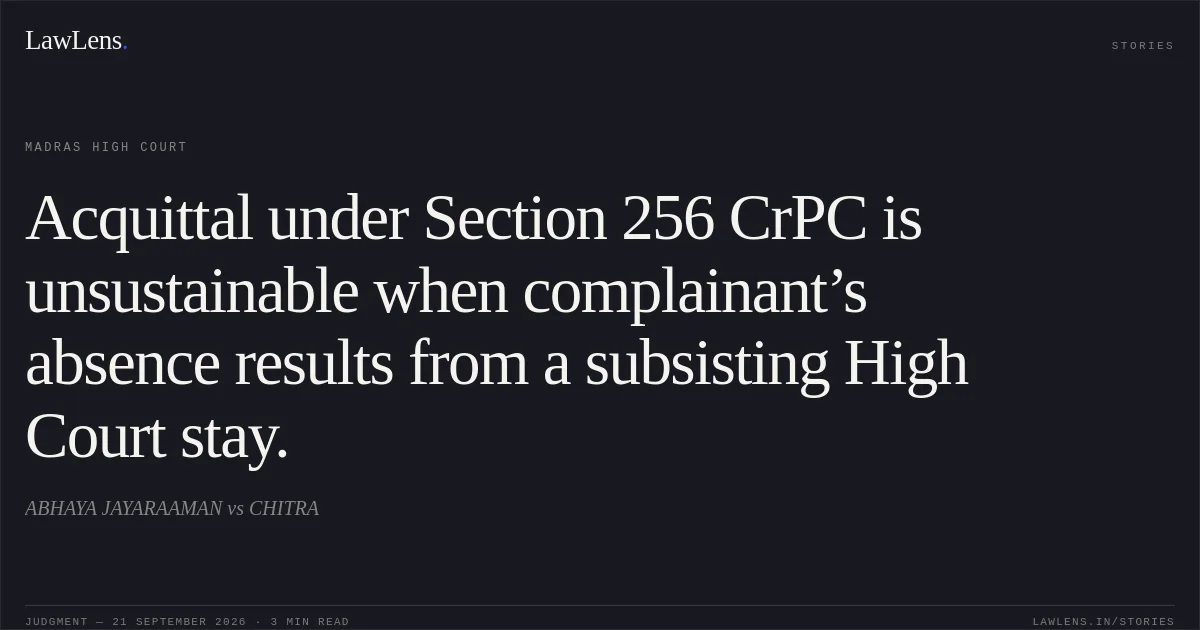
Source reference: para. 8; p.4While the stay remained operative, the Trial Court dismissed the complaint and acquitted the respondent under Section 256(1) Cr.P.C. on 17 December 2019, citing the complainant’s prolonged absence and non-representation by counsel.
Source reference: para. 9; p.5Subsequently, the criminal original petition was dismissed on 28 October 2021, with directions to the Trial Court to dispose of the complaint expeditiously and permitting the respondent’s exemption from personal appearance on specified dates.
Source reference: para. 10; pp.5–6The appellant challenged the dismissal and acquittal before the High Court.
Source reference: no citationIssues
Whether the Trial Court was justified in dismissing the complaint and acquitting the respondent under Section 256(1) Cr.P.C. when an interim order staying all further proceedings was in force.
Source reference: paras. 11–14; pp.6–8Whether the complaint in C.C.No.240 of 2017 should be restored to the file of the Trial Court in light of the subsequent order dated 28 October 2021 directing its expeditious disposal.
Source reference: paras. 13–15; pp.7–8Law Applied
The Court applied Section 256(1) Cr.P.C., which permits dismissal of a complaint and acquittal of the accused where the complainant fails to appear, subject to the court’s discretion and the circumstances of the case.
Source reference: para. 9; p.5It also considered Section 378(2) Cr.P.C. as the statutory basis for the criminal appeal against the order of acquittal.
Source reference: prayer; p.1The Court further applied the principle that a subordinate court cannot proceed with a matter in a manner inconsistent with an operative interim stay granted by the High Court; where proceedings are stayed, the complainant’s non-appearance cannot, in the circumstances, be treated as a valid basis for dismissal.
Source reference: no citationThe complaint was founded on the alleged dishonour of a cheque under Section 138 of the Negotiable Instruments Act, 1881.
Source reference: para. 7; p.4Reasoning
The High Court found that the respondent’s challenge to the complaint had resulted in an interim stay of all further proceedings from 20 April 2018 until the criminal original petition was disposed of on 28 October 2021.
Source reference: paras. 8, 11; pp.4, 6Therefore, on the date of the Trial Court’s order, the complainant and his counsel were reasonably entitled to proceed on the basis that no substantive steps could be taken in the complaint.
Source reference: no citationThe Court observed that, even if the complainant had appeared, the matter could only have been adjourned because the stay was operative.
Source reference: para. 12; p.7The Trial Court dismissed the complaint without taking into account either the interim stay or the pendency of the criminal original petition, making the acquittal under Section 256(1) Cr.P.C. unsustainable.
Source reference: paras. 12–14; pp.7–8Further, restoring the complaint was necessary to give effect to the subsequent High Court direction requiring its expeditious disposal.
Source reference: para. 13; p.7Holding
The High Court allowed the criminal appeal, set aside the Trial Court’s order dated 17 December 2019 dismissing the complaint and acquitting the respondent, and restored C.C.No.240 of 2017 to the file of the Judicial Magistrate, Fast Track Court, Alandur.
The Trial Court was directed to proceed in accordance with law, taking into account the directions issued in the order dated 28 October 2021, including the dispensation of the respondent’s personal appearance on the specified occasions.
Source reference: para. 15; p.8Acts & Sections Cited
7 provisions across 3 statutes referred to in this judgment. Each provision opens on LawLens.
Code of Criminal Procedure, 19735
Negotiable Instruments Act, 18811
Arbitration and Conciliation Act, 19961
Original Court PDF
ABHAYA JAYARAAMANvsCHITRA
Click to open original judgment
Original judgment, available to read, download and summarize on LawLens.in