Facts
The petitioner, A3, was charged in a murder case arising from the killing of a young Scheduled Caste man.
Source reference: para. 1–4The prosecution alleged that she had earlier contacted the deceased’s mother about the deceased’s relationship with her daughter and, after the killing, instructed her son (A1) to destroy evidence and take shelter at a quarry.
Source reference: para. 1–4The alleged post-occurrence meeting and instructions were inferred principally from call-detail records and shared cell-tower coverage.
Source reference: para. 1–4A3 sought to quash the final report under Section 528 of the Bharatiya Nagarik Suraksha Sanhita, 2023 (BNSS).
Source reference: para. 1–4Issues
Whether the materials, taken at face value, disclosed that A3 had participated in, abetted, or conspired in the principal offence, or had intentionally caused disappearance of evidence or harboured A1.
Source reference: para. 14–22, 25–29Whether the alleged telephone conversations with the deceased’s mother disclosed offences under Sections 3(1)(r), 3(1)(s), or 3(2)(v) of the SC/ST (Prevention of Atrocities) Act, 1989.
Source reference: para. 23–28Law Applied
The Court exercised its quashing jurisdiction under Section 528 BNSS to determine whether the prosecution materials, accepted at face value, disclosed the ingredients of the alleged offences.
Source reference: para. 1, 29For Sections 3(1)(r) and 3(1)(s) of the SC/ST Act, the Court identified the requirements of intentional insult or intimidation with intent to humiliate within public view, and abuse by caste name within public view, respectively.
Source reference: para. 23–24For Section 3(2)(v), it required a foundational basis connecting the accused to an underlying offence punishable with imprisonment for ten years or more.
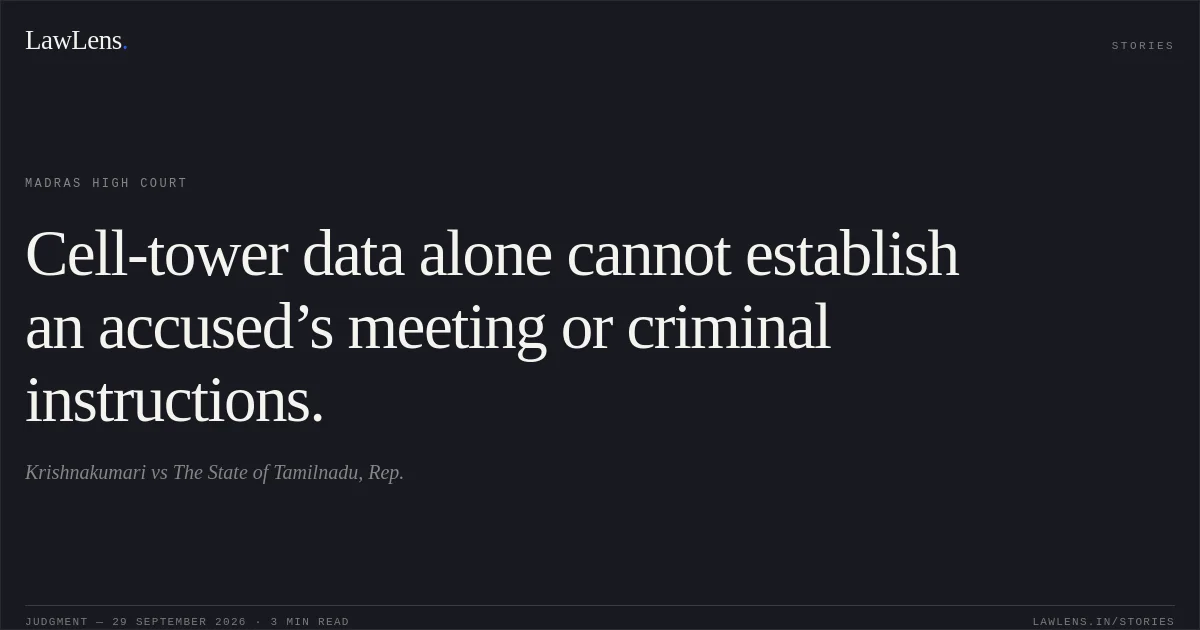
Source reference: para. 25–28The Court relied on Rahil v. State (Government of NCT of Delhi), Prabhakar Kutty Shetty v. State of Maharashtra, and Kunwarpal v. State through SHO, P.S. Special Cell for the principles that cell-tower data generally indicates an approximate coverage area, not a person’s exact location or physical presence with another, and that call records alone do not establish the content or incriminating character of a conversation.
Source reference: para. 15–18Reasoning
The statement of the deceased’s mother described requests between the two mothers concerning their children’s relationship, but did not support the final report’s characterisation of the conversations as threats or warnings; nor did it disclose caste-related words, an intent to humiliate on caste grounds, or communication in public view.
Source reference: para. 11–13, 23–24The shared tower data did not establish that A3 met A1, and the call records could not prove that she gave the alleged instructions.
Source reference: para. 14–22The call to A4 was equivocal, and the prosecution materials did not otherwise show that A3 arranged concealment or intended to screen A1 from punishment.
Source reference: para. 14–22The Court also found no material connecting A3 to a prior plan or agreement to commit the murder, or otherwise establishing the foundational basis required for Section 3(2)(v).
Source reference: para. 25–28Holding
The Court held that the prosecution materials did not disclose the ingredients of the offences alleged against A3 and that requiring her to undergo trial on those materials would amount to an abuse of process.
It allowed the petition and quashed the final report in S.C. No. 120 of 2025 insofar as A3 alone was concerned.
Source reference: para. 30–31The trial against the other accused was to proceed uninfluenced by the Court’s observations, and the order did not preclude the trial court from exercising its power under Section 358 BNSS if the evidence later disclosed A3’s complicity.
Source reference: para. 30–31Acts & Sections Cited
7 provisions across 3 statutes referred to in this judgment. Each provision opens on LawLens.
Bharatiya Nagarik Suraksha Sanhita, 20233
Bharatiya Nyaya Sanhita, 20233
Scheduled Castes and the Scheduled Tribes (Prevention of Atrocities) Act, 19891
Original Court PDF
KrishnakumarivsThe State of Tamilnadu, Rep.
Click to open original judgment
Original judgment, available to read, download and summarize on LawLens.in