Facts
The petitioner, Accused No. 2, sought to quash the final report in S.C. No. 120 of 2025, which charged him under Sections 103(1), 238(a), 249(a) and 318(3) of the Bharatiya Nyaya Sanhita, 2023 (BNS), and Sections 3(1)(r), 3(1)(s) and 3(2)(v) of the Scheduled Castes and the Scheduled Tribes (Prevention of Atrocities) Act, 1989.
Source reference: paras. 1–7The prosecution alleged that his son murdered a Scheduled Caste man because of the man’s relationship with the petitioner’s daughter.
Source reference: paras. 1–7The petitioner was alleged to have supplied the son with a two-wheeler bearing a false registration plate, received information about the murder, met his son and instructed him to destroy evidence, and contacted another accused.
Source reference: paras. 1–7The alleged meeting was inferred from cell-tower data; the prosecution also alleged that the petitioner went to the scene and identified his son to the police.
Source reference: paras. 1–7The petitioner challenged the charges, arguing that the evidence did not establish the alleged meeting or instructions and that the SC/ST Act ingredients were absent.
Source reference: paras. 1–7Issues
1. Whether the allegations and materials, including call-detail records and cell-tower data, disclosed offences of causing disappearance of evidence, harbouring an offender or cheating against the petitioner.
Source reference: paras. 13–24, 292. Whether the allegations disclosed the ingredients of offences under Sections 3(1)(r), 3(1)(s) or 3(2)(v) of the SC/ST Act.
Source reference: paras. 25–29Law Applied
Section 528 of the Bharatiya Nagarik Suraksha Sanhita, 2023 (BNSS), empowers the High Court to quash proceedings where the allegations, taken at face value, do not disclose the ingredients of an offence.
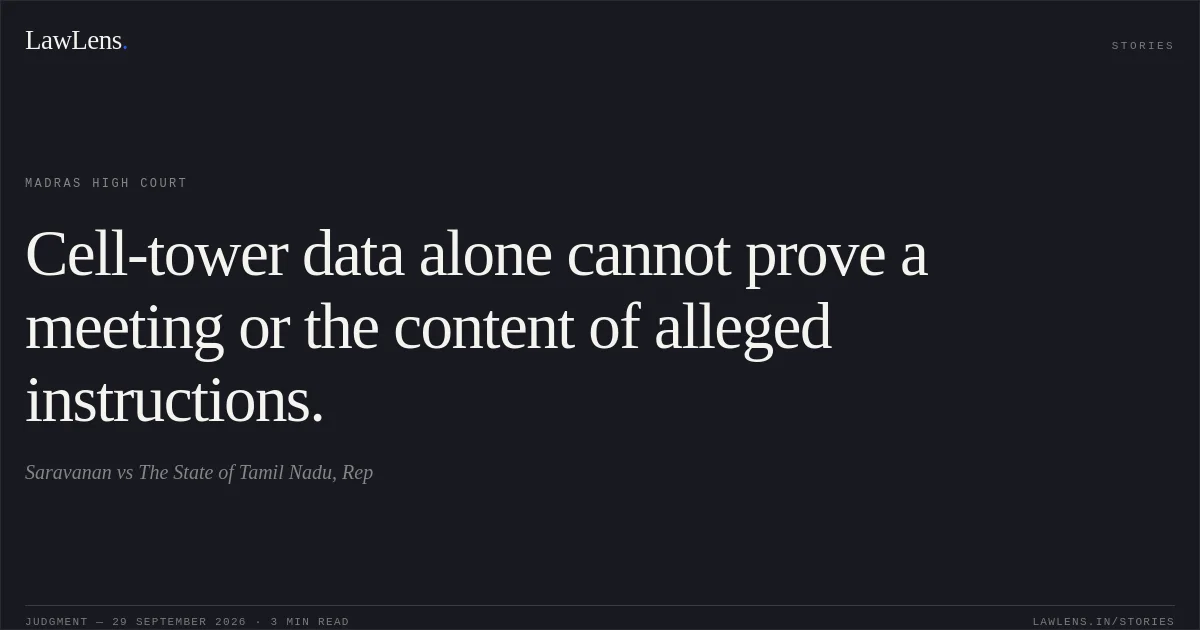
Source reference: para. 1; paras. 28–29Cell-tower data indicates a phone’s approximate coverage area, not its precise location, and call-detail records establish communication but not the content of a conversation; such material may have a limited corroborative role and cannot, without more, prove a meeting or the words spoken (Rahil v. State (Government of NCT of Delhi), 2025 SCC OnLine SC 1481, paras. 37–38; Prabhakar Kutty Shetty v. State of Maharashtra, 2026 SCC OnLine Bom 5123, para. 42; Kunwarpal v. State through SHO, P.S. Special Cell, 2024 SCC OnLine Del 1163, para. 13).
Source reference: paras. 14–18The offences of causing disappearance of evidence and harbouring require an intention to screen an offender from legal punishment or apprehension, respectively.
Source reference: para. 20Cheating requires deception causing the relevant person to act, omit to act or part with property.
Source reference: para. 23Sections 3(1)(r) and 3(1)(s) of the SC/ST Act require, respectively, the specified intentional insult or intimidation, or caste-name abuse, in a place within public view; Section 3(2)(v) requires commission of a qualifying offence against a person belonging to a Scheduled Caste or Scheduled Tribe, with knowledge of that status.
Source reference: paras. 25–28Reasoning
The prosecution relied on shared cell-tower coverage to infer a meeting and on call records to infer that the petitioner instructed his son to destroy evidence. The Court held that those records established neither the meeting nor the conversation’s content.
Source reference: paras. 13–18The prosecution’s own case was that the petitioner went to the scene shortly after receiving the information and told a police officer that his son had committed the murder; that conduct negated the alleged intention to screen the son from punishment or apprehension.
Source reference: paras. 19–20The separate allegation that the petitioner called another accused did not, without evidence of the call’s content or other supporting material, establish his role in the alleged disposal of evidence at the quarry.
Source reference: para. 21The 2023 transfer of the two-wheeler did not connect the petitioner to post-occurrence screening, and no deception practised upon the deceased was alleged.
Source reference: paras. 23–24As to the SC/ST Act, the final report identified no caste-based words or insult by the petitioner, and the earlier private conversations did not occur in a place within public view. Nor was he alleged to have participated in, or known of a plan to commit, the murder.
Source reference: paras. 25–28Holding
The Court held that the allegations, even taken at face value, did not disclose the charged offences against the petitioner.
It allowed the petition and quashed the final report in S.C. No. 120 of 2025 insofar as the petitioner alone was concerned; the connected miscellaneous petition was closed.
Source reference: paras. 29–31The Court clarified that its observations would not affect the case against the other accused and would not prevent the trial court from exercising its power under Section 358 BNSS if evidence at trial disclosed the petitioner’s complicity.
Source reference: para. 30Acts & Sections Cited
7 provisions across 3 statutes referred to in this judgment. Each provision opens on LawLens.
Bharatiya Nagarik Suraksha Sanhita, 20232
Bharatiya Nyaya Sanhita, 20234
Scheduled Castes and the Scheduled Tribes (Prevention of Atrocities) Act, 19891
Original Court PDF
SaravananvsThe State of Tamil Nadu, Rep
Click to open original judgment
Original judgment, available to read, download and summarize on LawLens.in