Facts
The applicant, appointed as a Technical Member of the National Company Law Tribunal (NCLT) on 01.10.2021... challenged a notification dated 16.03.2026 which appointed Respondent No. 2 (a Judicial Member who joined on 18.10.2021) as the Acting President of the NCLT.
Source reference: para. 2The applicant contended that as the senior-most member based on the date of assumption of charge, he was entitled to the position under Section 415(1) of the Companies Act, 2013.
Source reference: para. 2After initially approaching the Delhi High Court, the applicant was directed to seek alternative remedies, leading to the present filing before the Central Administrative Tribunal (CAT).
Source reference: para. 3The respondents raised a preliminary objection regarding the CAT's jurisdiction to adjudicate matters concerning NCLT members.
Source reference: para. 4Issues
1. Whether the Central Administrative Tribunal has the jurisdiction under Section 14 of the Administrative Tribunals Act, 1985, to adjudicate disputes regarding the service conditions or appointments of Members of the National Company Law Tribunal.
Source reference: para. 4Law Applied
Section 14 of the Administrative Tribunals Act, 1985, which restricts the Tribunal’s jurisdiction to recruitment and service matters concerning All-India Services, civil services of the Union, or "civil posts" under the Union.
Source reference: para. 6Criteria for a "civil post" established in State of Assam and Ors. v. Kanak Chandra Dutta, which requires a master-servant relationship and State control over the manner of work.
Source reference: para. 7Principles from Union of India Anr v. Shanker Raju, which established that presiding officers of quasi-judicial statutory tribunals do not hold civil posts.
Source reference: para. 8Madras Bar Association v. Union of India, which affirms the independent statutory nature of Tribunals as distinct from government departments.
Source reference: para. 11-12Reasoning
The Tribunal reasoned that for an application to be maintainable under Section 14 of the Administrative Tribunals Act, the post in question must qualify as a "civil post" or the institution must be specifically notified by the Central Government.
Source reference: para. 12The CAT observed that the NCLT is a statutory body created under Section 408 of the Companies Act and is not a department or wing of the Ministry of Corporate Affairs.
Source reference: para. 12Because the NCLT discharges judicial and quasi-judicial functions independently, its members do not share a traditional master-servant relationship with the Union Government.
Source reference: para. 11-14The Tribunal distinguished the applicant's reliance on A.K. Doshi (Dr.) v. CAT, noting that the legal status of NCLT members evolved significantly after the 2016 and 2021 amendments to the Companies Act, and that the NCLT has not been notified as an authority under the jurisdiction of the CAT.
Source reference: para. 12-13, 15Holding
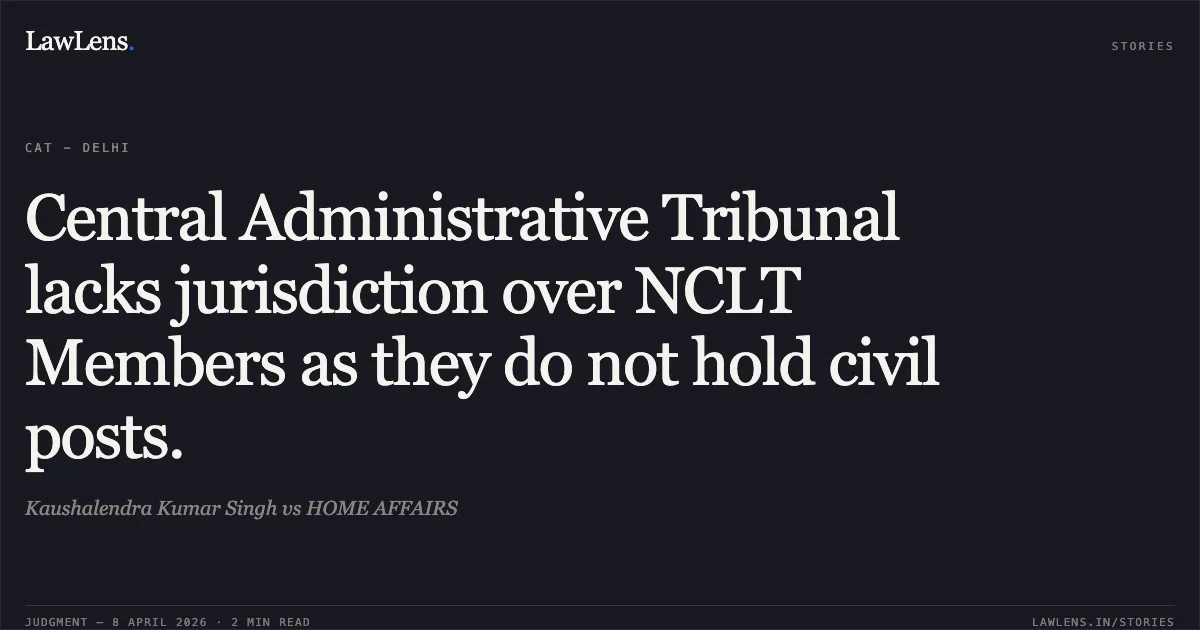
The Tribunal held that it lacks the jurisdiction to entertain the Original Application as the post of a Member of the NCLT is not a "civil post" under the Union, nor is the NCLT a notified organization under the Administrative Tribunals Act.
Consequently, the OA was dismissed for lack of jurisdiction, though the applicant was granted liberty to agitate his grievances before the appropriate legal forum.
Source reference: para. 16No order was made as to costs.
Source reference: para. 17Acts & Sections Cited
9 provisions across 4 statutes referred to in this judgment. Each provision opens on LawLens.
Administrative Tribunals Act, 19852
Companies Act, 20133
Indian Penal Code, 18603
Code of Criminal Procedure, 19731
Original Court PDF
Kaushalendra Kumar SinghvsHOME AFFAIRS
Click to open original judgment
Original judgment, available to read, download and summarize on LawLens.in