Facts
The Petitioners, retired and serving employees of Steel Authority of India (SAIL), deposited substantial savings as Fixed Deposits in the Respondent No. 4 Society, a Multi-State Cooperative Credit Society.
Source reference: p. 8-9Upon the Society’s failure to release funds for medical and personal emergencies, many Petitioners obtained favorable orders from the Cooperative Ombudsman under Section 85A of the Multi-State Cooperative Societies (MSCS) Act, 2002, directing repayment with interest.
Source reference: p. 9-10Despite these orders, the Society remained in default, prompting writ petitions before the Delhi High Court for enforcement.
Source reference: p. 11Interim inquiries by the Institute of Public Auditors of India (IPAI) and a forensic audit revealed severe financial mismanagement, erosion of net worth (deficit of approx. ₹365 crores), and illegal fund diversions to a private trust.
Source reference: p. 17, 19, 26Simultaneously, the West Bengal Directorate of Economic Offences froze the Society’s bank accounts following multiple FIRs against its former management.
Source reference: p. 29-31Issues
1. Whether the orders passed by the Cooperative Ombudsman under Section 85A of the MSCS Act are enforceable in the absence of a specific statutory execution mechanism.
Source reference: p. 13 / para. 122. Whether the financial condition and mismanagement of the Respondent Society warrant winding up proceedings and the appointment of a Liquidator to secure depositors' interests.
Source reference: p. 36 / para. 37-39Law Applied
Section 85A of the MSCS Act, 2002, which provides for the appointment of an Ombudsman for grievance redressal and mandates that societies "shall be bound to comply" with its directions within one month.
Source reference: p. 33Sections 86, 89, and 90 of the MSCS Act regarding the winding up of societies and the appointment and powers of a Liquidator.
Source reference: p. 37-38Rule 29 of the MSCS Rules, 2002, which establishes the priority of claims, placing repayment of deposits to members second only to outside liabilities.
Source reference: p. 39The precedent Writers & Publishers (P) Ltd. v. Super Bazar Official Liquidator (2021) 13 SCC 279, which clarifies the statutory scheme of liquidation and the binding nature of the order of priorities under the Rules.
Source reference: p. 38-40Reasoning
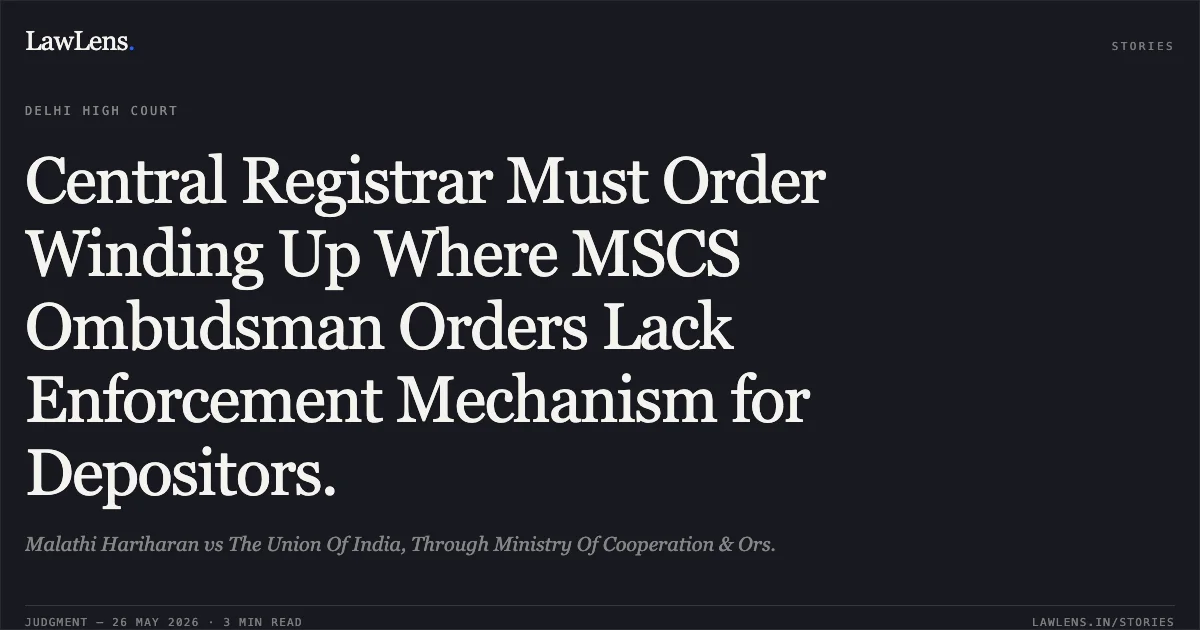
The Court observed a critical legislative lacuna: while Section 85A mandates compliance with Ombudsman orders, the MSCS Act provides no mechanism for their enforcement, rendering them "paper orders".
Source reference: p. 35The Court found that the Society’s leadership had blatantly ignored these statutory directions and breached fiduciary duties.
Source reference: p. 36Based on the forensic audit and IPAI inquiry, the Court determined that the Society had "seized to function in accordance with Cooperative Principles," justifying the invocation of the Central Registrar’s winding-up powers under Section 86.
Source reference: p. 36-37Applying Rule 29, the Court reasoned that the only viable method to return the Petitioners’ "hard-earned money" was to liquidate the Society’s substantial immovable assets (hospitals and holiday homes) and investments, thereby converting frozen assets into a fund managed by a Liquidator to satisfy claims according to statutory priority.
Source reference: p. 40-41Holding
The Court disposed of the petitions by directing the Central Registrar to pass a winding-up order under Section 86 and appoint a Liquidator by June 15, 2026.
The Liquidator is ordered to take charge of all assets, including those disclosed in the Society's affidavit (valued at several hundred crores), and transfer all funds to a new nationalized bank account by July 15, 2026.
Source reference: p. 41-42The Court held that claims of those with Ombudsman orders must be prioritized and settled by October 15, 2026.
Source reference: p. 42Acts & Sections Cited
17 provisions across 4 statutes referred to in this judgment. Each provision opens on LawLens.
Multi-State Co-operative Societies Act, 2002
Bharatiya Nyaya Sanhita, 20233
Bharatiya Nagarik Suraksha Sanhita, 20231
West Bengal Protection Of Interest Of Depositors In Financial Establishments Act, 20131
Original Court PDF
Malathi HariharanvsThe Union Of India, Through Ministry Of Cooperation & Ors.
Click to open original judgment
Original judgment, available to read, download and summarize on LawLens.in