Facts
The appellant manufactured copper powder, copper wire rope and copper wire.
Source reference: no citationThe Department investigated M/s Metal Alloy Industries (“MAI”), alleging that it had no substantive manufacturing facility and was issuing or passing on CENVAT credit through paper transactions without actual movement of goods.
Source reference: para. 2; p. 2The investigation further alleged that M/s Bhiwadi Cylinders Pvt. Ltd. had received invoices from MAI without receiving the corresponding goods and had subsequently issued an invoice to the appellant for 9,772 kg of copper ingots.
Source reference: para. 2.2; p. 3The Department alleged that the appellant had fraudulently availed CENVAT credit of ₹5,25,245 on the basis of Invoice No. 61 dated 20 August 2015, and proposed recovery of the credit with interest under Section 11AA of the Central Excise Act, 1944, along with an equivalent penalty under Section 11AC(1)(c).
Source reference: para. 2.2; p. 3The demand and penalty were confirmed by the adjudicating authority and upheld by the Commissioner (Appeals).
Source reference: para. 2.2; p. 3Before the Tribunal, the appellant relied on the invoice, Goods Receipts issued by MAA Shakumbari Logistics Pvt. Ltd., and entries in the RG 23A Part-II register to establish receipt and use of the copper ingots in its factory.
Source reference: para. 4; pp. 3–4The Department relied principally on statements recorded during the investigation and on the alleged absence of manufacturing facilities at the premises of the upstream suppliers.
Source reference: para. 5; p. 4Issues
Whether the appellant was entitled to CENVAT credit of ₹5,25,245 on the copper ingots covered by Invoice No. 61, or whether the credit was liable to be denied on the allegation that the goods were not physically received?
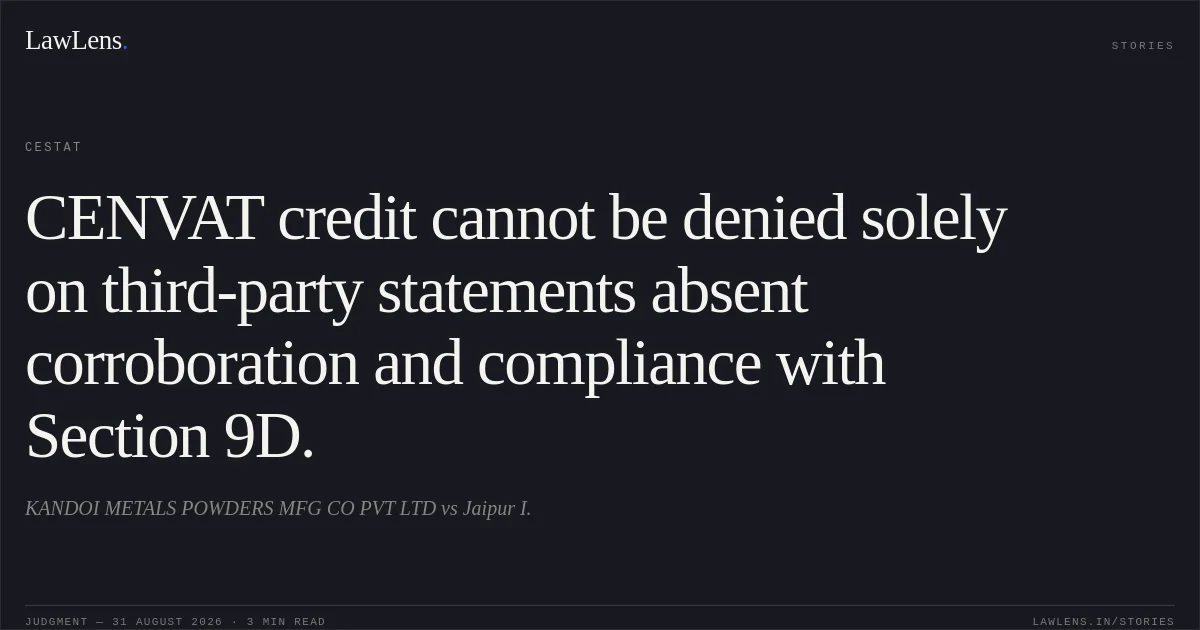
Source reference: paras. 2.2, 6–7.2; pp. 3, 5–7Whether the demand of credit, interest and equivalent penalty could be sustained solely on the basis of third-party statements and the alleged absence of manufacturing facilities at the suppliers’ premises, without corroborative evidence or examination of the transporter and the appellant?
Source reference: paras. 7–7.2; pp. 6–7Law Applied
The Tribunal applied Rule 14 of the CENVAT Credit Rules, 2004, read with Sections 11A and 11AA of the Central Excise Act, 1944, concerning recovery of wrongly availed credit and interest, and Section 11AC(1)(c) concerning equivalent penalty.
Source reference: para. 2.2; p. 3It also referred to Section 9D of the Central Excise Act, under which statements recorded during investigation cannot be relied upon as substantive evidence without the prescribed procedure for their admission and examination.
Source reference: para. 7.1; p. 6The Tribunal proceeded on the principle that the Department bears the burden of proving non-receipt of inputs and fraudulent availment of credit, and that documentary evidence evidencing movement and receipt of goods must be considered and cannot be displaced merely by uncorroborated oral statements.
Source reference: paras. 7.1–7.2; pp. 6–7It relied particularly on R.N. Metals v. Commissioner of Customs, Excise & CGST, Jaipur, 2025 (6) TMI 438 (CESTAT New Delhi), concerning denial of credit based only on third-party evidence and unsubstantiated allegations.
Source reference: para. 7.2; p. 7Reasoning
The Tribunal found that the Department had not conducted any inquiry with MAA Shakumbari Logistics Pvt. Ltd., the transporter, despite the appellant producing Goods Receipts showing transportation of copper ingots to the appellant’s premises.
Source reference: para. 7; p. 5The invoice and transport documents were treated as corroborative documentary evidence of the movement and delivery of the goods, while the appellant had also recorded their receipt in its RG 23A Part-II register.
Source reference: paras. 4, 7; pp. 3–5Against this material, the Department relied primarily on statements of persons connected with MAI and the alleged lack of manufacturing facilities at the suppliers’ premises.
Source reference: no citationThe Tribunal held that such evidence was insufficient, particularly because the statements were not supported by corroborative documents and the requirements of Section 9D had not been complied with.
Source reference: para. 7.1; p. 6It further noted that the appellant’s premises had neither been searched nor investigated, its statement had not been recorded, and there was no dispute that it manufactured and cleared final products on payment of excise duty.
Source reference: para. 7.2; p. 7Accordingly, the Department failed to discharge its burden of establishing that the appellant had not received the inputs.
Source reference: no citationHolding
The Tribunal answered the issues in favour of the appellant.
It held that denial of CENVAT credit of ₹5,25,245 based on third-party material, without adequate corroboration and without disproving the appellant’s transport and receipt documents, was unsustainable.
Source reference: paras. 7–8; pp. 5–7The Order-in-Appeal dated 15 March 2023 and the consequential demand of credit, interest and penalty were set aside.
Source reference: para. 8; p. 7The appeal was allowed with consequential relief.
Source reference: para. 8; p. 7Acts & Sections Cited
2 provisions across 1 statute referred to in this judgment. Each provision opens on LawLens.
Central Excise Act, 19442
Original Court PDF
KANDOI METALS POWDERS MFG CO PVT LTDvsJaipur I.
Click to open original judgment
Original judgment, available to read, download and summarize on LawLens.in