Facts
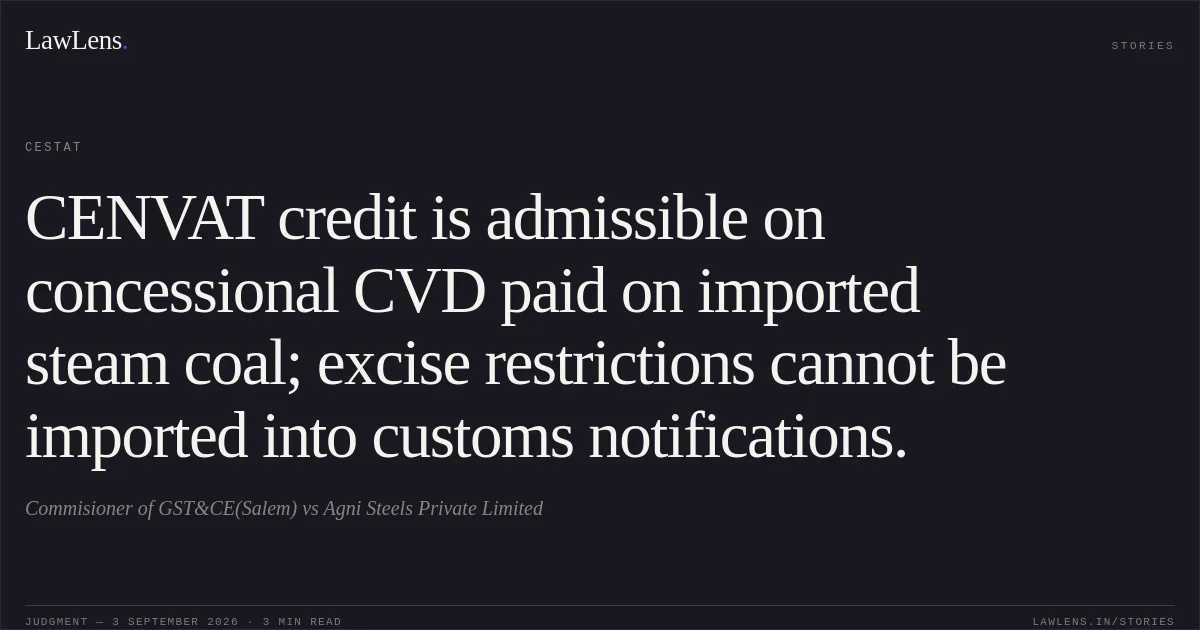
Agni Steel Pvt. Ltd. manufactured sponge iron and availed CENVAT credit under the CENVAT Credit Rules, 2004 (“CCR 2004”). Between June 2011 and September 2015, it availed credit of ₹1,60,20,657 on CVD paid on imported steam coal.
Source reference: para. 2, pp. 1–2The Department alleged that CVD paid at the concessional rate of 1%/2% was ineligible for credit under Rule 3 of the CCR 2004 and issued a show-cause notice proposing recovery, interest and penalty.
Source reference: para. 2, pp. 1–2A further demand of ₹6,66,356 was raised for October 2015 to March 2016.
Source reference: para. 2, pp. 1–2The adjudicating authority confirmed credit demand of ₹84,65,519 with an equal penalty and dropped the balance demand.
Source reference: para. 2, pp. 1–2The Commissioner (Appeals) allowed the assessee’s appeal and set aside the adjudication order. The Department challenged that decision before the Tribunal; the assessee filed cross-objections.
Source reference: para. 2, pp. 1–2Issues
1. Whether CENVAT credit of 1%/2% CVD paid on imported steam coal was admissible under Rule 3(1)(vii) of the CCR 2004.
Source reference: para. 5, pp. 7–82. Whether restrictions contained in Central Excise exemption notifications could be imported into or applied to Customs Notification No. 12/2012-Cus governing the CVD paid on imported steam coal.
Source reference: para. 5, pp. 8–103. Whether the Department was entitled to recover the credit under the extended limitation period and impose penalty under Rule 15(2) of the CCR 2004 read with Section 11AC of the Central Excise Act, 1944.
Source reference: para. 5, p. 8Law Applied
Section 3(1) of the Customs Tariff Act, 1975 levies additional duty of customs, or CVD, which remains a customs duty even though its measure is linked to the excise duty on like goods; Section 3(8) applies the relevant customs exemption provisions to such duty.
Source reference: para. 4, pp. 5–6Rule 3(1)(vii) of the CCR 2004 expressly permits credit of additional duty leviable under Section 3 of the Customs Tariff Act, without restricting credit where the duty is paid at a concessional rate.
Source reference: para. 5, pp. 8–9The proviso to Rule 3(1)(i), which restricts credit of excise duty paid under specified Central Excise exemption notifications, applies to excise duty and cannot be extended to CVD paid under an independent Customs notification.
Source reference: para. 4, pp. 5–7Conditions cannot be implied into an exemption notification, consistent with Hansraj Gordhandas v. H.H. Dave, AIR 1970 SC 755.
Source reference: para. 5, pp. 8–9The Tribunal also relied on Shyam Steel Industries Ltd., 2022 (382) E.L.T. 329 (Cal.), and its own consistent decisions, including Chettinad Cements & Ramco Cements Ltd. and Seshasayee Paper and Boards Ltd., holding that concessional-rate CVD on imported coal is creditable.
Source reference: para. 5, pp. 9–10Reasoning
The Tribunal held that the CVD paid by the assessee was additional duty of customs under Section 3 of the Customs Tariff Act and therefore fell within the express language of Rule 3(1)(vii) of the CCR 2004.
Source reference: para. 5, pp. 8–9Although the Department argued that the concessional CVD rate corresponded to a concessional Central Excise rate carrying a bar on credit, the Tribunal found that the statutory restriction in Rule 3(1)(i) was specifically confined to excise duty and did not cover CVD.
Source reference: para. 4, pp. 5–7; para. 5, pp. 8–10Customs Notification No. 12/2012-Cus prescribed the applicable CVD rate but contained no condition prohibiting availment of CENVAT credit; consequently, the Department could not import conditions from Central Excise notifications into the Customs notification.
Source reference: para. 4, pp. 5–7; para. 5, pp. 8–10Following the consistent view of coordinate Benches and the Calcutta High Court, the Tribunal found the denial of credit legally unsustainable.
Source reference: para. 5, pp. 9–10Since the substantive demand itself failed, the consequential liability for interest, extended-period recovery and penalty also could not survive.
Source reference: para. 5, pp. 9–10Holding
The Tribunal held that CENVAT credit of 1%/2% CVD paid on imported steam coal under Customs Notification No. 12/2012-Cus was admissible under Rule 3(1)(vii) of the CCR 2004.
Restrictions applicable to excise duty under Central Excise exemption notifications could not be superimposed upon CVD paid under the Customs notification.
Source reference: para. 5, pp. 8–10The Department’s appeal was rejected, the Commissioner (Appeals)’s order allowing the assessee’s appeal was sustained, and the proceedings were disposed of along with the assessee’s cross-objections.
Source reference: para. 6, p. 10Acts & Sections Cited
3 provisions across 3 statutes referred to in this judgment. Each provision opens on LawLens.
Central Excise Act, 19441
Customs Tariff Act, 19751
Customs Act,19621
Original Court PDF
Commisioner of GST&CE(Salem)vsAgni Steels Private Limited
Click to open original judgment
Original judgment, available to read, download and summarize on LawLens.in