Facts
MIRC Electronics Ltd. manufactured electronic and electrical goods falling under Chapters 8528, 8450, 8529 and 8415 of the Central Excise Tariff Act, 1985, and availed CENVAT credit of service tax paid on input services.
Source reference: p.2The Department disputed credit claimed on brokerage and commission, detention charges, insurance services, membership fees, rent-a-cab/conveyance services and staff welfare expenses, alleging that these services did not qualify as “input services” under Rule 2(l) of the CENVAT Credit Rules, 2004.
Source reference: p.2Based on an audit objection, show-cause notices dated 11 January 2018 and 15 May 2018 were issued, and the adjudicating authority confirmed the demands by order dated 18 December 2018.
Source reference: p.2The Commissioner (Appeals) upheld the denial of credit but reduced the penalty to 10% of the disputed credit.
Source reference: p.2Issues
1. Whether CENVAT credit was admissible on brokerage and commission services and membership fees used for sales promotion and business-related activities?
Source reference: pp.6–72. Whether detention charges incurred in relation to imported raw materials stored before clearance to the factory qualified as input services?
Source reference: p.73. Whether insurance services relating to plant and machinery, stock and goods in transit were excluded as services used primarily for the personal benefit of employees?
Source reference: p.74. Whether CENVAT credit was admissible on rent-a-cab/conveyance services and staff welfare expenses, including canteen and employee transportation services?
Source reference: pp.7–85. Whether the penalty imposed under Rule 15 of the CENVAT Credit Rules, 2004 read with Section 11AC of the Central Excise Act, 1944 was legally sustainable and, if so, whether it was limited to 10% of the wrongly availed credit?
Source reference: pp.8–9Law Applied
The Tribunal applied Rule 2(l) of the CENVAT Credit Rules, 2004, which covers services used directly or indirectly in or in relation to the manufacture of final products and services specifically included in the definition, such as advertisement or sales promotion, storage up to the place of removal, procurement of inputs and business exhibition services.
Source reference: pp.4–6The Explanation inserted by Notification No. 2/2016-C.E. (N.T.) dated 3 February 2016 clarified that “sales promotion” includes services involving the sale of dutiable goods on commission basis.
Source reference: p.6Rule 3 enabled credit of service tax paid on eligible input services.
Source reference: p.6Services falling within the exclusion relating to services used primarily for the personal use or consumption of employees were not eligible for credit.
Source reference: p.5For staff welfare services, the Tribunal relied on Toyota Kirloskar Motor Pvt. Ltd. v. Commissioner of Central Tax, Bangalore, 2021 (50) GSTL 286 (Kar.), affirmed by the Supreme Court at 2021 (55) GSTL 129 (SC), holding that canteen and employee transportation services were not eligible merely because they were provided pursuant to statutory obligations under the Factories Act.
Source reference: p.8Penalty for irregular availment of credit, absent fraud, collusion or wilful misstatement, was governed by Rule 15 read with Section 11AC(1)(a), and was limited to 10% of the wrongly availed credit.
Source reference: pp.8–9Reasoning
The Tribunal treated the definition of “input service” as consisting of a main part, an inclusive part and an exclusionary part.
Source reference: pp.5–6Brokerage and commission services were directly connected with the sale and promotion of the assessee’s manufactured goods; they were therefore covered by the sales-promotion limb of Rule 2(l), reinforced by the 2016 Explanation.
Source reference: p.7Membership fees paid to associations and federations were likewise held to support exhibitions, sales promotion and procurement activities connected with the assessee’s business and were consequently eligible for credit.
Source reference: p.7Detention charges related to imported raw materials stored before being transported to the factory, and the charges were included in the cost of those materials; they therefore had a sufficient nexus with manufacture under the main part of Rule 2(l).
Source reference: p.7Insurance premiums relating to factory plant and machinery, stock and goods in transit were not employee-benefit services and did not fall within the exclusion for personal use or consumption.
Source reference: p.7The assessee conceded that rent-a-cab services were ineligible and had reversed the corresponding credit; the Tribunal left the quantification and verification of that liability to the original authority.
Source reference: p.8In contrast, credit on staff welfare services, including canteen and bus facilities, was disallowed under the binding principle in Toyota Kirloskar, notwithstanding the assessee’s argument that the facilities were provided to comply with the Factories Act.
Source reference: p.8Since only rent-a-cab services and staff welfare expenses represented irregularly availed credit, the penalty could survive only in respect of those services and was correctly limited to 10%.
Source reference: pp.8–9Holding
The appeal was partly allowed.
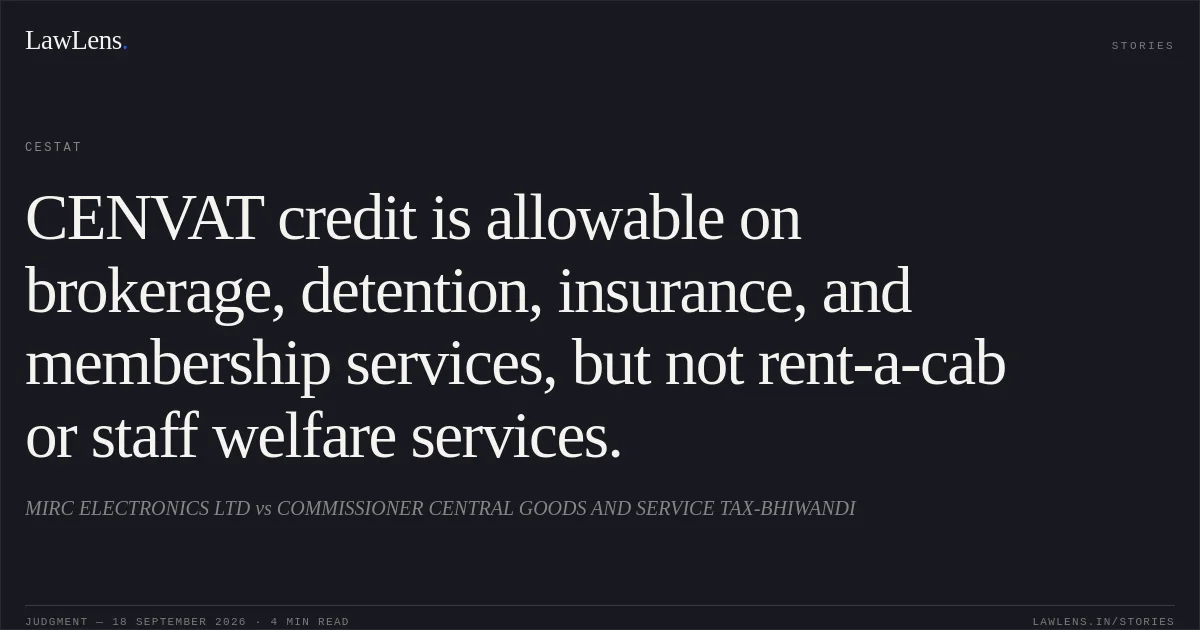
The Tribunal set aside the denial of CENVAT credit on brokerage and commission, detention charges, insurance services and membership fees.
Source reference: p.9The denial of credit on rent-a-cab services and staff welfare expenses was sustained; the rent-a-cab liability was to be examined by the original authority in light of the assessee’s reversal, while the staff welfare credit was required to be repaid with interest.
Source reference: pp.7–9The penalty was sustained only in relation to the two disqualified categories—rent-a-cab services and staff welfare expenses—and was confined to 10% of the irregularly availed credit.
Source reference: p.9Acts & Sections Cited
1 provisions across 1 statute referred to in this judgment. Each provision opens on LawLens.
Central Excise Act, 19441
Original Court PDF
MIRC ELECTRONICS LTDvsCOMMISSIONER CENTRAL GOODS AND SERVICE TAX-BHIWANDI
Click to open original judgment
Original judgment, available to read, download and summarize on LawLens.in