Facts
The first respondent was employed as a Junior Assistant in the fourth respondent, a co-operative housing society. He resigned on 11 January 2019; the resignation was accepted and he was relieved from service, but his terminal benefits—including gratuity, provident fund, earned-leave salary, security deposit and other monetary dues—were not settled.
Source reference: p.3, para. 3He consequently filed W.P. No. 19725 of 2022 seeking a writ of mandamus for payment of approximately ₹18,30,600 with 12% interest.
Source reference: p.2, para. 2The Single Judge allowed the writ petition, relying principally on A. Sengodan v. Registrar of Co-operative Societies, 2015 (6) MLJ 684.
Source reference: p.3, para. 3; p.13, para. 22The Managing Director of the Tamil Nadu Co-operative Federation appealed, contending that the writ petition was not maintainable under the principles laid down by the Larger Bench in K. Marappan v. Deputy Registrar of Co-operative Societies, (2006) 4 CTC 689, and that the first respondent was not an employee of the appellant Federation.
Source reference: p.3, para. 4Issues
1. Whether a writ petition under Article 226 is maintainable for enforcement of terminal benefits claimed by an employee of a co-operative society whose service conditions are governed by the Act, Rules and the society’s bye-laws?
Source reference: pp.8–12, paras. 12–182. Whether the Single Judge was justified in granting a mandamus by relying on A. Sengodan, notwithstanding the Larger Bench decision in K. Marappan?
Source reference: pp.5–6, 13–14, paras. 7–9, 223. Whether the first respondent should instead be relegated to the alternative statutory remedy under Section 153 of the Tamil Nadu Co-operative Societies Act, 1983?
Source reference: pp.11–13, paras. 17–21, 23Law Applied
The Court applied Article 226 of the Constitution and the principles stated by the Larger Bench in K. Marappan v. Deputy Registrar of Co-operative Societies, (2006) 4 CTC 689.
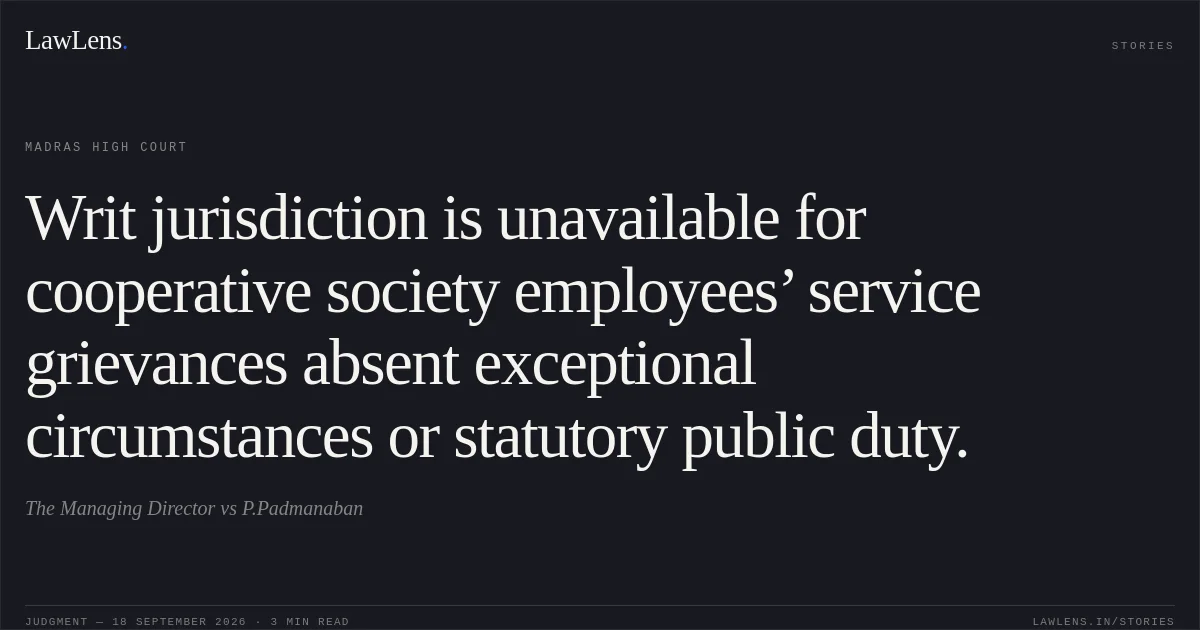
Source reference: pp.6–10, para. 9Under Marappan, a writ may lie against a co-operative society that qualifies as “State” under Article 12, or for enforcement of a statutory public duty; however, service conditions governed by a society’s bye-laws cannot ordinarily be enforced through a writ because such bye-laws do not have the force of law.
Source reference: pp.6–10, para. 9The Court held that employee service grievances, including claims for terminal benefits, are not “statutory public duties” owed by the society to the public generally.
Source reference: pp.8–11, paras. 12–17It further applied the rule that where an efficacious alternative remedy exists, particularly under Section 153 of the Tamil Nadu Co-operative Societies Act, 1983, the High Court should ordinarily decline to exercise writ jurisdiction absent special circumstances.
Source reference: pp.11–13, paras. 17–21The Court also relied on National Insurance Co. Ltd. v. Pranay Sethi, (2017) 16 SCC 680, for the principle that a co-equal Bench must follow the binding decision of a Larger Bench.
Source reference: p.5, para. 8Reasoning
The Court treated the claim for gratuity, provident fund, leave salary and other terminal dues as a service-related grievance arising from the respondent’s employment in the co-operative society.
Source reference: pp.8–11, paras. 12–17Such a claim did not constitute enforcement of a statutory public duty under Marappan; rather, it was governed by the Tamil Nadu Co-operative Societies Act, the 1988 Rules, and the society’s applicable bye-laws.
Source reference: pp.8–11, paras. 12–17Since the bye-laws did not have the force of law and the society was not shown to be “State” under Article 12, the dispute could not ordinarily be adjudicated through a writ petition.
Source reference: pp.8–11, paras. 12–17The availability of a statutory remedy under Section 153, together with the possibility of disputed factual questions concerning the entitlement and non-payment of benefits, reinforced the need to approach the competent statutory authority first.
Source reference: pp.11–13, paras. 17–21Accordingly, the Division Bench held that the Single Judge’s reliance on A. Sengodan was inconsistent with the binding Larger Bench ruling in Marappan and could not be sustained.
Source reference: p.13, para. 22Holding
The Court held that the writ petition seeking terminal benefits from the co-operative society was not maintainable under Article 226 in the circumstances of the case.
The order dated 2 April 2026 in W.P. No. 19725 of 2022 was set aside, and the writ appeal was allowed without costs.
Source reference: p.14, para. 23The first respondent was granted liberty to file a revision petition under Section 153 of the Tamil Nadu Co-operative Societies Act; any such petition was directed to be entertained without reference to delay and decided on merits, in accordance with law, as expeditiously as possible.
Source reference: p.14, para. 23Acts & Sections Cited
3 provisions across 1 statute referred to in this judgment. Linked provisions open on LawLens.
Tamil Nadu Co-Operative Societies Act, 19833
Original Court PDF
The Managing DirectorvsP.Padmanaban
Click to open original judgment
Original judgment, available to read, download and summarize on LawLens.in