Facts
The appellant (T.R.L.) manufactures 'Dead Burnt Magnesite' (D.B.M.) at its Salem unit, which is an exempted/nil-rated product. D.B.M. is produced using furnace oil as fuel
Source reference: para 2.1A portion of D.B.M. is used at Salem to manufacture dutiable monolithic mortars, while the remainder is stock-transferred to T.R.L.’s Belpahar unit in Odisha
Source reference: para 2.4At Belpahar, the D.B.M. is used as an intermediate product to manufacture dutiable refractory bricks and mortars
Source reference: para 2.1The Department issued a show-cause notice seeking to recover CENVAT credit of Rs. 52,51,685/- on the furnace oil, arguing that credit is ineligible for fuel used in the manufacture of the exempted product D.B.M.
Source reference: para 2.3-2.4The C.E.S.T.A.T. upheld the duty liability but waived the penalty
Source reference: para 2.9Issues
1. Whether the C.E.S.T.A.T. was correct in holding that CENVAT credit taken on fuel must be expunged when the exempted intermediate product is used by the manufacturer in another factory to produce dutiable final goods
Source reference: para 2.10 / para 82. Whether the clearance of D.B.M. from the Salem unit to the Belpahar unit constitutes a "sale" or a "stock-transfer"
Source reference: para 83. Whether the term "within the factory of production" in Rule 57AA(d) restricts credit if the final dutiable product is manufactured in a separate unit of the same manufacturer
Source reference: para 8Law Applied
The court primarily applied Rule 57AD and Rule 57AA(d) of the erstwhile Central Excise Rules, 1944, and Rule 6 of the CENVAT Credit Rules, 2001, which generally prohibit input credit for exempted goods but provide exceptions for fuel under specific circumstances
Source reference: para 9-10It relied on the precedent of Escorts Ltd. v. CCE, which established that an intermediate product does not become "final" just because it is transferred to another factory of the same manufacturer, and credit is available if duty is paid on the ultimate final product
Source reference: para 11.1The court also distinguished CCE v. Gujarat Narmada Valley Fertilizers Co. Ltd., noting that the prohibition in Rule 57AD(1) is plenary and applies to fuel if the final product is exempted
Source reference: para 17Reasoning
The Court reasoned that D.B.M. is not the "final product" in this context; it is an intermediate product because it is used by the same manufacturer to produce dutiable bricks and mortars
Source reference: para 11.2Since the ultimate goods cleared for sale are dutiable at 16%, the bar under Rule 57AD(1) against claiming credit for inputs used in "exempted goods" does not trigger
Source reference: para 13.2, 18The Court characterized the movement of D.B.M. between units as a "stock-transfer" rather than a sale, as there was no consideration or change in ownership
Source reference: para 12Regarding the geographic restriction in the definition of "input" under Rule 57AA(d) (“within the factory of production”), the Court adopted a "liberal and wider interpretation". It held that denying credit based solely on the physical distance between two units of the same manufacturer (sharing a common balance sheet) would frustrate the objective of the CENVAT scheme, which is to prevent the cascading effect of taxes
Source reference: para 16Holding
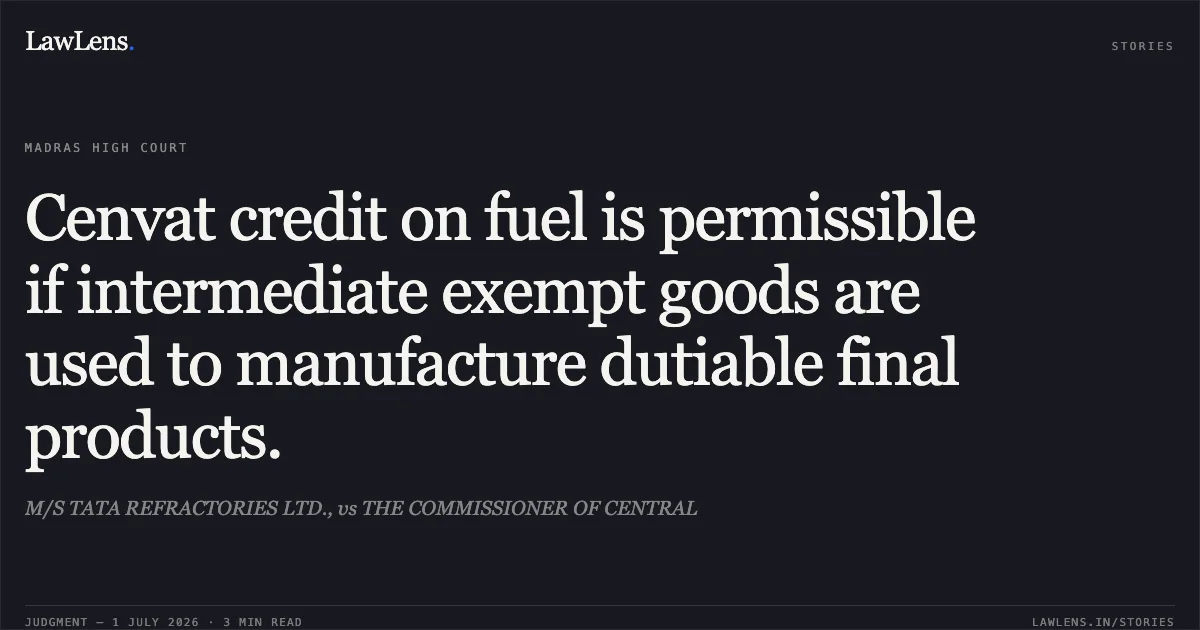
The Court answered the question of law in favour of the assessee, holding that C.E.S.T.A.T. erred in expunging the credit
It concluded that CENVAT credit on furnace oil is permissible because the ultimate final products (refractory mortars/bricks) are dutiable, regardless of the intermediate stage of D.B.M. or its transfer to a sister unit
Source reference: para 18The Court set aside the C.E.S.T.A.T. order dated March 11, 2011, and restored the Order-in-Appeal dated June 10, 2004, which allowed the credit to the appellant
Source reference: para 20Acts & Sections Cited
1 provisions across 1 statute referred to in this judgment. Each provision opens on LawLens.
Central Excise Act, 19441
Original Court PDF
M/S TATA REFRACTORIES LTD.,vsTHE COMMISSIONER OF CENTRAL
Click to open original judgment
Original judgment, available to read, download and summarize on LawLens.in


