Facts
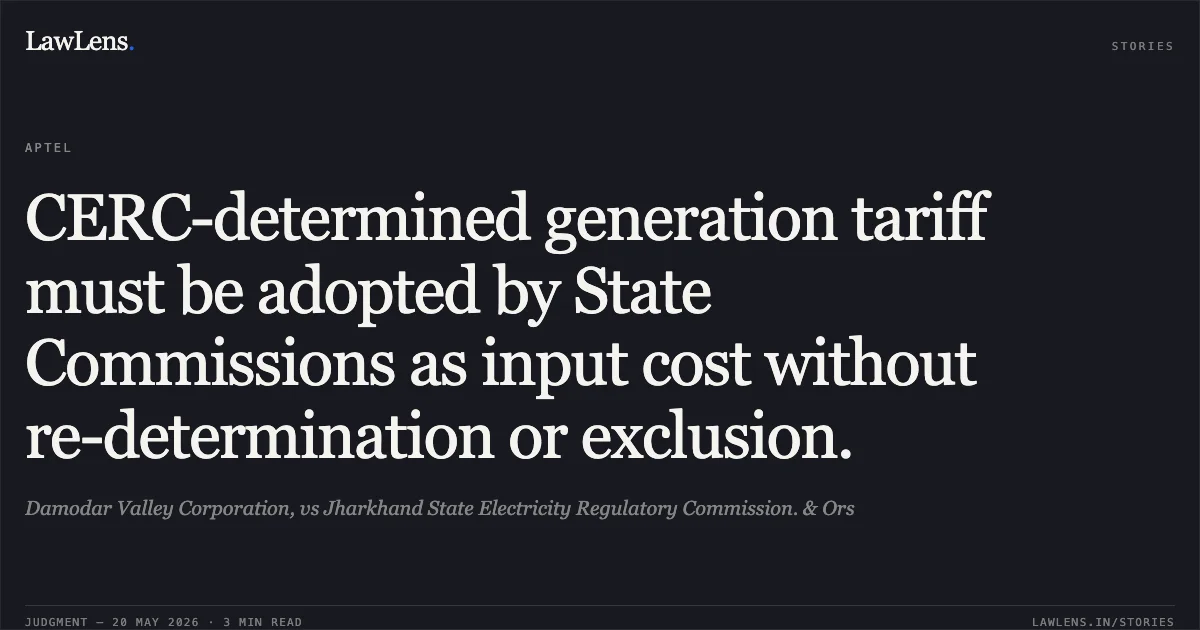
Damodar Valley Corporation (DVC), a statutory body under the DVC Act, 1948, challenged an order dated 19.04.2017 passed by the Jharkhand State Electricity Regulatory Commission (JSERC).
Source reference: p.2Under Section 79 of the Electricity Act, 2003, the Central Commission (CERC) determines DVC's generation and transmission tariffs, while JSERC determines retail supply tariffs.
Source reference: p.3-4Following directions from the Supreme Court to undertake a true-up exercise, JSERC issued the Impugned Order for FY 2006-07 to 2014-15.
Source reference: p.4DVC appealed the order on three grounds: disallowance of pay revision arrears previously approved by CERC, linkage of statutory fund contributions to plant availability, and the imposition of normative T&D loss targets instead of actuals.
Source reference: p.5Issues
1. Whether the State Commission could disallow pay revision expenditure of Rs. 210 Crore for FY 2006-09 when the same was specifically approved by the CERC in its order dated 08.05.2013.
Source reference: p.5 / para. 112. Whether the recovery of contributions toward the Pension & Gratuity (P&G) Fund and Sinking Fund (under Section 40 of many DVC Act) should be linked to the normative plant availability factor for FY 2009-14.
Source reference: p.5 / para. 273. Whether JSERC erred in applying a normative T&D loss target of 3.00% for FY 2012-13 to FY 2014-15 instead of considering actual losses.
Source reference: p.5 / para. 39Law Applied
Rule 8 of the Electricity Rules, 2005, which stipulates that tariffs determined by the Central Commission shall not be subject to re-determination by a State Commission.
Source reference: p.10Section 40 of the DVC Act, 1948, regarding the statutory obligation to maintain P&G and Sinking Funds.
Source reference: p.11-12Regulation 43(2)(iv) of the CERC Tariff Regulations, 2009, which treats such funds as recoverable expenditure.
Source reference: p.15Section 61 of the Electricity Act, 2003, emphasizing that loss reduction targets must be rational and grounded in empirical data, supported by the precedent in WESCO v. OERC regarding "ground realities".
Source reference: p.19, 22-23Reasoning
Regarding Issue 1, the Tribunal held that JSERC’s exclusion of the Rs. 210 Crore pay revision arrears was unsustainable because CERC had explicitly allowed it in the body of its order (paras 132-136); a mere omission in a summary table cannot override operative findings, and Rule 8 prohibits JSERC from modifying CERC-determined input costs.
Source reference: p.10-11For Issue 2, the Tribunal reasoned that while fund contributions are statutory, once they are subsumed into the Annual Fixed Charges (AFC), their recovery is governed by the regulatory framework of availability-based tariffs. Thus, they must be linked to plant performance like any other fixed cost component.
Source reference: p.17-18On Issue 3, the Tribunal found JSERC’s 3% T&D loss ceiling arbitrary. It noted that JSERC had allowed higher actual losses in previous years and its own MYT order promised a true-up based on actuals; hence, restricting losses to normative targets without a fresh prudence check or rational basis was a regulatory error.
Source reference: p.21-23Holding
The Tribunal partly allowed the appeal. It set aside the disallowance of Rs. 210 Crore (Issue A), directing JSERC to include it in the tariff and upheld JSERC’s decision to link P&G and Sinking Fund recovery to plant availability (Issue B).
It remanded the issue of T&D losses (Issue C) back to JSERC to conduct a proper prudence check of actual losses for FY 2012-13 to FY 2014-15 and JSERC was directed to pass consequential orders with carrying cost within three months.
Source reference: p.24-25Acts & Sections Cited
4 provisions across 2 statutes referred to in this judgment. Each provision opens on LawLens.
Damodar Valley Corporation Act, 19481
Electricity Act, 20033
Original Court PDF
Damodar Valley Corporation,vsJharkhand State Electricity Regulatory Commission. & Ors
Click to open original judgment
Original judgment, available to read, download and summarize on LawLens.in