Facts
The appellant (wife) and respondent (husband) were married on 28.04.2021 and have a daughter born in 2022.
Source reference: p. 2Alleging separate residence since March 2022 due to strained relations, both parties filed a joint petition for divorce by mutual consent under Section 13(B) of the Hindu Marriage Act, 1955, on 11.05.2023.
Source reference: p. 3During the proceedings, the husband (AW-1) deposed that he had established conjugal relations with the appellant as recently as 15.03.2023.
Source reference: p. 7The Family Court, Sheohar, rejected the petition on 06.06.2023, holding that the mandatory one-year separation period was not met.
Source reference: p. 2The appellant challenged this dismissal, arguing the husband's oral testimony was a tactic to stall the suit and contradicted the written joint affidavit.
Source reference: p. 5-6Issues
1. Whether the requirement of "living separately for a period of one year or more" under Section 13(B) is satisfied if marital obligations were fulfilled within the year preceding the petition.
Source reference: p. 7 / para. 72. Whether the court should prioritize oral testimony (deposition) over the averments made in a written joint petition for divorce by mutual consent.
Source reference: p. 8 / para. 8Law Applied
The court applied Section 13(B) of the Hindu Marriage Act, 1955, which mandates that a joint petition for divorce must be grounded on the parties living separately for at least one year immediately preceding the presentation of the petition.
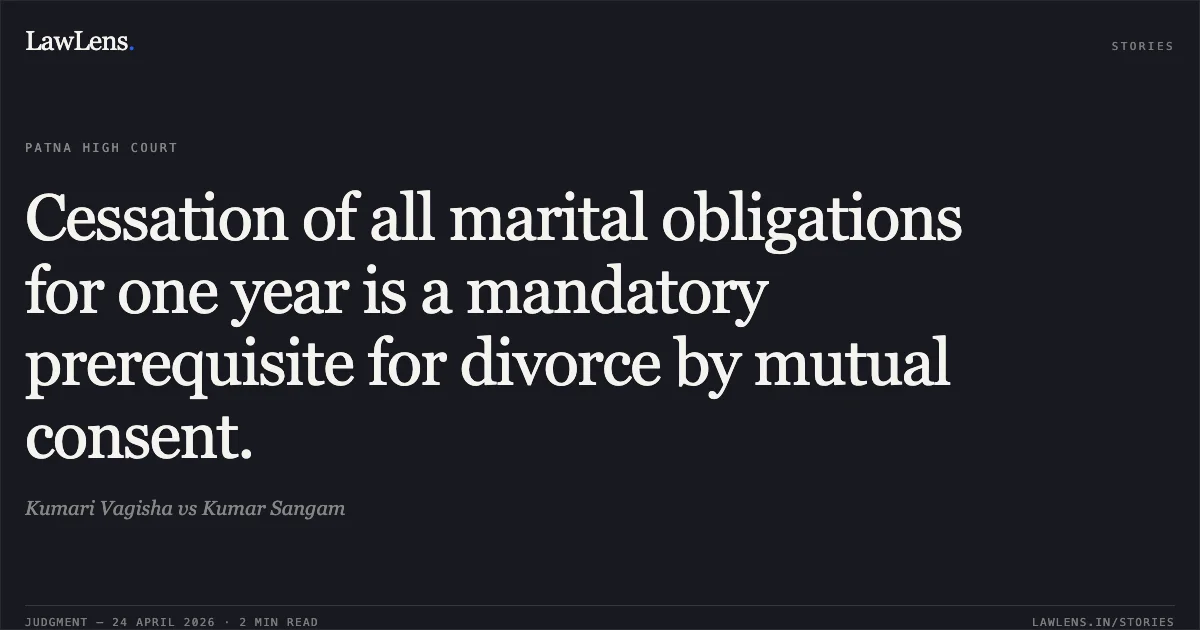
Source reference: p. 6-7The court interpreted "living separately" to mean a complete cessation of marital obligations and the absence of an intention to resume cohabitation, regardless of physical residence.
Source reference: p. 8Additionally, the court applied Section 5 of the Limitation Act to condone a 410-day delay in filing the appeal.
Source reference: p. 1Reasoning
The High Court observed that Section 13(B) requires the court to be "satisfied" after inquiry that the averments in the petition are true.
Source reference: p. 7In this case, while the written petition claimed a one-year separation, the husband’s oral deposition (AW-1) explicitly admitted to fulfilling marital obligations on 15.03.2023—barely two months before the filing of the suit on 11.05.2023.
Source reference: p. 8The court reasoned that "living separately" is a legal status defined by the absence of conjugal life; the husband's admission proved that marital relations existed within the statutory one-year "cooling period".
Source reference: p. 8Consequently, the court held that the jurisdictional fact required for a Section 13(B) decree—a continuous one-year separation—was absent, rendering the Family Court's dismissal legally sound.
Source reference: p. 8Holding
The Court dismissed the miscellaneous appeal, affirming the Family Court's judgment that the statutory requirement of one-year separation was not met due to the admission of conjugal relations in March 2023.
However, noting a new joint compromise filed on 17.02.2026 during the appeal, the Court granted the parties liberty to file a fresh petition under Section 13(B) before the Family Court within four weeks, directing the lower court to decide the fresh petition on its merits without being prejudiced by the previous dismissal.
Source reference: p. 9Acts & Sections Cited
1 provisions across 1 statute referred to in this judgment. Each provision opens on LawLens.
Limitation Act, 19631
Original Court PDF
Kumari VagishavsKumar Sangam
Click to open original judgment
Original judgment, available to read, download and summarize on LawLens.in