01Facts
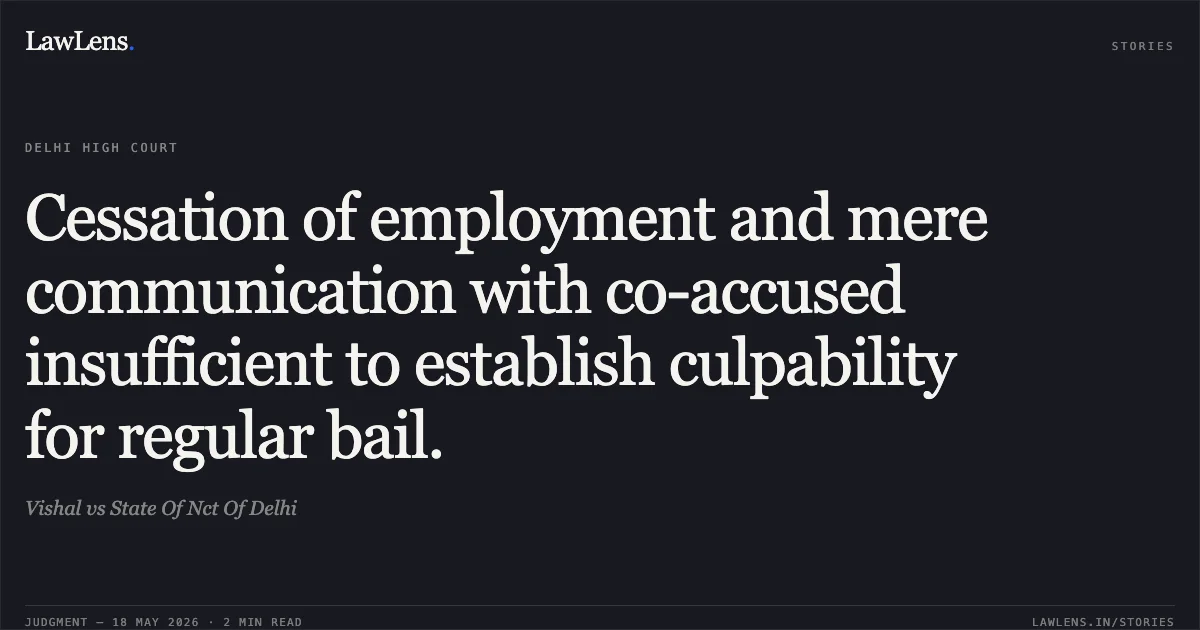
The Petitioner, a peon in a private company, sought regular bail in connection with e-FIR No. 80014479/2025 where it was alleged he acted as a conduit by tipping off co-accused persons about two company officials carrying Rs. 25,31,000/-, which led to a robbery.
pp. 1-2The Petitioner argued that he joined the investigation voluntarily under Section 179 BNSS, no recovery was made from him, and he had been incarcerated for over 15 months.
p. 2The State opposed bail, citing a Facebook Messenger call between the Petitioner and a co-accused and suggesting his resignation from work post-incident indicated guilt.
p. 202Issues
i.1. Whether the Petitioner is entitled to regular bail considering the nature of the evidence and the duration of his custody.
p. 3ii.2. Whether the post-offence conduct of the Petitioner (resigning from his job) and the withdrawal of a co-accused’s bail application are sufficient grounds to deny bail.
pp. 2-303Law Applied
The court's decision was governed by the principles of bail under the Bhartiya Nagarik Suraksha Sanhita (BNSS), specifically regarding the deprivation of personal liberty.
p. 3The Petitioner was charged under Sections 310(2), 317(3), and 61(2) of the Bhartiya Nyaya Sanhita (BNS).
p. 1Post-offence conduct must be weighed against reasonable alternative explanations, such as fear of police, rather than an automatic presumption of culpability.
p. 3Provisions in the judgment · 4 · Linked ones open on LawLens
Bharatiya Nyaya Sanhita, 2023 Section 61Section 310Section 317
Bharatiya Nagarik Suraksha Sanhita, 2023 Section 179
04Reasoning
Regarding the eye-witnesses scheduled for examination, the court noted that their testimony would not implicate the Petitioner given his specific role as an alleged "tipper-off" rather than an active participant at the crime scene; thus, the status of the co-accused's bail was irrelevant.
pp. 2-3The court dismissed the State’s argument regarding the Petitioner’s resignation, reasoning that a low-level employee (peon) might stop going to work out of fear of police involvement rather than guilt.
p. 3The court observed that the only technical evidence—a Facebook Messenger call—was still pending forensic analysis, and no recovery had been made from the Petitioner.
pp. 2-305Holding
The Court answered the issues in favor of the Petitioner, holding that there was no reason to further deprive him of his liberty.
p. 3The bail application was allowed, and the Petitioner was ordered to be released on bail subject to a personal bond of Rs. 10,000/- with one surety in the like amount to the satisfaction of the Trial Court.
p. 3Original Court PDF
VishalvsState Of Nct Of Delhi
Click to open original judgment
Original judgment, available to read, download and summarize on LawLens.in