Facts
The Petitioner (Sports Authority of India) challenged the Labour Court Award dated January 8, 2003, which held that the late Respondent (Workman) was a "workman" and was illegally terminated in violation of Section 25F of the Industrial Disputes Act, 1947
Source reference: p. 1-2The Workman was appointed as a Supervisor on an ad hoc and contractual basis through various appointment letters, the last being effective from December 11, 1989, to January 10, 1990, on a salary of Rs. 1,800/-
Source reference: p. 2-3His services ceased on January 24, 1990
Source reference: p. 3The Workman alleged his duties were clerical/manual (accounts, liaison, electronic touchpad maintenance) despite the "Supervisor" designation
Source reference: p. 3The Petitioner contended the Workman was a supervisor excluded from Section 2(s) and that the cessation of service was a non-renewal of contract under Section 2(oo)(bb)
Source reference: p. 4-5Issues
1. Whether the Respondent was a "Workman" under Section 2(s) of the Industrial Disputes Act, 1947, despite his designation as a Supervisor
Source reference: p. 7, para. 5(a)2. Whether the cessation of employment was covered by the contractual exception under Section 2(oo)(bb) of the Act
Source reference: p. 7, para. 5(b)3. Whether the Labour Court erred in finding the Respondent had completed 240 days of continuous service in the absence of specific pleading or evidence
Source reference: p. 7, para. 5(c)Law Applied
The Court applied Section 2(s) of the Industrial Disputes Act, which defines "workman," highlighting that designation is not determinative; the dominant nature of duties governs the status (Arkal Govind Raj Rao v. Ciba Geigy of India Ltd.)
Source reference: p. 11-12It relied on Section 2(oo)(bb), which excludes termination resulting from non-renewal of a fixed-term contract from the definition of "retrenchment," as upheld in State of Rajasthan v. Rameshwar Lal Gahlot and M. Venugopal v. LIC
Source reference: p. 14-15For Section 25F protection, the court applied Section 25B regarding "continuous service," noting the burden of proving 240 days of work lies heavily on the workman as per R.M. Yellatti v. Assistant Executive Engineer and Manager, RBI v. S. Mani
Source reference: p. 18-20Reasoning
On the first issue, the High Court upheld the Labour Court’s finding that the Respondent was a "workman," noting the Petitioner failed to produce evidence that the Respondent exercised administrative or managerial powers like sanctioning leave or initiating discipline
Source reference: p. 12-13On the second issue, the Court found the Labour Court failed to determine if the cessation was a "retrenchment" or a contract expiry under Section 2(oo)(bb)
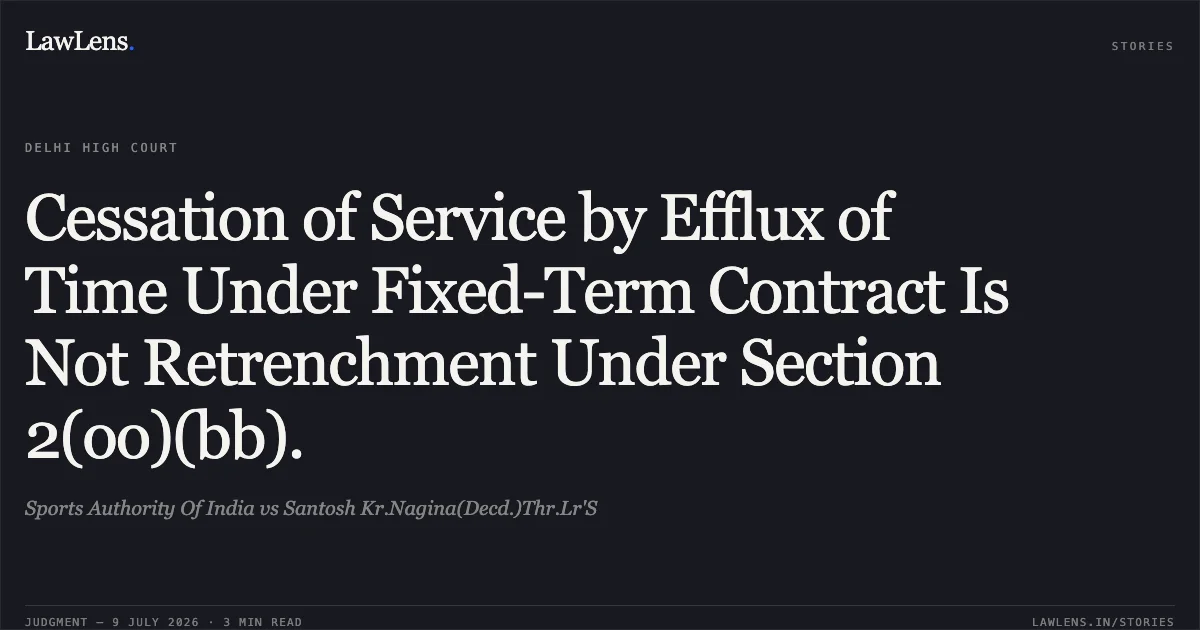
Source reference: p. 15The court observed that the Respondent’s appointment ended by efflux of time, and in the absence of any finding that the contracts were a "sham" or "mala fide," the exception under Section 2(oo)(bb) applied
Source reference: p. 16-17Regarding the third issue, the Court found the Labour Court's finding of 240 days of service to be perverse as the Workman’s Statement of Claim lacked specific pleadings and no cogent evidence was adduced to prove 240 days of work in the twelve months preceding termination
Source reference: p. 22-23Pleadings cannot substitute for proof
Source reference: p. 20Holding
The Court held that while the Respondent was a "workman", he was not entitled to Section 25F protection because his termination fell under the Section 2(oo)(bb) exception for contractual expiry and thus did not constitute "retrenchment", and he failed to discharge the burden of proof to show 240 days of continuous service
The Court concluded the Labour Court's findings were unsustainable in law. The Writ Petition was allowed, and the Award dated January 8, 2003, was set aside
Source reference: p. 25-26Acts & Sections Cited
3 provisions across 1 statute referred to in this judgment. Linked provisions open on LawLens.
Industrial Disputes Act, 19473
Original Court PDF
Sports Authority Of IndiavsSantosh Kr.Nagina(Decd.)Thr.Lr'S
Click to open original judgment
Original judgment, available to read, download and summarize on LawLens.in


