Facts
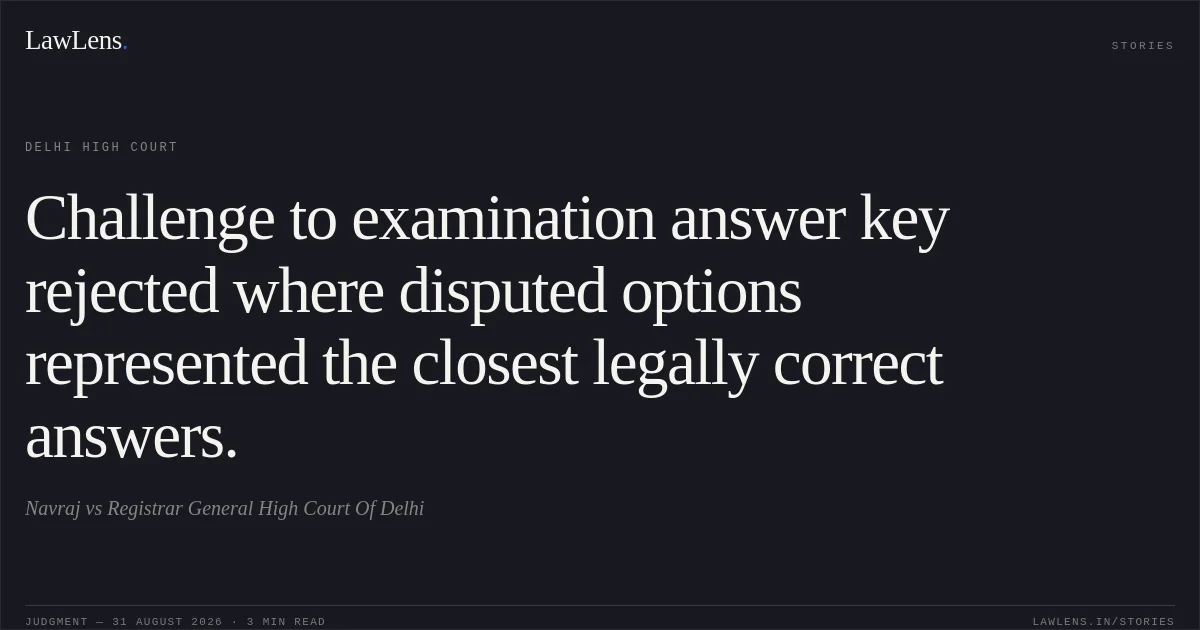
The petitioner challenged the respondent’s decision dated 12 August 2026 concerning objections to the model answer keys for the Delhi Higher Judicial Services Preliminary Examination, 2026, conducted on 26 July 2026. Although 11 questions were deleted, the answer-key entries for Questions 65, 73 and 81 of Booklet Series ‘B’ were retained. On the basis of the final evaluation, the petitioner secured 70.50 marks, below the cut-off for admission to the Mains Examination, and was consequently excluded from the shortlist
Source reference: pp. 1–3, paras. 1–2The petitioner sought correction or deletion of the disputed questions, re-computation of marks, and provisional permission to appear in the Mains Examination
Source reference: pp. 1–3, para. 1Issues
Whether Option (4)—“None of the above”—was the correct answer to Question 65 concerning the categories of offences under Section 343 of the Bharatiya Nagarik Suraksha Sanhita, 2023 (“BNSS”) for which pardon may be tendered
Source reference: pp. 3–5, paras. 3–8Whether Question 73, concerning the court competent to try a POCSO offence committed by a child, was vague or incapable of yielding a single objectively correct answer, or whether “Children’s Court” was the correct answer
Source reference: pp. 3, 5–6, paras. 3, 9–11Whether, in the absence of a prior Test Identification Parade (“TIP”), the identification of unknown accused persons in court could be relied upon, and whether Option (3) was the correct answer to Question 81
Source reference: pp. 3, 6–9, paras. 3, 12–15Whether the petitioner was entitled to consequential re-computation of marks and inclusion in the shortlist for the Mains Examination
Source reference: pp. 1–3, 10, paras. 1–2, 16Law Applied
The Court applied Section 343(2)(a) of the BNSS, which provides that the pardon provision applies to offences triable exclusively by the Court of Session or by a Special Judge appointed under any other law
Source reference: p. 4, paras. 4–6It considered the statutory scheme of the Juvenile Justice (Care and Protection of Children) Act, 2015, including the Juvenile Justice Board’s ordinary jurisdiction and the circumstances under Sections 15 and 18 in which a matter may proceed before the Children’s Court
Source reference: pp. 5–6, paras. 9–11On evidentiary identification, the Court relied on Malkhansingh v. State of Madhya Pradesh, (2003) 5 SCC 746, and V.C. Shukla v. State (Delhi Administration), (1980) 2 SCC 665, for the principle that identification for the first time in court by a witness who is a stranger to the accused, without prior TIP, may have little or no evidentiary value
Source reference: pp. 7–9, paras. 13–14The Court distinguished the principle stated in Harjindra Singh v. State of U.P., 2026 SCC OnLine SC 966, that absence of a TIP is not invariably fatal where the witness had an opportunity to observe or interact with the accused
Source reference: pp. 6–8, paras. 12–14Reasoning
Regarding Question 65, the Court held that, among the available options, Option (2)—offences triable exclusively by the Court of Session—was the closest and necessarily correct answer, notwithstanding that Section 343(2)(a) also refers to Special Judges; the omission of that additional statutory category did not make Option (2) incorrect
Source reference: pp. 4–5, paras. 6–8Regarding Question 73, the Court accepted the respondent’s position that, because the offence was stated to be under the POCSO Act, the competent forum was the Children’s Court, and rejected the petitioner’s contention that the question was incomplete for not specifying the offence, age, punishment or classification
Source reference: pp. 5–6, paras. 9–11Regarding Question 81, the Court treated the accused as unknown offenders and distinguished cases where the witness had prior acquaintance or a meaningful opportunity to observe the accused. Applying Malkhansingh and V.C. Shukla, it found that first-time identification of total strangers in court without a prior TIP could not be treated as reliably probative; accordingly, the petitioner’s challenge to the answer key was rejected
Source reference: pp. 6–9, paras. 12–15Holding
The Court rejected all challenges to Questions 65, 73 and 81 and upheld the respondent’s answer-key decisions
Since no correction or deletion was warranted, the petitioner was not entitled to re-computation of marks, inclusion in the Mains shortlist, or provisional participation in the Mains Examination. The writ petition and pending application were dismissed for lack of merit
Source reference: p. 10, para. 16Acts & Sections Cited
3 provisions across 2 statutes referred to in this judgment. Each provision opens on LawLens.
Bharatiya Nagarik Suraksha Sanhita, 20231
Juvenile Justice (Care and Protection of Children) Act, 2015.2
Original Court PDF
NavrajvsRegistrar General High Court Of Delhi
Click to open original judgment
Original judgment, available to read, download and summarize on LawLens.in