Facts
On 16 June 2003, the Food Inspector inspected the premises of Aakash Sales and purchased three 700-ml bottles of “Gluco-C Syrup” for ₹114 in the presence of panch witnesses.
Source reference: p.2; para.8After obtaining sanction under Section 20 of the Prevention of Food Adulteration Act, 1954 (“PFA Act”), the Food Inspector filed Criminal Case No.3360 of 2003, and the Public Analyst’s report opined that the product was misbranded under Sections 2(ix)(e) and 2(ix)(k) of the PFA Act read with Rule 40 of the PFA Rules.
Source reference: p.2; p.5, para.5.1The Trial Court convicted the accused on 3 July 2010 for breach of Rule 40 and sentenced them to three months’ simple imprisonment and a fine of ₹1,000, with a default sentence of five days’ simple imprisonment.
Source reference: p.3; para.9In Criminal Appeal No.99 of 2010, the Sessions Court set aside the conviction and acquitted the accused on 21 October 2011, holding that the prosecution had failed to prove the charge beyond reasonable doubt.
Source reference: p.3; para.2.6The State challenged that acquittal before the High Court under Section 378(4) of the Code of Criminal Procedure, 1973.
Source reference: p.1; para.1Issues
Whether the Appellate Court committed an error in setting aside the conviction and acquitting the respondents-accused?
Source reference: p.7, para.7Whether the Appellate Court erred in appreciating the oral and documentary evidence led by the prosecution?
Source reference: p.7, para.7Whether the impugned judgment of acquittal suffered from illegality or perversity warranting interference by the High Court?
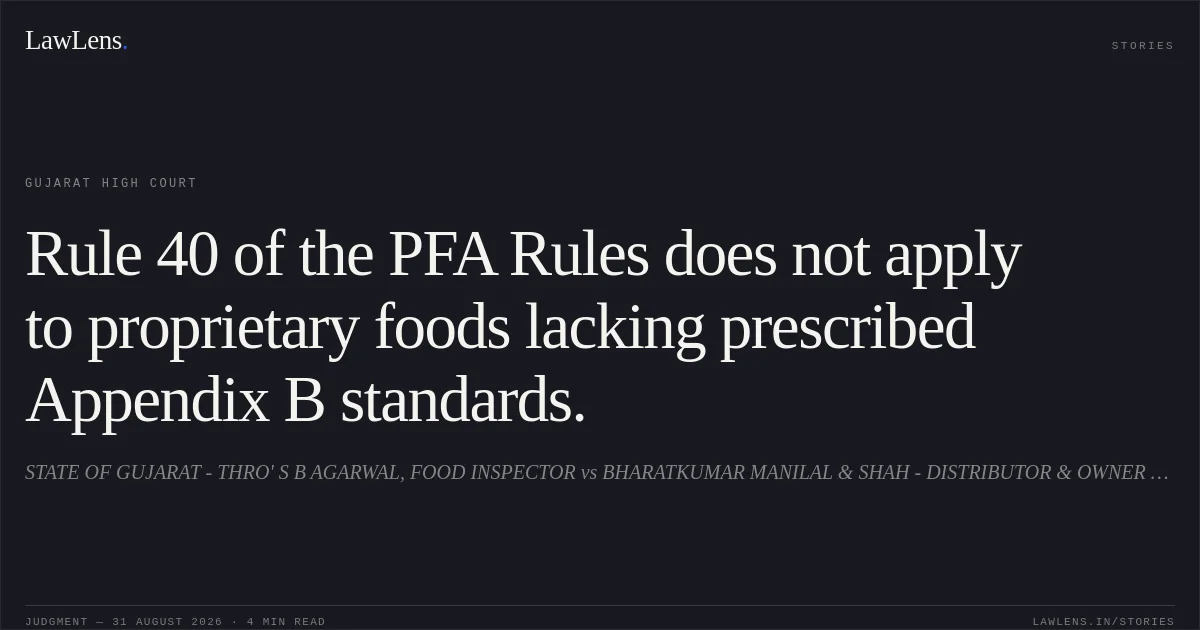
Source reference: p.7, para.7Whether “Gluco-C Syrup” was a proprietary food not governed by the specific fruit-product requirements under Rule 40(2) of the PFA Rules, and whether the alleged conduct constituted an offence under Rule 40?
Source reference: pp.10–12, paras.15–18Law Applied
The Court considered Rule 40 of the PFA Rules, particularly Rule 40(2), which prohibits the misleading description or pictorial representation of a food product as containing fruit when it does not contain the prescribed fruit juice, pulp, or content.
Source reference: p.9, para.11It applied Sections 2(ix)(e) and 2(ix)(k) of the PFA Act, under which an article is misbranded where a false claim is made on its label or where it is not labelled in accordance with the Act or Rules.
Source reference: pp.10–11, paras.13–14The Court also relied on Rule 37-A, defining “proprietary food” as food not standardised under Appendix B, and held that such a product is not subject to the specific standards applicable to standardised fruit products.
Source reference: p.11, para.16On appeals against acquittal, the Court applied the principles in Chandrappa v. State of Karnataka, (2007) 4 SCC 415; Rajesh Prasad v. State of Bihar, (2022) 3 SCC 471; Babu Sahebagouda Rudragoudar v. State of Karnataka, (2024) 8 SCC 149; and Ramesh v. State of Karnataka, (2024) 9 SCC 169, namely that although an appellate court may fully reappreciate the evidence, the accused benefit from a strengthened double presumption of innocence and an acquittal should not be disturbed where two reasonable conclusions are possible.
Source reference: pp.15–17, paras.25–28Reasoning
The Court found that “Gluco-C Syrup” did not fall within any category of fruit product standardised under Appendix B and was therefore a proprietary food under Rule 37-A.
Source reference: pp.10–12, paras.15–16Consequently, the specific requirements in Rule 40(2)(i) concerning the prescribed quantity of fruit juice, pulp, or fruit content were held inapplicable.
Source reference: pp.10–12, paras.15–16The Court further reasoned that any allegation arising from a misleading label or pictorial representation would, if established, fall under the misbranding provisions in Sections 2(ix)(e) and (k) of the PFA Act rather than constitute the offence charged under Rule 40.
Source reference: p.12, para.18The Public Analyst’s report showed the product’s ingredients but did not establish adulteration or the presence of foreign material.
Source reference: p.11, para.16On the evidentiary record, the prosecution failed to produce credible and convincing evidence connecting the accused with the charged offence beyond reasonable doubt.
Source reference: p.17, paras.29–30Applying the restrictive standard governing interference with an acquittal, the Court concluded that the Sessions Court’s view was a reasonable and legally sustainable view, not perverse or manifestly erroneous.
Source reference: pp.14–18, paras.23–30Holding
The High Court answered the issues against the State and held that the Appellate Court had committed no error of law or fact in acquitting the respondents.
The prosecution failed to prove the charge under Rule 40 of the PFA Rules beyond reasonable doubt, and “Gluco-C Syrup” was treated as proprietary food for which the specific Rule 40(2) fruit-product requirements did not apply.
Source reference: pp.11–14, paras.16–24The State’s appeal was dismissed, the judgment of acquittal dated 21 October 2011 was confirmed, the respondents’ bail bonds were cancelled, and the record and proceedings were directed to be returned to the concerned court.
Source reference: p.18, para.31Acts & Sections Cited
3 provisions across 1 statute referred to in this judgment. Each provision opens on LawLens.
Code of Criminal Procedure, 19733
Original Court PDF
STATE OF GUJARAT - THRO' S B AGARWAL, FOOD INSPECTORvsBHARATKUMAR MANILAL & SHAH - DISTRIBUTOR & OWNER OF C/O. AKA
Click to open original judgment
Original judgment, available to read, download and summarize on LawLens.in