Facts
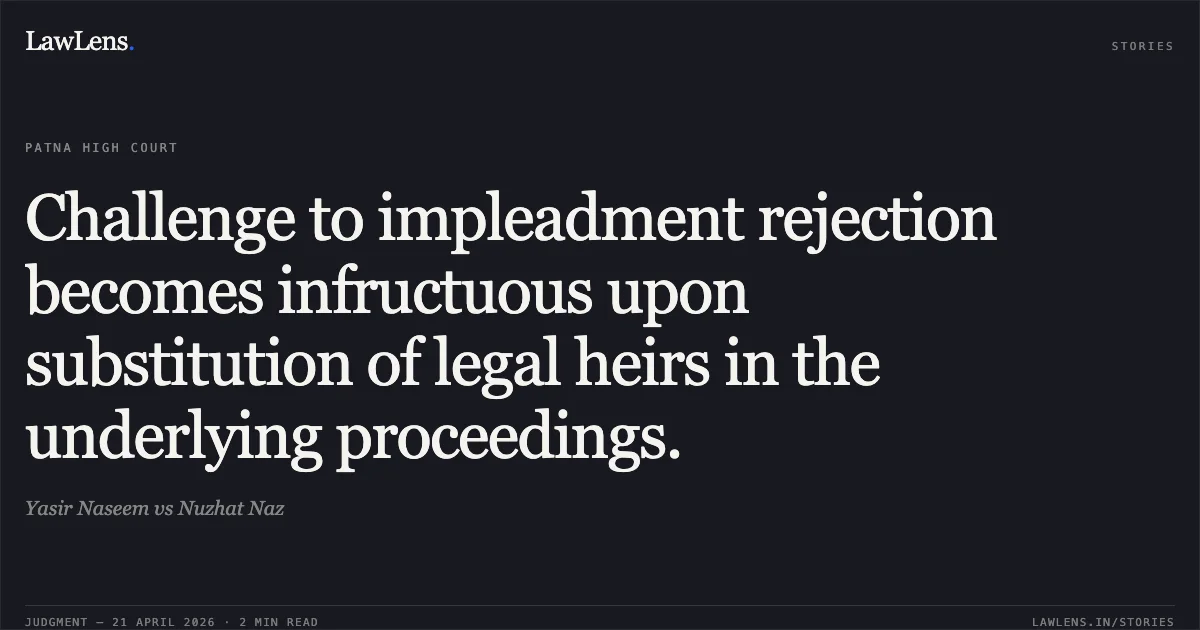
The petitioner, Yasir Naseem, filed an application under Order 1 Rule 10 of the Code of Civil Procedure (CPC) for impleadment as a party respondent in Misc. Appeal No. 01/2002, pending before the Additional District Judge-4, Patna
Source reference: para 2-3The lower court rejected the application on 17.12.2015, observing that the intervention was based on forged and fabricated documents
Source reference: para 3, 6During the pendency of the subsequent challenge in the High Court, Respondent No. 2 (the petitioner’s mother) died, and the petitioner and his brothers were substituted as her legal heirs (Respondents 2.1 to 2.4)
Source reference: para 4Subsequently, the petitioner himself died on 21.06.2020, leading to further interlocutory applications for substitution by his brothers
Source reference: para 4, 6Issues
1. Whether the petition challenging the rejection of an impleadment application survives after the petitioner has already been substituted as a legal heir of a deceased respondent in the same lower court proceedings?
Source reference: para 52. Whether the lower court’s observation regarding the forged nature of the petitioner’s documents was legally sustainable without a formal trial of their veracity?
Source reference: para 7Law Applied
The court considered the procedural requirements of Order 1 Rule 10 of the CPC regarding the addition of necessary and proper parties
Source reference: para 2It further applied the principle of "infructuous litigation," wherein a legal challenge loses its practical significance or necessity due to intervening events—specifically, the death of parties and the subsequent devolution of interest to legal heirs who are already represented on record
Source reference: para 5, 8Reasoning
The High Court observed that the primary relief sought—impleadment—had effectively been rendered moot.
Source reference: para 5Since the original Respondent No. 2 (the petitioner’s mother) was a party to the appeal and had died, her legal heirs, including the petitioner, would necessarily be substituted in her place.
Source reference: para 5Consequently, the petitioner's status as a party was secured through inheritance, making the independent impleadment application redundant.
Source reference: para 5, 8Regarding the petitioner's concern over the lower court's finding of "forged documents," the High Court noted the respondents' concession that the veracity of the documents had never been formally tested.
Source reference: para 7The court found that the lower court had no occasion to record a final finding on forgery at the impleadment stage, thereby neutralizing the potential prejudice.
Source reference: para 7, 8Holding
The High Court held that the matter had become infructuous due to the death of Respondent No. 2 and the petitioner, as the legal heirs were already entitled to substitution in the lower court.
The civil miscellaneous petition was disposed of accordingly, alongside all pending interlocutory applications.
Source reference: para 8, 9The court effectively set aside the concern regarding the "forged" observation by noting it was made without testing the veracity of the evidence.
Source reference: para 7Acts & Sections Cited
1 provisions across 1 statute referred to in this judgment. Each provision opens on LawLens.
Code of Civil Procedure, 19081
Original Court PDF
Yasir NaseemvsNuzhat Naz
Click to open original judgment
Original judgment, available to read, download and summarize on LawLens.in