Facts
The petitioner challenged a fresh show-cause notice in Form GST MOV-10 and an adjudication order in Form GST MOV-11 confiscating goods and a conveyance under Section 130 of the CGST Act.
Source reference: paras. 2–2.3The notice and order followed an earlier round of litigation in which the High Court had set aside the prior proceedings and remanded the matter for reconsideration.
Source reference: paras. 2–2.3On remand, the petitioner received a fresh notice, was asked to attend a personal hearing, and filed a written reply; the adjudicating authority then confirmed the proposed demand.
Source reference: paras. 2–2.3The petitioner alleged, among other things, that the officer lacked authorization under Rule 138B and that relevant documents had not been supplied.
Source reference: paras. 3–5.1The State relied on the petitioner’s statutory appeal under Section 107.
Source reference: paras. 3–5.1Issues
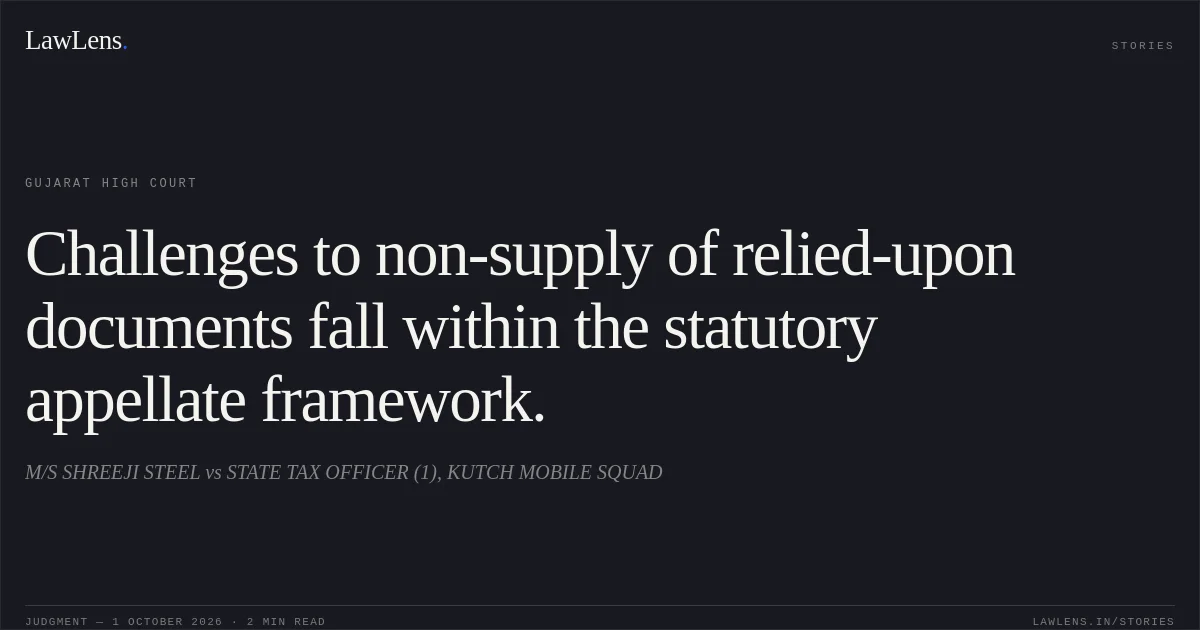
1. Whether the High Court should entertain the writ petition despite the alternative statutory appeal under Section 107, in light of the alleged jurisdictional and natural-justice defects
Source reference: paras. 4, 7–92. Whether the physical verification and ensuing proceedings violated Rule 138B because the officer was not duly authorized
Source reference: paras. 3, 7.13. Whether the alleged non-supply of relied-upon documents justified writ intervention, rather than being pursued in the statutory appeal
Source reference: paras. 3.2, 9–11Law Applied
Section 107 of the CGST Act provides a statutory appellate remedy.
Source reference: para. 8Under Assistant Commissioner of State Tax v. Commercial Steel Ltd., an alternative remedy does not absolutely bar a petition under Article 226, but writ intervention is ordinarily confined to exceptional cases involving breach of fundamental rights, violation of natural justice, excess of jurisdiction, or a challenge to the vires of legislation.
Source reference: para. 8Rule 138B governs verification of documents and conveyances and requires physical verification to be carried out by the proper officer authorized by the Commissioner or an empowered officer; its proviso permits another officer to verify a specific conveyance upon specified information of tax evasion and the requisite approval.
Source reference: para. 7.1; pp. 7–9Complaints about non-supply of relied-upon documents or the adjudicating authority’s treatment of the record may be examined through the statutory appellate process and, without more, do not warrant bypassing that remedy.
Source reference: paras. 10–11Reasoning
The Court found no Rule 138B violation on the record, concluding that the physical verification had been conducted by a proper officer authorized by the Commissioner.
Source reference: para. 7.1It also noted that the petitioner had received the relevant forms and documents, was given an opportunity to attend a hearing, and had filed a reply that the authority considered before passing a detailed order.
Source reference: paras. 7.1, 9The alleged non-supply or non-consideration of documents concerned the adjudicatory record and could be raised in an appeal; the Court therefore found none of the Commercial Steel exceptions established.
Source reference: paras. 8–11Holding
The Court dismissed the writ petition, holding that the petitioner had an efficacious alternative remedy under Section 107 and had not shown a basis for exceptional intervention under Article 226.
The petitioner remained at liberty to pursue the statutory appeal; no relief was granted in the writ petition.
Source reference: paras. 9, 12Acts & Sections Cited
7 provisions across 3 statutes referred to in this judgment. Each provision opens on LawLens.
Central Goods and Services Tax Act, 20174
Integrated Goods and Services Tax Act, 20171
Original Court PDF
M/S SHREEJI STEELvsSTATE TAX OFFICER (1), KUTCH MOBILE SQUAD
Click to open original judgment
Original judgment, available to read, download and summarize on LawLens.in