01Facts
The petitioner challenged a notice dated 12 August 2026 issued by Respondent No. 4 and sought protection against coercive action, including attachment of her residential house at Navratan Bagh Colony, Indore.
¶ 1She contended that proceedings before the competent Consumer Court had concluded, an appeal filed by the bank was pending, and execution proceedings had been initiated by her.
¶ 3According to the petitioner, despite the issuance of a non-bailable warrant against the bank’s non-appearance, the bank initiated proceedings under the Securitisation and Reconstruction of Financial Assets and Enforcement of Security Interest Act, 2002 (“SARFAESI Act”) and obtained an order under Section 14 without issuing her notice under the relevant provisions.
¶ 302Issues
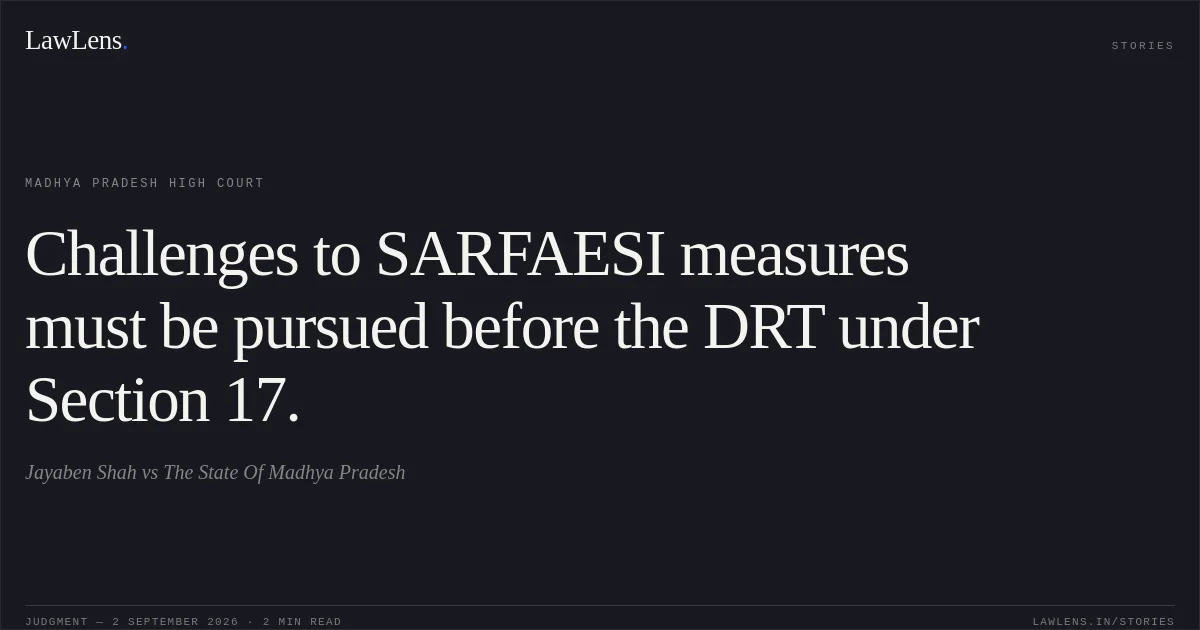
i.Whether the petitioner’s challenge to the bank’s measures under the SARFAESI Act, including the action pursuant to Section 14, should be entertained under Article 226 despite the availability of a statutory remedy before the DRT under Section 17.
¶ 6–8ii.Whether the petitioner was entitled to relief restraining the respondents from taking coercive action against or attaching her secured residential property.
¶ 103Law Applied
The Court applied Section 14 of the SARFAESI Act, which authorises the Chief Metropolitan Magistrate or District Magistrate to assist a secured creditor in taking possession of secured assets, subject to the statutory requirements, including the authorised officer’s affidavit and compliance with Section 13 and the applicable rules.
¶ 5Section 17 provides that any person, including the borrower, aggrieved by measures taken under Section 13(4) may apply to the DRT within forty-five days; the DRT may examine the legality of the measures, declare them invalid, restore possession, and issue appropriate directions.
¶ 7The Court followed the settled principle that the SARFAESI Act is a self-contained code and that a writ petition ordinarily should not be entertained where an alternative, efficacious statutory remedy is available, absent exceptional circumstances.
¶ 6Provisions in the judgment · 3 · Linked ones open on LawLens
Securitisation and Reconstruction of Financial Assets and Enforcement of Security Interest Act, 2002 Section 13Section 14Section 17
04Reasoning
The petitioner’s grievance directly concerned the bank’s initiation and continuation of recovery measures under the SARFAESI Act, including the Section 14 possession proceedings.
¶ 3Since Section 17 expressly permits “any person,” including a borrower or other aggrieved person, to challenge measures taken under Section 13(4), the DRT was competent to examine whether the bank had complied with the SARFAESI Act and the Rules and to grant consequential relief, including restoration of possession.
¶ 7The Court therefore held that the petitioner had an alternative and efficacious remedy.
¶ 6–8Her reliance on the pending consumer proceedings and alleged absence of notice did not justify bypassing the statutory mechanism, particularly when the challenge was to SARFAESI measures.
¶ 6–805Holding
The High Court declined to exercise its writ jurisdiction under Article 226 on account of the available remedy under Section 17 of the SARFAESI Act.
¶ 8The petition challenging the notice dated 12 August 2026 and seeking protection against attachment or other coercive action was dismissed, leaving the petitioner to pursue her remedy before the DRT.
¶ 8Original Court PDF
Jayaben ShahvsThe State Of Madhya Pradesh
Click to open original judgment
Original judgment, available to read, download and summarize on LawLens.in