Facts
The petitioner filed a petition under Section 528 of the Bharatiya Nagarik Suraksha Sanhita (B.N.S.S.), 2023, seeking to quash Charge-sheet No. 451/2025 and FIR No. 357/2025
Source reference: para 2The FIR was registered following the death of Omprakash Verma due to electrocution
Source reference: para 4Investigations revealed that the petitioner, along with co-accused persons, allegedly conspired to lay live electric wires connected to a nearby temple to trap wild animals
Source reference: para 4It was alleged that the victim accidentally touched the wire and died, after which the accused attempted to destroy evidence by concealing the wires
Source reference: para 4The petitioner contended that his involvement was based solely on the memorandum statement of a co-accused with no independent recovery, making it inadmissible under Section 23 of the Bhartiya Sakshya Adhiniyam, 2023
Source reference: para 5He previously filed a quashing petition (Cr.M.P. No. 474/2026) which was dismissed with liberty to challenge the charge-sheet once filed
Source reference: para 3Issues
1. Whether the FIR and subsequent charge-sheet against the petitioner should be quashed on the grounds that the allegations are based solely on the inadmissible statement of a co-accused
Source reference: para 52. Whether the material on record prima facie discloses the commission of a cognizable offence justifying the continuation of criminal proceedings
Source reference: para 8-9Law Applied
The Court primarily applied Section 528 of the B.N.S.S., 2023, regarding the inherent powers of the High Court to prevent abuse of process
Source reference: para 2, 9It relied on the landmark precedent M/s Neeharika Infrastructure Pvt. Ltd. v. State of Maharashtra, which established that the power to quash should be exercised sparingly and only in the "rarest of rare cases," emphasizing that the court must not evaluate the reliability or merits of allegations at the investigation stage but only whether a cognizable offence is disclosed
Source reference: para 6, 9The court also considered Sections 105 (culpable homicide not amounting to murder), 238(B) (causing disappearance of evidence), and 3(5) (common intention) of the Bharatiya Nyaya Sanhita (B.N.S.)
Source reference: para 4Reasoning
The Court observed that while the petitioner claimed his implication was based only on a co-accused's statement, the case diary contained additional evidence
Source reference: para 10Specifically, the statements of witnesses Sunil, Narayan, and Dilip prima facie established the petitioner’s active participation, including allegations that he directed his nephew to connect the wires and provided liquor to the other accused during the act
Source reference: para 10Applying the Neeharika principle, the Court held that it cannot conduct a mini-trial or inquire into the reliability of allegations at this stage
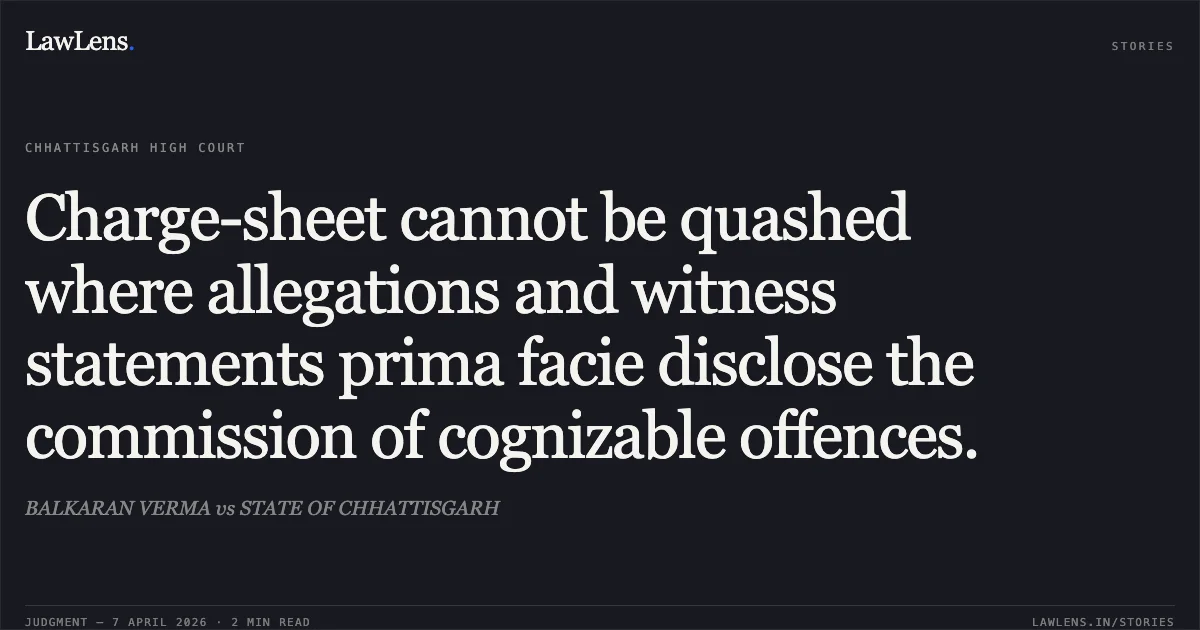
Source reference: para 9, 11Since the material annexed to the charge-sheet suggested the petitioner’s involvement in spreading live wires and common intention, the legal threshold for quashing was not met, as the allegations, taken at face value, constitute the charged offences
Source reference: para 10-11Holding
The High Court dismissed the petition, holding that there was sufficient material to proceed with the trial against the petitioner
The Court concluded that it could not be said that no offence was disclosed, and therefore, interference with the charge-sheet was not warranted
Source reference: para 11The prayer for quashing Charge-sheet No. 451/2025 and FIR No. 357/2025 was denied
Source reference: para 12Acts & Sections Cited
6 provisions across 4 statutes referred to in this judgment. Each provision opens on LawLens.
Bharatiya Nagarik Suraksha Sanhita, 20231
Bharatiya Nyaya Sanhita, 20233
Bharatiya Sakshya Adhiniyam, 20231
Code of Criminal Procedure, 19731
Original Court PDF
BALKARAN VERMAvsSTATE OF CHHATTISGARH
Click to open original judgment
Original judgment, available to read, download and summarize on LawLens.in