Facts
The applicant, an Assistant Superintendent of Post Offices (ASPO), was served a charge memorandum dated 06.07.2021 alleging irregular engagements of two individuals as GDSMD based on fake certificates during his tenure between 2012–2015.
Source reference: p. 3The memorandum and the appointment of the Inquiry Officer (IO) and Presenting Officer (PO) were approved by the Director Postal Services (DPS), Agra.
Source reference: p. 3Following an inquiry that proved the charges, the Disciplinary Authority dismissed the applicant on 18.01.2023.
Source reference: p. 3On appeal, the Appellate Authority (AA) modified the penalty to "compulsory retirement" on 04.09.2024, notably recording that no mala fide intention was established against the applicant.
Source reference: p. 3-4The applicant challenged these orders asserting that the DPS lacked competence to initiate proceedings for major penalties against an ASPO.
Source reference: p. 4Issues
1. Whether the disciplinary proceedings and charge memorandum were vitiated because they were approved and issued by an authority (Director Postal Services) incompetent to impose major penalties for the post held by the applicant.
Source reference: p. 6, para 10(i)2. Whether the findings of "irregular engagement" without mala fide intention constitute "misconduct" warranting disciplinary action under the settled principles of law.
Source reference: p. 7, para 10(ii)Law Applied
The Tribunal primarily applied Rule 14 of the CCS (CCA) Rules, 1965, regarding the procedure for imposing major penalties, and Rule 13(2), which clarifies the authority to institute proceedings.
Source reference: p. 9-10Mandate that the Disciplinary Authority competent to impose the penalty must specifically approve the charge memorandum as per Union of India v. B.V. Gopinath (2014) and Sunny Abraham v. Union of India (2022).
Source reference: p. 4, 7-11The ratio from Union of India v. J. Ahmed (1979) establishes that "innocent mistakes," "errors of judgment," or "lack of efficiency" do not ipso facto constitute misconduct unless accompanied by mens rea or gross negligence leading to atrocious consequences.
Source reference: p. 5, 12-14Reasoning
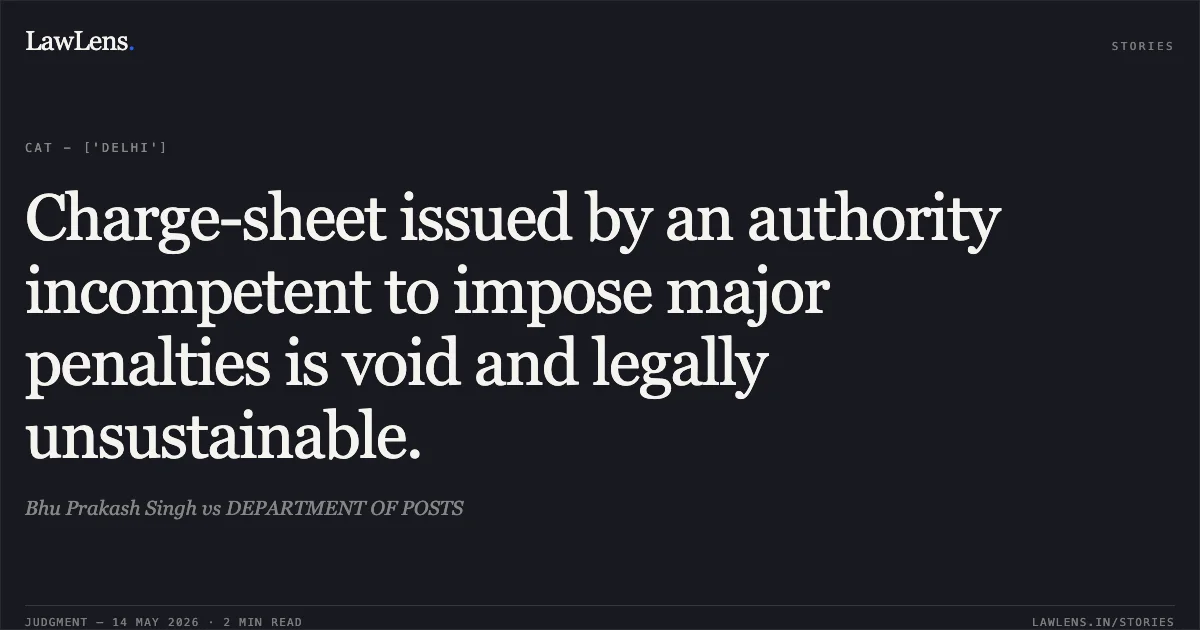
The Tribunal observed that for the post of ASPO, the Chief Post Master General (CPMG) is the competent authority to impose major penalties, whereas the Director Postal Services (Agra) is only competent for minor penalties.
Source reference: p. 6, para 9While a lower authority may "institute" proceedings under Rule 13(2), the actual charge memorandum must be approved by the specific authority competent to impose the intended penalty; failure to do so violates the protections under Article 311(2) of the Constitution.
Source reference: p. 10-12The Tribunal highlighted the Appellate Authority’s own finding that the applicant had no mala fide intention. Under the J. Ahmed doctrine, an irregular appointment resulting from an innocent mistake or negligence, without proven bad faith or irreparable damage, does not meet the legal threshold of "misconduct" required for major penalty proceedings.
Source reference: p. 12-14Holding
The Tribunal allowed the Original Application, holding that the initiation of proceedings by an incompetent authority rendered the process fundamentally defective.
The Tribunal quashed the charge memo dated 06.07.2021 and the penalty orders dated 18.01.2023 and 04.09.2024, and directed the respondents to reinstate the applicant with all consequential financial benefits within six weeks.
Source reference: p. 14, para 15(i)-(iii)Acts & Sections Cited
1 provisions across 1 statute referred to in this judgment. Each provision opens on LawLens.
Administrative Tribunals Act, 19851
Original Court PDF
Bhu Prakash SinghvsDEPARTMENT OF POSTS
Click to open original judgment
Original judgment, available to read, download and summarize on LawLens.in