01Facts
The complainant paid ₹1 lakh as an advance to book a site in the petitioners’ layout.
pp. 3–6After obtaining a legal opinion and RTI information, he alleged that the layout plan supplied to him was forged and that the layout lacked approval.
pp. 3–6The advance was later refunded, but the complainant lodged a police complaint.
pp. 3–6The police registered an FIR against the petitioners under Sections 418, 420, 465, 468, 471 read with Section 34 of the IPC.
pp. 3–6The petitioners sought to quash the complaint and FIR, contending, among other things, that the dispute was civil and the allegations disclosed no criminal offence.
p. 1202Issues
i.1. Whether the complaint and FIR disclosed the essential ingredients of cheating under Sections 418 and 420 IPC against the petitioners.
pp. 12, 15–16ii.2. Whether the allegations disclosed the petitioners’ commission of forgery or knowing use of a forged document under Sections 465, 468 and 471 IPC.
pp. 16–18iii.3. Whether the complainant’s lack of continuing financial loss following repayment, or the civil character of the dispute, warranted quashing the criminal proceedings.
pp. 12–1503Law Applied
Sections 418 and 420 IPC require the relevant dishonest or fraudulent intention and inducement; for cheating, the dishonest intention must exist when the promise is made, and the offence requires inducement and delivery of property (Hira Lal Hari Lal Bhagwati v. CBI).
p. 16Under Sections 463, 465, 468 and 471 IPC, forgery requires making a false document with the requisite intent; Section 468 concerns forgery for the purpose of cheating, and Section 471 requires use of a forged document as genuine with knowledge or reason to believe it is forged.
pp. 16–18Criminal law may generally be set in motion by any person unless a statute provides otherwise (A.R. Antulay v. R.S. Nayak).
pp. 13–15Civil and criminal proceedings may coexist where the alleged acts disclose the essential ingredients of a criminal offence; the court must assess those ingredients.
p. 15The court also relied on Neeharika Infrastructure (P) Ltd. v. State of Maharashtra regarding restraint from assessing the merits of allegations during an investigation.
p. 11Provisions in the judgment · 16 · Linked ones open on LawLens
Indian Penal Code, 1860 Section 34Section 418Section 420Section 463Section 465Section 467Section 468Section 471
Code of Criminal Procedure, 1973 Section 2Section 190Section 195Section 196Section 197Section 198Section 199Section 482
04Reasoning
The court rejected the objection based on the complainant’s locus standi: repayment did not, by itself, extinguish possible criminal liability, and a private complainant need not establish a continuing personal loss to set criminal law in motion.
pp. 12–15It nevertheless found the allegations insufficient against these petitioners.
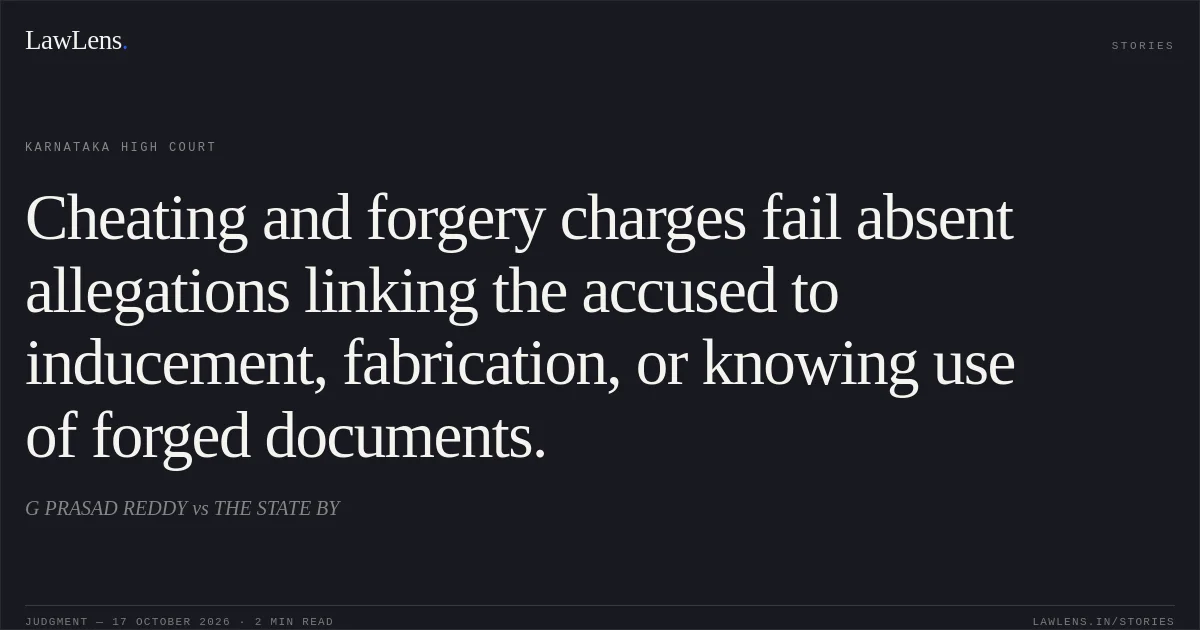
p. 16The complaint described interactions with the firm’s marketing executive and legal officer, but did not allege that the petitioners induced the complainant or that those employees acted on their instructions; the essential ingredients of Sections 418 and 420 IPC were therefore absent.
p. 16Although the complaint alleged that a forged layout plan had been supplied, it did not allege that either petitioner made the false document or knowingly used it as genuine.
pp. 17–18The court accordingly found that the forgery-related offences were not made out against the petitioners.
pp. 17–1805Holding
The High Court allowed the petition and quashed the FIR in Crime No. 109/2020, registered by Kengeri Police Station against the petitioners under Sections 418, 420, 465, 468, 471 read with Section 34 IPC.
p. 18Original Court PDF
G PRASAD REDDYvsTHE STATE BY
Click to open original judgment
Original judgment, available to read, download and summarize on LawLens.in