Facts
The informant alleged that she agreed to purchase 8 decimals and 4 kari of land owned by the petitioners through their power-of-attorney holders, co-accused Deepa Devi and Shravan Kumar Mishra.
Source reference: pp. 2–3The total consideration was ₹22,80,000, against which she allegedly paid ₹12,45,000 through cash and cheques.
Source reference: pp. 2–3Although the parties, including the petitioners, allegedly attended the Registry Office on 22 April 2016, the sale deed was not executed.
Source reference: pp. 2–3Subsequently, a panchayati allegedly resulted in an assurance to refund the money, followed by issuance of a cheque for ₹50,000 by co-accused Shravan Kumar Mishra, which was dishonoured for insufficiency of funds.
Source reference: pp. 2–3Katihar (N) P.S. Case No. 264 of 2017 was registered for offences under Sections 420, 406, 465, 467 and 120B IPC.
Source reference: p. 3After investigation, a charge-sheet was submitted and the Chief Judicial Magistrate, Katihar, took cognizance against the petitioners on 29 January 2018.
Source reference: p. 3The petitioners invoked the High Court’s inherent jurisdiction to quash the cognizance order, contending that they had neither executed the agreement nor received any money, and that the dispute was essentially civil in nature.
Source reference: pp. 3–7Issues
Whether the allegations and materials disclosed the commission of offences under Sections 420, 406, 465, 467 and 120B IPC by the petitioners, who were merely the owners of the land and had not entered into the agreement or received the consideration.
Source reference: paras. 6–7; p. 8Whether the dispute arising from the non-execution of an agreement for sale was essentially civil in nature and whether continuation of the criminal proceedings against the petitioners would constitute an abuse of the process of law.
Source reference: paras. 7–9; pp. 8–16Whether the order dated 29 January 2018 taking cognizance against the petitioners was liable to be quashed under the High Court’s inherent jurisdiction.
Source reference: para. 9; p. 16Law Applied
The Court applied Section 482 CrPC, which empowers the High Court to prevent abuse of the process of any court and secure the ends of justice.
Source reference: pp. 8–10It relied on the principles in Usha Chakraborty v. State of West Bengal, including that a civil dispute may possess a criminal texture, but criminal proceedings should be quashed where a fundamentally civil dispute has been given a criminal cloak and the allegations do not disclose the requisite criminal offence.
Source reference: pp. 8–10The Court also referred to Mohd. Ibrahim v. State of Bihar, which requires deception, dishonest or fraudulent inducement, delivery or retention of property, and resulting or likely harm for cheating under Section 420 IPC.
Source reference: pp. 5–6Vesa Holdings (P) Ltd. v. State of Kerala, holding that mere availability of a civil remedy is not determinative, but cheating requires dishonest intention at the inception of the transaction.
Source reference: p. 10Kunti v. State of U.P., reiterating that mere breach of contract does not constitute cheating absent fraudulent or dishonest intention from the beginning.
Source reference: pp. 6–7The Court further considered the quashing principles in State of Haryana v. Bhajan Lal and the cautionary principles governing Section 482 jurisdiction stated in Neeharika Infrastructure (P) Ltd. v. State of Maharashtra.
Source reference: pp. 11–16Reasoning
The Court found that the petitioners were the landowners but had not entered into the agreement for sale with the informant.
Source reference: para. 7; p. 8The agreement was executed by the power-of-attorney holders, Deepa Devi and Shravan Kumar Mishra, and the consideration was allegedly paid to them in cash or into their bank accounts.
Source reference: para. 7; p. 8On these facts, the essential elements of deception, dishonest inducement and entrustment or dishonest misappropriation were not established against the petitioners.
Source reference: paras. 7–9; pp. 8–16Their alleged presence at the Registry Office or at subsequent meetings did not, without more, demonstrate that they had induced the informant at the inception of the transaction or had participated in the alleged fraudulent receipt of money.
Source reference: paras. 7–9; pp. 8–16Applying the principles governing civil disputes cloaked as criminal offences, the Court held that continuation of the prosecution against the petitioners was not justified.
Source reference: paras. 7–9; pp. 8–16Holding
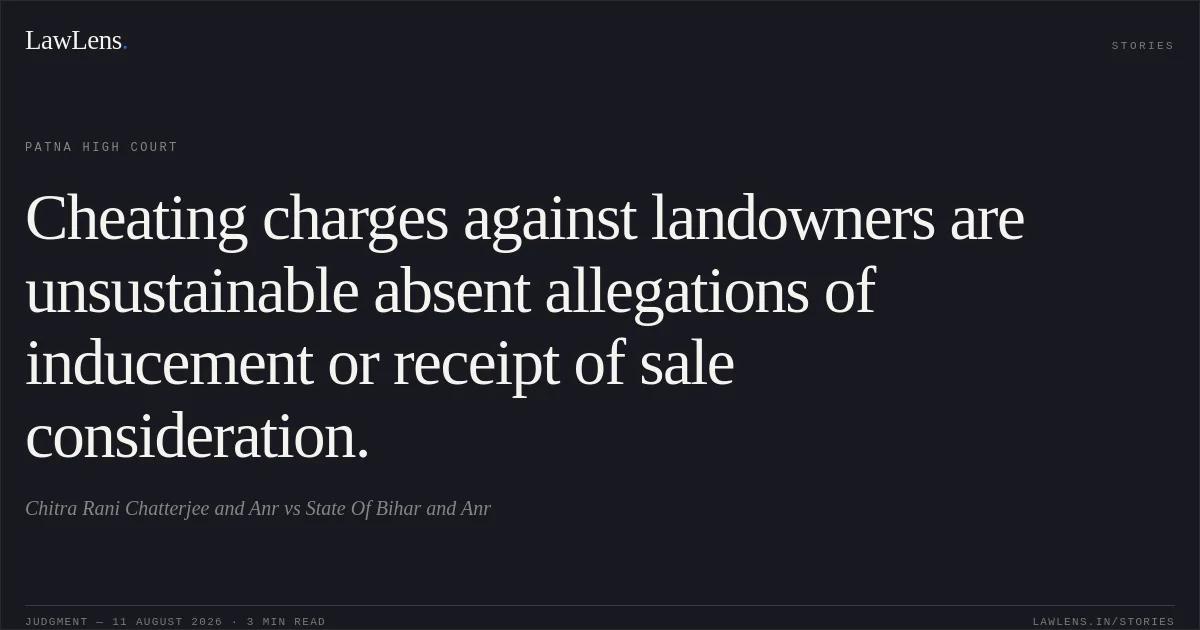
The High Court held that the order dated 29 January 2018 taking cognizance in Katihar (N) P.S. Case No. 264 of 2017 was unsustainable in law insofar as it concerned the petitioners.
The cognizance order was accordingly quashed and set aside with respect to Chitra Rani Chatterjee and Sumit Kumar Mukherjee only.
Source reference: para. 9; p. 16The application under Section 482 CrPC was allowed.
Source reference: para. 9; p. 16Acts & Sections Cited
8 provisions across 3 statutes referred to in this judgment. Each provision opens on LawLens.
Indian Penal Code, 18604
Code of Criminal Procedure, 19733
Negotiable Instruments Act, 18811
Original Court PDF
Chitra Rani Chatterjee and AnrvsState Of Bihar and Anr
Click to open original judgment
Original judgment, available to read, download and summarize on LawLens.in