Facts
The petitioner, proprietor of DBA Investment Pvt. Ltd., entered into an agreement for development of land belonging to Opposite Party Nos. 2–5 and co-accused Paresh Banerjee. He issued a cheque for ₹11,00,000 to Paresh Banerjee, but the ownership of the land was not transferred.
Source reference: paras. 6–7, pp. 2–3At subsequent meetings, partial cash refunds were allegedly made, while the balance remained unpaid.
Source reference: paras. 6–7, pp. 2–3The Judicial Magistrate took cognizance of offences under Sections 406 and 420 IPC only against Paresh Banerjee and declined to summon Opposite Party Nos. 2–5.
Source reference: para. 7, p. 3The petitioner’s criminal revision was dismissed by the Sessions Judge, Dhanbad, who held that there was no specific allegation of deception, entrustment, or a criminal role against Opposite Party Nos. 2–5, and that the dispute was essentially civil in nature.
Source reference: para. 8, pp. 3–4The petitioner thereafter invoked the High Court’s jurisdiction under Section 482 CrPC seeking quashing of the Magistrate’s and Revisional Court’s orders and issuance of summons against Opposite Party Nos. 2–5.
Source reference: para. 5, p. 2Issues
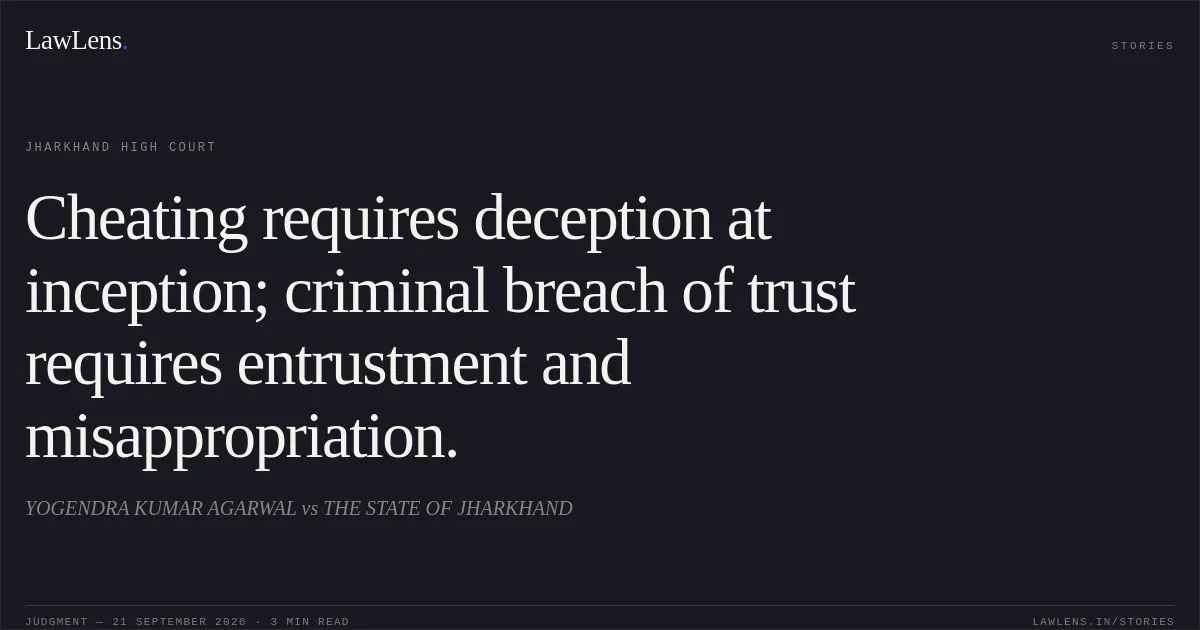
Whether the allegations against Opposite Party Nos. 2–5 disclosed the offence of cheating under Section 420 IPC, particularly the requirement of deception or dishonest intention at the inception of the transaction?
Source reference: paras. 11–12, pp. 6–7Whether the allegations disclosed criminal breach of trust under Section 406 IPC in the absence of entrustment of property to, and misappropriation by, Opposite Party Nos. 2–5?
Source reference: paras. 13–14, p. 7Whether the Magistrate and Sessions Judge committed any illegality in declining to summon Opposite Party Nos. 2–5?
Source reference: para. 15, p. 8Law Applied
The Court exercised its inherent jurisdiction under Section 482 of the Code of Criminal Procedure, 1973.
Source reference: para. 5, p. 2For Section 420 IPC, the Court applied the principle that cheating requires deception and dishonest intention at the inception of the transaction; a subsequent failure to perform a contractual promise or a later-formed intention to cheat ordinarily constitutes a civil breach, not cheating, relying on Uma Shankar Gopalika v. State of Bihar, (2005) 10 SCC 336.
Source reference: para. 11, p. 6For Section 406 IPC, the Court applied the requirements of entrustment of property and subsequent dishonest misappropriation, conversion, or use contrary to a legal direction, relying on Ram Narayan Popli v. Central Bureau of Investigation, (2003) 3 SCC 641.
Source reference: para. 13, p. 7Reasoning
The Court found no allegation that Opposite Party Nos. 2–5 had a dishonest intention or had practised deception from the beginning of the transaction.
Source reference: para. 12, p. 7The mere failure to transfer ownership or refund the remaining amount did not satisfy the foundational requirement of Section 420 IPC.
Source reference: para. 12, p. 7Further, the allegation concerning payment and entrustment of ₹11,00,000 was specifically directed against co-accused Paresh Banerjee, and there was no allegation that Opposite Party Nos. 2–5 had received, misappropriated, or converted any entrusted property.
Source reference: para. 14, p. 7Consequently, even if the allegations were accepted in their entirety, the essential ingredients of Sections 406 and 420 IPC were absent against Opposite Party Nos. 2–5.
Source reference: para. 15, p. 8Holding
The High Court held that the allegations did not disclose either cheating under Section 420 IPC or criminal breach of trust under Section 406 IPC against Opposite Party Nos. 2–5.
The lower courts therefore committed no illegality in refusing to summon them.
Source reference: para. 15, p. 8It upheld the orders dated 20 May 2022 of the Judicial Magistrate and 29 April 2023 of the Sessions Judge, Dhanbad, and dismissed the criminal miscellaneous petition as meritless.
Source reference: paras. 15–16, p. 8Acts & Sections Cited
3 provisions across 2 statutes referred to in this judgment. Each provision opens on LawLens.
Code of Criminal Procedure, 19731
Indian Penal Code, 18602
Original Court PDF
YOGENDRA KUMAR AGARWALvsTHE STATE OF JHARKHAND
Click to open original judgment
Original judgment, available to read, download and summarize on LawLens.in