01Facts
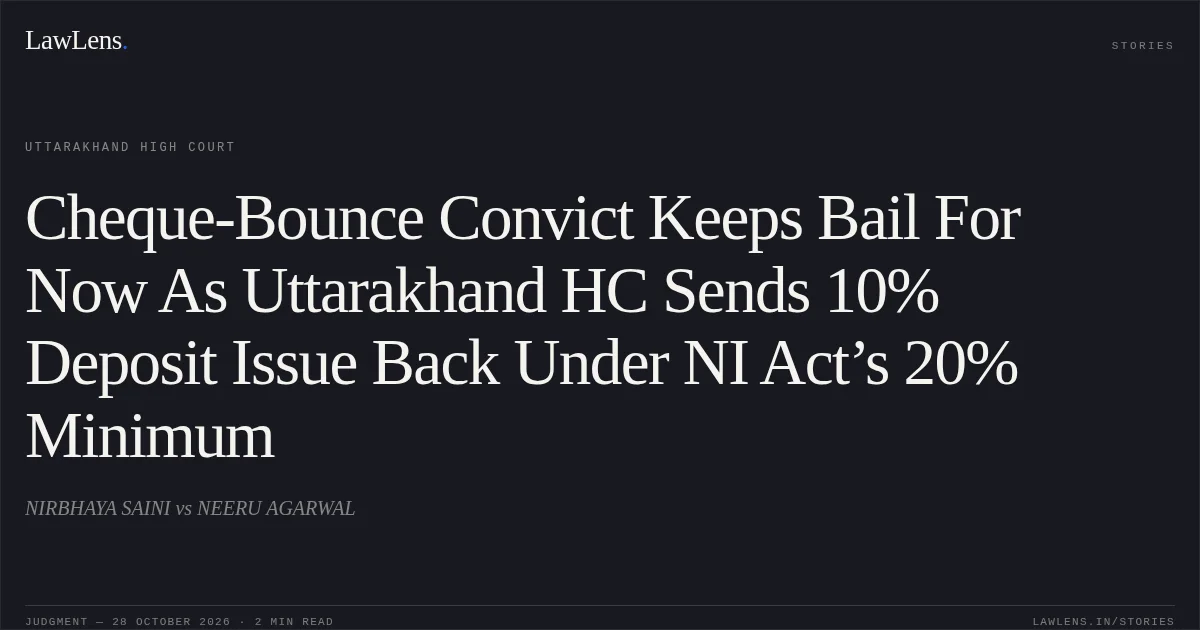
The applicant was convicted under Section 138 of the Negotiable Instruments Act, 1881, and sentenced to six months’ simple imprisonment and a fine of ₹31,00,000.
¶ 3–7In the applicant’s appeal, the appellate court suspended the sentence and granted bail on condition that he deposit 10% of the fine.
¶ 3–7The applicant challenged only that condition, arguing that it was imposed without reasons and was inconsistent with Section 148 of the Act.
¶ 3–7The High Court considered whether the condition could stand in light of the statutory minimum deposit.
¶ 9–1002Issues
i.Whether the appellate court’s direction to deposit 10% of the fine, as a condition of suspension of sentence and bail in an appeal from a conviction under Section 138 of the Act, could stand under Section 148.
¶ 9–10ii.Whether the question of deposit should be reconsidered by the appellate court in light of Section 148 and the law laid down by the Supreme Court.
¶ 1103Law Applied
Section 148 of the Negotiable Instruments Act empowers an appellate court hearing an appeal against conviction under Section 138 to direct the appellant to deposit a sum that is at least 20% of the fine or compensation awarded by the trial court; the provision also allows the court to extend the time for deposit for sufficient cause.
¶ 9The High Court also directed reconsideration in light of the Supreme Court’s decision in Muskan Enterprises and Another v. The State of Punjab and Another, (2024) 20 SCC 85, which it identified as relevant to the scope of the appellate court’s power under Section 148.
¶ 7, 11Provisions in the judgment · 4 · Linked ones open on LawLens
Bharatiya Nagarik Suraksha Sanhita, 2023 Section 528
Negotiable Instruments Act, 1881 Section 138Section 148
Code of Criminal Procedure, 1973 Section 389
04Reasoning
The appellate court had imposed a 10% deposit condition, which fell below the minimum prescribed by Section 148.
¶ 10The High Court therefore held that the condition required reconsideration under the statutory provision and the applicable Supreme Court law.
¶ 10It did not itself determine the amount to be deposited; instead, it remitted that question to the appellate court for reconsideration after hearing the parties.
¶ 1105Holding
The High Court allowed the application and set aside the appellate court’s order only insofar as it required a 10% deposit.
¶ 11–13It remitted the question of deposit to the appellate court for fresh consideration under Section 148 and the applicable law, after hearing the parties.
¶ 11–13The suspension of sentence and grant of bail otherwise remained unchanged, subject to the fresh order.
¶ 11–13Original Court PDF
NIRBHAYA SAINIvsNEERU AGARWAL
Click to open original judgment
Original judgment, available to read, download and summarize on LawLens.in