01Facts
The applicants sought to quash the charge-sheet, cognizance/summoning order and proceedings in a POCSO special sessions trial arising from an FIR alleging offences under Sections 354, 384, 506 and 420 of the IPC and Sections 16 and 17 of the POCSO Act.
¶ 2–7They relied on a settlement with respondent nos. 2 and 3, who stated that they did not wish to pursue the proceedings.
¶ 2–7The applicants also contended that the FIR was a counterblast to proceedings they had brought against respondent no. 3 under Section 138 of the Negotiable Instruments Act.
¶ 2–7The State opposed the compounding application.
¶ 2–7Applicant nos. 1 and 2 and respondent nos. 2 and 3 appeared before the Court; applicant no. 3 was absent due to an advanced pregnancy and hospitalisation.
¶ 2–702Issues
i.Whether the High Court should exercise its inherent jurisdiction under Section 528 of the BNSS to quash the criminal proceedings on the basis of a settlement, notwithstanding the POCSO allegations.
¶ 9–11ii.Whether the compounding application and the related criminal proceedings should be disposed of in accordance with the parties’ settlement.
¶ 3, 1203Law Applied
Section 528 of the BNSS confers inherent jurisdiction on the High Court to make orders necessary to secure the ends of justice; that jurisdiction is distinct from the statutory power to compound offences and may, in appropriate cases, extend to non-compoundable offences.
¶ 10–11In Gian Singh v. State of Punjab, (2012) 10 SCC 303; Narinder Singh v. State of Punjab, (2014) 6 SCC 466; and State of Madhya Pradesh v. Laxmi Narayan, (2019) 5 SCC 688, the Supreme Court set out that quashing on the basis of compromise requires consideration of the nature and gravity of the offence, the circumstances of the dispute, its impact on society, and whether quashing would secure the ends of justice.
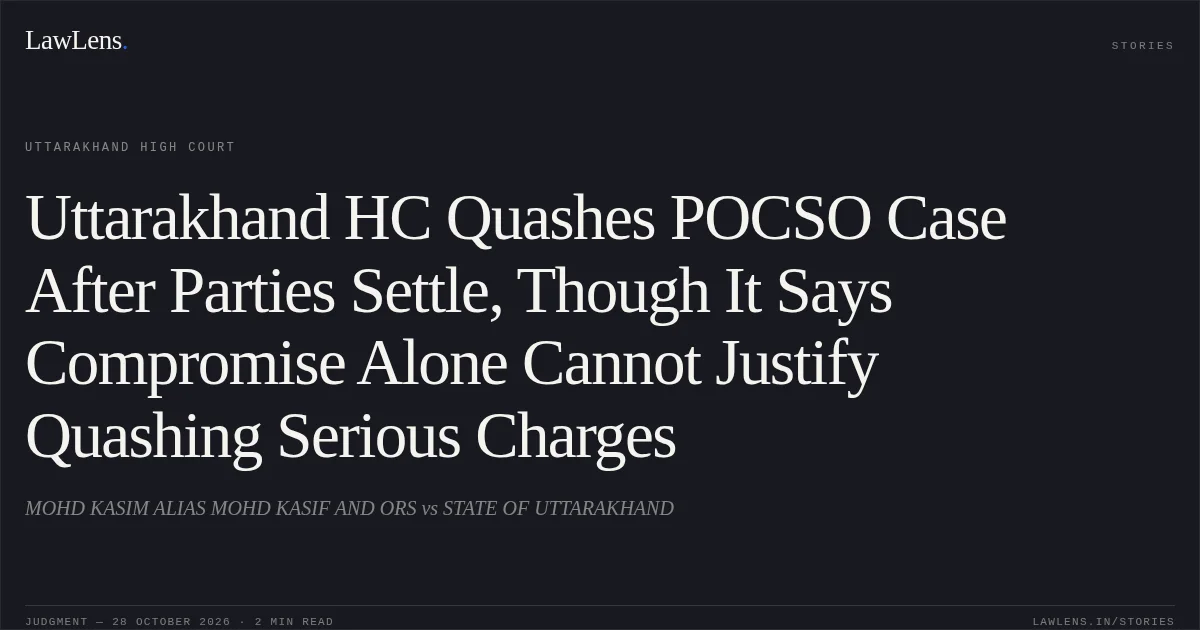
¶ 10–11A compromise or complainant’s unwillingness to proceed is not, by itself, sufficient to quash serious offences, particularly offences under the POCSO Act.
¶ 10–11Provisions in the judgment · 8 · Linked ones open on LawLens
Bharatiya Nagarik Suraksha Sanhita, 2023 Section 528
Indian Penal Code, 1860 Section 354Section 384Section 506Section 420
Protection of Children from Sexual Offences Act, 2012 Section 16Section 17
Negotiable Instruments Act, 1881 Section 138
04Reasoning
The Court found that the settlement was voluntary and that respondent nos. 2 and 3 unequivocally wished not to pursue the case.
¶ 6–12It noted the applicants’ contention that the FIR followed their Section 138 proceedings against respondent no. 3 and referred to the governing principles for compromise-based quashing.
¶ 6–12However, although it stated that compromise alone cannot justify quashing serious offences, particularly POCSO offences, the Court did not explain how the gravity and societal impact of the allegations were weighed or why quashing was warranted in this case.
¶ 6–12It nevertheless disposed of the compounding application in terms of the settlement and exercised its inherent jurisdiction to quash the proceedings.
¶ 6–1205Holding
The Court allowed the application under Section 528 of the BNSS, disposed of the compounding application in terms of the settlement, and quashed the charge-sheet dated 02.04.2023, the cognizance/summoning order dated 11.04.2023, and the entire proceedings in Special Sessions Trial No. 395 of 2023 arising from FIR No. 677 of 2022.
¶ 12–14The criminal miscellaneous application and any pending applications were disposed of accordingly.
¶ 12–14Original Court PDF
MOHD KASIM ALIAS MOHD KASIF AND ORSvsSTATE OF UTTARAKHAND
Click to open original judgment
Original judgment, available to read, download and summarize on LawLens.in