Facts
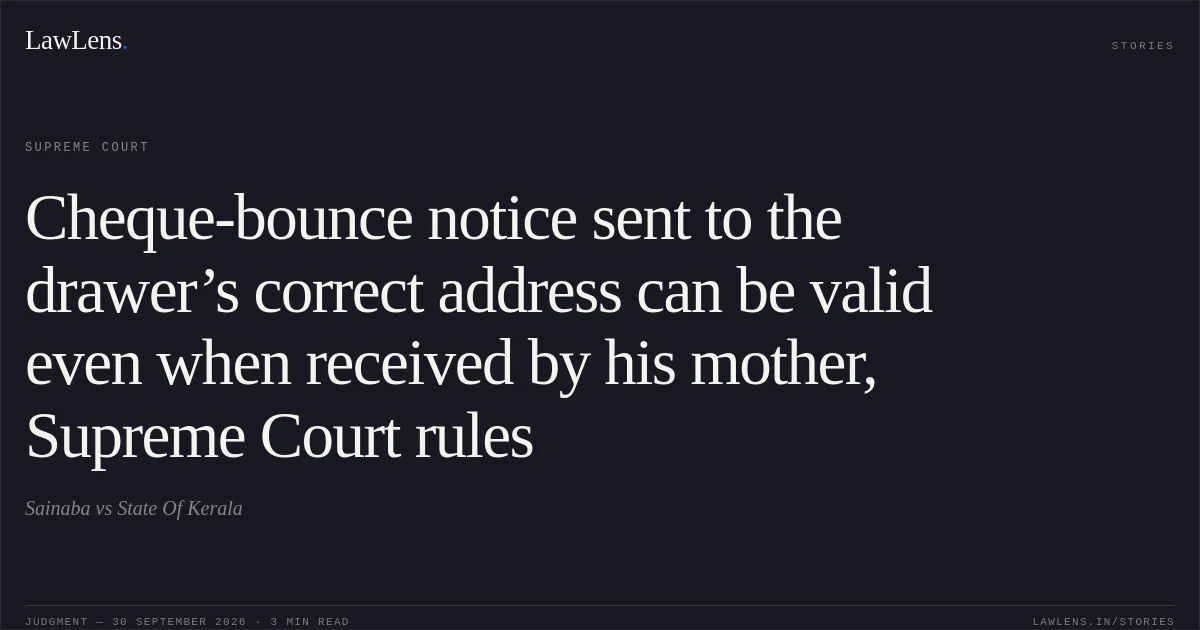
The appellant-complainant alleged that respondent No. 2 had borrowed ₹3,00,000 and issued a cheque in repayment, which was dishonoured.
Source reference: paras. 4–5, pp. 2–3The statutory demand notice was sent by registered post to respondent No. 2’s address and received by his mother.
Source reference: paras. 4–5, pp. 2–3The Trial Court convicted respondent No. 2 under Section 138 of the Negotiable Instruments Act, 1881, finding that the notice had been sent to his correct address; the Appellate Court affirmed the conviction.
Source reference: paras. 7–8, pp. 3–4The Kerala High Court allowed the revision and set aside the conviction because the notice had been received by the accused’s mother, rather than personally by the accused.
Source reference: para. 9, p. 4The complainant appealed to the Supreme Court.
Source reference: paras. 2, 10–15, pp. 1, 4–6Issues
1. Whether dispatch of a Section 138 demand notice by registered post to the drawer’s correct address raises a presumption of valid service when the notice is received by a family member residing at that address.
Source reference: paras. 18–24, pp. 6–122. Whether the High Court erred in setting aside the concurrent convictions solely because the notice was not personally received by the drawer.
Source reference: paras. 31–35, pp. 14–16Law Applied
Proviso (b) to Section 138 of the Negotiable Instruments Act, 1881 requires the payee to give written demand notice to the drawer within thirty days of receiving information of dishonour; the drawer’s failure to pay within fifteen days of receipt of notice gives rise to the cause of action.
Source reference: para. 18, pp. 6–7Under Section 27 of the General Clauses Act, 1897, a document properly addressed, prepaid and sent by registered post is presumed to have been served in the ordinary course of post, unless the contrary is proved; Section 114 of the Indian Evidence Act, 1872 supports the presumption of service.
Source reference: paras. 19, 23–24, pp. 7, 10–12K. Bhaskaran v. Sankaran Vaidhyan Balan, D. Vinod Shivappa v. Nanda Belliappa and the three-Judge Bench decision in C.C. Alavi Haji v. Palapetty Muhammed establish that dispatch to the drawer’s correct address satisfies the requirement of “giving” notice, subject to the drawer’s opportunity to rebut the presumption.
Source reference: paras. 20–24, pp. 7–12The Court held M.D. Thomas v. P.S. Jaleel per incuriam because it did not consider the binding precedents or determine whether the notice was correctly addressed and whether the recipient family member resided with the drawer.
Source reference: paras. 25–30, pp. 12–14Reasoning
The notice was sent by registered post to the same address that respondent No. 2 used in the proceedings, including his vakalatnama, appeal and revision; he had also appeared in court after summons were delivered at that address and had not disputed its correctness.
Source reference: para. 31, p. 14Its receipt by his mother did not, by itself, rebut the statutory presumption.
Source reference: paras. 32, 35, pp. 14–16Respondent No. 2 did not establish that the address was incorrect, that he was unaware the notice had reached his address, or that he and his mother resided separately or had an inimical relationship.
Source reference: paras. 32, 35, pp. 14–16The High Court therefore wrongly placed the burden on the complainant to prove the accused’s actual awareness and disregarded the presumption arising from proper dispatch.
Source reference: paras. 33–34, p. 15Holding
The Supreme Court held that dispatch of the notice to respondent No. 2’s correct address satisfied the statutory requirement of giving notice, and that the presumption of service had not been rebutted.
It allowed the appeal, set aside the High Court’s judgment, and restored the Trial Court’s sentence of six months’ simple imprisonment and fine of ₹3,00,000, with the default stipulation.
Source reference: paras. 35–37, p. 16Acts & Sections Cited
4 provisions across 3 statutes referred to in this judgment. Each provision opens on LawLens.
Negotiable Instruments Act, 18811
Code of Criminal Procedure, 19732
General Clauses Act, 18971
Original Court PDF
SainabavsState Of Kerala
Click to open original judgment
Original judgment, available to read, download and summarize on LawLens.in