Facts
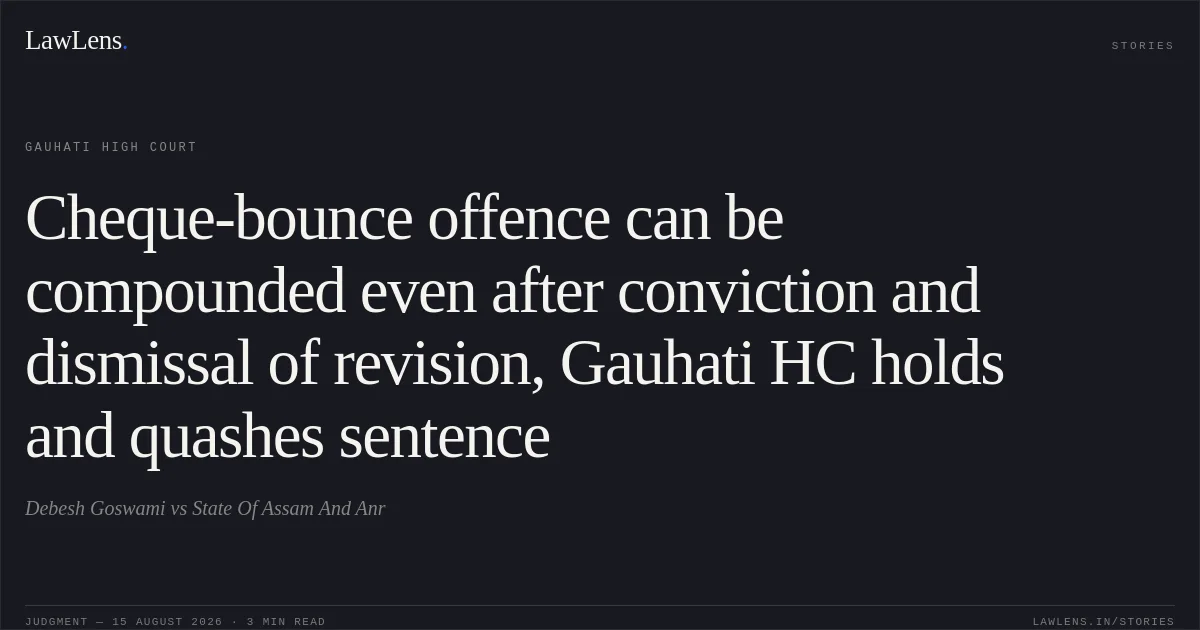
The petitioner was convicted under Section 138 of the Negotiable Instruments Act, 1881 (“NI Act”) by the Judicial Magistrate First Class, Kamrup (Metro), Guwahati, and sentenced to two months’ simple imprisonment with compensation of ₹5,00,000, with a further one month’s simple imprisonment in default of payment
Source reference: p.3, para. 3The conviction was affirmed by the Additional Sessions Judge (FTC) No. 3, Kamrup (Metro), in Criminal Appeal No. 200/2013, and the petitioner’s subsequent criminal revision was dismissed
Source reference: p.2, para. 2; p.9, para. 15During the pendency of the present petition under Section 528 of the Bharatiya Nagarik Suraksha Sanhita, 2023 (“BNSS”) read with Article 227 of the Constitution, the petitioner and the complainant/respondent No. 2 entered into a Settlement Agreement dated 16.06.2026.
Source reference: pp.3–4, paras. 5–6The petitioner agreed to pay ₹4,50,000 in full and final settlement, in addition to ₹1,50,000 previously deposited and released to the complainant pursuant to the revision proceedings
Source reference: pp.3–4, paras. 5–6The parties jointly sought compounding of the offence under Section 147 of the NI Act
Source reference: p.4, para. 6Issues
1. Whether an offence under Section 138 of the NI Act can be compounded under Section 147 of the NI Act after conviction and sentence have been affirmed in appeal and the subsequent criminal revision has been dismissed?
Source reference: p.4, para. 72. Whether the High Court can exercise its inherent jurisdiction under Section 528 BNSS to permit such compounding and set aside the finally affirmed conviction and sentence when no further proceedings are pending?
Source reference: pp.5–6, paras. 9–10Law Applied
Section 147 of the NI Act provides that every offence punishable under the Act is compoundable, notwithstanding the Code of Criminal Procedure
Source reference: p.6, para. 11In K.M. Ibrahim v. K.P. Mohammed, (2010) 1 SCC 798, the Supreme Court held that Section 147 has overriding effect and permits compounding of an offence under Section 138 even at the appellate stage, including in proceedings under Article 136
Source reference: pp.6–7, para. 12The Court also relied on Gian Chand Garg v. Harpal Singh, 2025 SCC OnLine SC 2317, including the principle that an offence under Section 138 may be compounded at any stage where the parties have voluntarily settled the dispute, and that courts should not override such compounding
Source reference: pp.7–8, paras. 13–14Accordingly, the High Court’s inherent power under Section 528 BNSS may be exercised to give effect to a settlement and quash the conviction and sentence in an appropriate Section 138 prosecution
Source reference: pp.8–9, paras. 14–15Reasoning
The Court treated the complainant’s voluntary settlement and receipt of the agreed payment as bringing the case within the broad statutory mandate of Section 147 of the NI Act.
Source reference: pp.6–9, paras. 12–15Since the provision permits compounding notwithstanding the procedural limitations in the criminal-procedure law, the fact that the conviction had been affirmed in appeal and the revision proceedings had ended did not create a legal bar
Source reference: pp.6–9, paras. 12–15Applying the Supreme Court’s interpretation in K.M. Ibrahim and Gian Chand Garg, the Court held that the purpose of Section 147 is to facilitate settlement of cheque-dishonour disputes and that the High Court could exercise its inherent jurisdiction even after the conclusion of the ordinary proceedings
Source reference: pp.7–9, paras. 13–15Holding
The Court answered both issues in the affirmative.
It permitted compounding of the offence under Section 138 of the NI Act on the basis of the settlement between the parties, set aside the judgments of conviction and sentence passed by the trial and appellate courts, and quashed the non-bailable warrant issued against the petitioner
Source reference: p.9, para. 16The criminal petition was accordingly allowed
Source reference: p.9, para. 17Acts & Sections Cited
4 provisions across 3 statutes referred to in this judgment. Each provision opens on LawLens.
Bharatiya Nagarik Suraksha Sanhita, 20231
Negotiable Instruments Act, 18812
Code of Criminal Procedure, 19731
Original Court PDF
Debesh GoswamivsState Of Assam And Anr
Click to open original judgment
Original judgment, available to read, download and summarize on LawLens.in