01Facts
The complainant society alleged that the accused took a personal loan of ₹1,25,000 on 29.9.2014.
¶ 2, 26The accused defaulted and issued a cheque dated 11.4.2019 for ₹2,06,624.
¶ 2, 6The cheque was dishonoured for "insufficient funds." A statutory notice dated 30.4.2019 was served, and the complaint under Section 138 of the NI Act was filed on 13.6.2019.
¶ 2, 9The accused pleaded not guilty, stated that he had paid ₹50,000 earlier, and led no evidence.
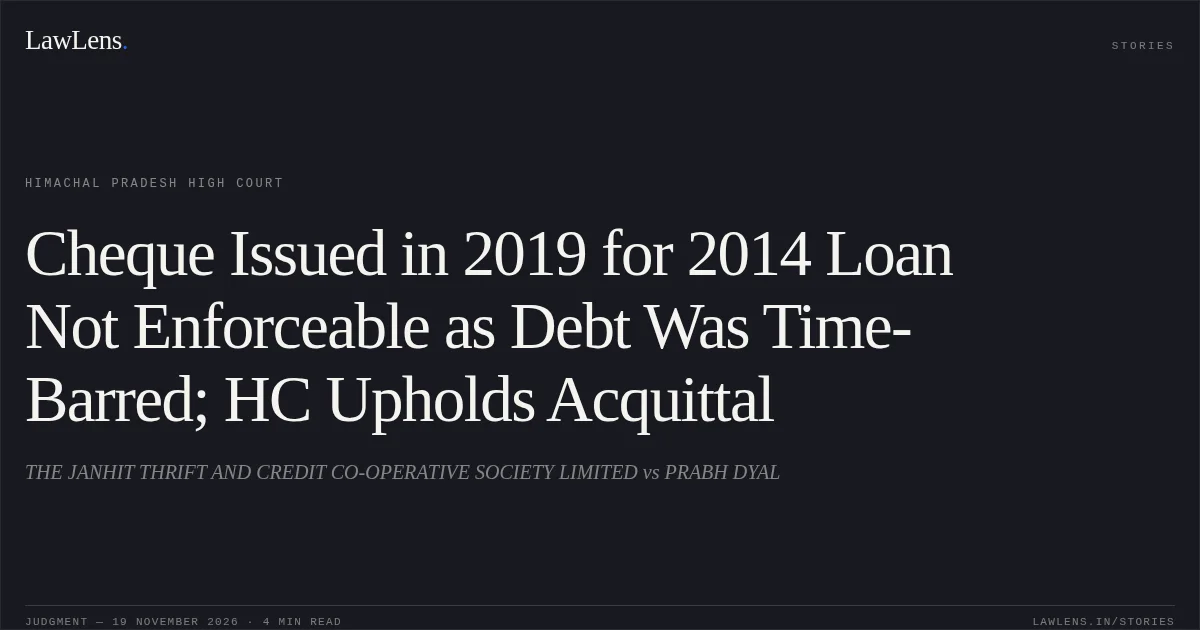
¶ 3, 5The Trial Court dismissed the complaint, holding that the cheque was issued after the three-year limitation period had expired, so it was not towards a legally enforceable debt.
¶ 6The Appellate Court (Sessions Judge, Mandi) affirmed this.
¶ 7The complainant then filed the present revision, relying on a ₹500 payment on 7.10.2016 shown in a statement of account, and filed an application to lead this document as additional evidence.
¶ 8–9The statement of account was filed with the complaint but never exhibited.
¶ 9, 24The complaint did not plead the ₹500 payment, and CW-1 did not depose to it.
¶ 2002Issues
i.1. Whether the High Court, in revision, can interfere with an order of acquittal.
¶ 12ii.2. Whether the statement of account, not exhibited before the Trial Court, may be admitted as additional evidence under Section 432 BNSS (Section 391 Cr.P.C.) at the revisional stage.
¶ 13–19, 24iii.3. Whether the alleged part-payment of ₹500 on 7.10.2016 constitutes an acknowledgement under Section 19 of the Limitation Act, 1963, extending limitation.
¶ 20–23, 25iv.4. Whether a cheque issued in 2019 towards a loan advanced in 2014 is a cheque for a legally enforceable debt, given that the debt was time-barred.
¶ 26v.5. Whether Section 49 of the H.P. Cooperative Societies Act, 1968 excludes the application of the Limitation Act to the present proceedings.
¶ 27–2803Law Applied
An acquittal may be set aside in revision only for manifest error of law or procedure, glaring illegality, or misreading or non-consideration of material evidence, and the revisional court cannot convert an acquittal into a conviction, citing Ganesha v. Sharanappa, (2014) 1 SCC 87.
¶ 12Additional evidence is admissible under Section 432 BNSS / Section 391 Cr.P.C. only where it is necessary to prevent a failure of justice, the party was not prevented by lack of due diligence, and it cannot be used to fill gaps or reverse the trial court's judgment, citing State of Rajasthan v. Asharam, Sukhjeet Singh v. State of U.P., State (NCT of Delhi) v. Pankaj Chaudhary, H.N. Jagadeesh v. R. Rajeshwari, Rajvinder Singh v. State of Haryana, and Ajitsinh Chehuji Rathod v. State of Gujarat.
¶ 14–19Under Section 19 of the Limitation Act, a part-payment extends limitation only if it is made by the debtor within the limitation period and is acknowledged in writing in the debtor's hand or signed by him, citing Kangra District Wholesale Co-operative Supplies and Marketing Society Ltd. v. Buta Mal Sohan Lal, 1996 SCC OnLine HP 58, and Shanti Conductors (P) Ltd. v. Assam SEB, (2020) 2 SCC 677.
¶ 21–22Under Article 19 of the Limitation Act, a claim for money lent is barred after three years, and a cheque issued towards a time-barred debt is not for a legally enforceable debt, citing Social Leasing (India) Ltd. v. Rajan Kumar Kanthwal, 2025 SCC OnLine HP 3131.
¶ 26Section 49 of the H.P. Cooperative Societies Act excludes the Limitation Act only for proceedings under Sections 69, 73 and 88, citing Jogindera Central Cooperative Bank Ltd. v. Addl. Registrar (Mon.) Cooperative Societies, MANU/HP/0751/2025.
¶ 27Provisions in the judgment · 24 · Linked ones open on LawLens
Negotiable Instruments Act, 1881 Section 138
Code of Criminal Procedure, 1973 Section 311Section 313Section 391
Bharatiya Nagarik Suraksha Sanhita, 2023 Section 432
Limitation Act, 1963 18 provisions
Section 4Section 5Section 6Section 7Section 8Section 9Section 10Section 11Section 12Section 13Section 14Section 15Section 16Section 17Section 18Section 19Section 20Section 29Code of Civil Procedure, 1908 Section 7
04Reasoning
The Court found no perversity in the acquittal. The Trial and Appellate Courts correctly found that the loan was advanced in 2014 and the cheque was issued in 2019, so the debt was time-barred when the cheque was issued.
¶ 6–7, 26The ₹500 payment could not revive limitation because the complaint neither pleaded it nor was it proved through CW-1.
¶ 20No written acknowledgement by the debtor was produced, and a statement of account is not a substitute for one.
¶ 21, 23The statement of account shows a "TFR from DDS-406" entry, indicating a transfer from another account rather than a payment by the debtor, so Section 19 is not satisfied.
¶ 25On additional evidence, the document was filed but not exhibited through inadvertence, which is negligence and not due diligence. Admitting it would also fill a gap left by the complainant at trial, which Section 391 does not permit.
¶ 15–16, 24–25The proceedings were not initiated under Sections 69, 73 or 88 of the Cooperative Societies Act, so Section 49 does not displace the Limitation Act.
¶ 27–2805Holding
The acquittal suffers from no manifest error, glaring illegality or miscarriage of justice, so the revision fails.
¶ 12, 29The ₹500 payment was neither pleaded nor proved in the required written form, so it does not extend limitation under Section 19 of the Limitation Act.
¶ 20–25The cheque was issued towards a time-barred debt and so was not for a legally enforceable liability.
¶ 26Section 49 of the H.P. Cooperative Societies Act does not exclude the Limitation Act in the present case.
¶ 28The application for additional evidence is effectively rejected, since the document would not assist the determination and the non-exhibition was due to negligence.
¶ 24–25The revision is dismissed, the judgments of the Trial Court and Appellate Court are affirmed, and the record is to be returned forthwith.
¶ 29–31Original Court PDF
THE JANHIT THRIFT AND CREDIT CO-OPERATIVE SOCIETY LIMITEDvsPRABH DYAL
Click to open original judgment
Original judgment, available to read, download and summarize on LawLens.in