Facts
The complainant had filed CCC No. 1228/2015 against police officers concerning a ‘B’ report filed during an interim order in proceedings arising from his criminal complaint against the accused.
Source reference: pp. 3–8The accused admitted issuing a cheque for Rs.1,00,000, with an endorsement stating it was towards an agreement and the withdrawal of CCC No. 1228/2015, and that it should be presented after withdrawal.
Source reference: pp. 3–8The complainant encashed the cheque but alleged that it had been issued under intimidation.
Source reference: pp. 3–8With the Advocate General’s consent under Section 15 of the Contempt of Courts Act, 1971, he initiated this criminal contempt proceeding.
Source reference: pp. 3–8The Court framed a charge alleging that the accused pressured and threatened him to withdraw the earlier contempt petition; the matter proceeded to trial.
Source reference: pp. 3–8The complainant’s encashment of the cheque and subsequent withdrawal of CCC No. 1228/2015 were also considered by the Court.
Source reference: pp. 16–21Issues
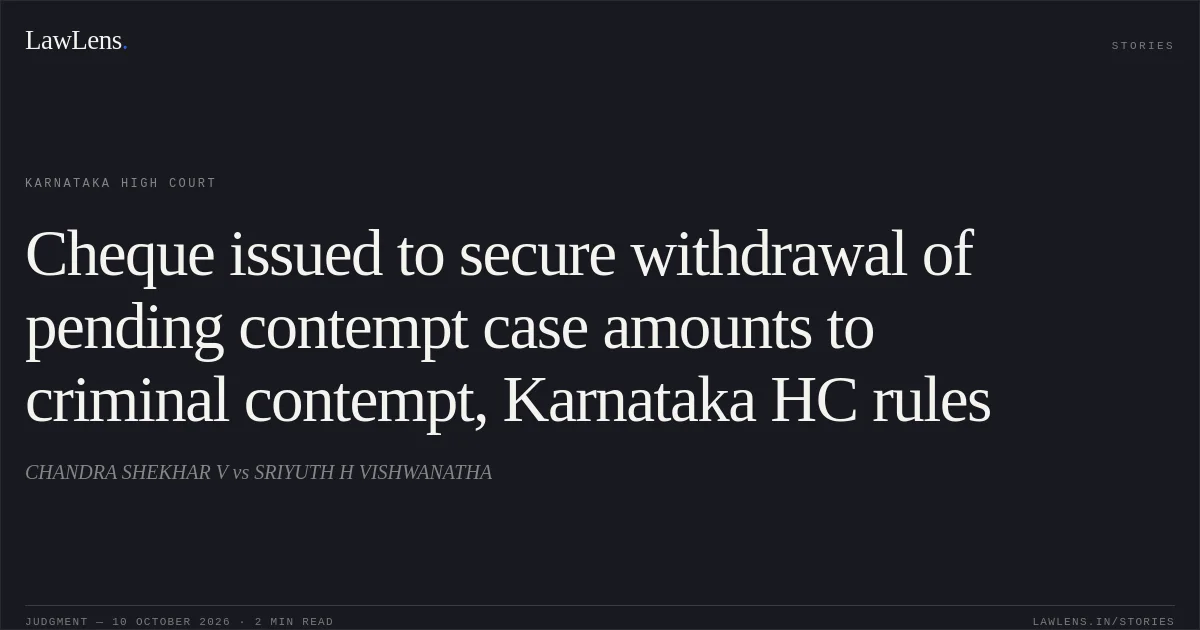
1. Whether the accused’s issuance of a cheque on the condition that the complainant withdraw CCC No. 1228/2015 amounted to criminal contempt under Section 2(c) of the Contempt of Courts Act, 1971.
Source reference: pp. 7–8, 162. Whether the complainant’s conduct in encashing the cheque and pursuing the contempt proceedings warranted an adverse order, including costs.
Source reference: pp. 16–21Law Applied
The Court considered Article 215 of the Constitution and Sections 2(c), 12 and 15 of the Contempt of Courts Act, 1971.
Source reference: p. 4Section 2(c) defines criminal contempt to include conduct that interferes, or tends to interfere, with the due course of a judicial proceeding or the administration of justice.
Source reference: p. 4Section 12 provides for punishment for contempt.
Source reference: p. 4Section 15 governs cognizance of criminal contempt, including the requirement of consent for a private complainant’s motion.
Source reference: p. 4The Court also stated that contempt jurisdiction is extraordinary and is exercised to uphold the majesty of the Court; a complainant’s compromised conduct may weigh against the complainant and be relevant to the Court’s assessment.
Source reference: p. 20Reasoning
The accused admitted issuing the cheque and its endorsement linking payment to withdrawal of the pending contempt petition.
Source reference: pp. 16–19The Court held that conditioning payment on withdrawal of a judicial proceeding interfered with the administration of justice and intimidated the complainant, notwithstanding the complainant’s encashment of the cheque.
Source reference: pp. 16–19At the same time, the complainant’s decision to encash the cheque and later pursue contempt proceedings—and his subsequent withdrawal of the earlier petition—was found blameworthy and to have consumed judicial time in a personal dispute.
Source reference: pp. 18–21The Court therefore treated the complainant’s conduct as warranting costs, while not absolving the accused of contempt.
Source reference: pp. 18–21Holding
The Court found the charge proved beyond reasonable doubt and convicted the accused of criminal contempt under Section 12(1) of the Contempt of Courts Act, 1971.
It sentenced him to simple imprisonment until 5:00 p.m. on the day of judgment and imposed a fine of Rs.2,000, with one day’s simple imprisonment in default.
Source reference: pp. 21–23The complainant was not convicted, but was ordered to pay Rs.10,000 to the Registry as costs.
Source reference: pp. 21–23The Court also directed issuance of a conviction warrant and disposal of pending applications.
Source reference: pp. 21–23Acts & Sections Cited
4 provisions across 2 statutes referred to in this judgment. Each provision opens on LawLens.
Contempt of Courts Act, 19713
Negotiable Instruments Act, 18811
Original Court PDF
CHANDRA SHEKHAR VvsSRIYUTH H VISHWANATHA
Click to open original judgment
Original judgment, available to read, download and summarize on LawLens.in