Facts
The respondent-assessee, a registered dealer under the Gujarat Value Added Tax Act, 2003 (“VAT Act”), manufactured and sold peppermint, sugar candy, sakariya and chewing gum
Source reference: para. 4Following inspection and seizure of its books, the Assessing Officer assessed chewing-gum sales at 12.5%, treating them as falling under the residuary Entry 87 of Schedule II rather than Entry 74A, which covered “sweets and sweetmeats” taxable at 4%.
Source reference: paras. 5–7Interest under Section 42(6) and penalties under Sections 34(7) and 34(12) of the VAT Act were also imposed.
Source reference: para. 7The first appellate authority granted relief concerning sakariya and reduced the penalties but upheld the 12.5% classification of chewing gum.
Source reference: para. 8The Gujarat Value Added Tax Tribunal subsequently held that chewing gum fell under Entry 74A and set aside the consequential interest and penalties.
Source reference: para. 9The State challenged that decision under Section 78 of the VAT Act.
Source reference: para. 2Issues
1. Whether chewing gum is taxable as “sweets and sweetmeats” under Entry 74A of Schedule II to the Gujarat VAT Act, 2003, or under the residuary Entry 87?
Source reference: para. 3(i); paras. 39–402. Whether the Tribunal was justified in deleting the interest and penalties imposed under Sections 42(6), 34(7) and 34(12) of the VAT Act?
Source reference: para. 3(ii); paras. 7, 9 and 56Law Applied
The Court applied Entries 74A and 87 of Schedule II to the VAT Act: Entry 74A covers “sweets and sweetmeats”, while Entry 87 applies to goods not covered by the specified or preceding entries.
Source reference: para. 40Classification under an undefined taxing entry is determined by the common-parlance or trade-parlance test, namely, how the product is understood by consumers and persons dealing in it.
Source reference: no citationRelying principally on Commissioner of Trade Tax, U.P. v. Associated Distributors Ltd., the Court held that chewing gum and bubble gum are not “sweetmeats” because they are kept in the mouth and discarded after chewing, rather than eaten as confectionery.
Source reference: paras. 14, 48 and 50The Court also considered the Food Safety and Standards Regulations, 2011, the Central Excise Tariff classification of chewing gum under Heading 1704.10.00, and departmental circulars and determination orders, but held that such materials could not override the binding common-parlance rule laid down by the Supreme Court.
Source reference: paras. 41–45, 51 and 55Since chewing gum was not covered by Entry 74A or any other specific entry, it fell under the residuary Entry 87.
Source reference: paras. 54–56Interest and penalties were consequential to the correct tax assessment under the VAT Act.
Source reference: para. 56Reasoning
The Court compared the statutory description in Entry 74A with the ordinary and commercial understanding of chewing gum.
Source reference: paras. 41–44, 50Although chewing gum contains sugar and is classified as sugar confectionery under the Central Excise Tariff, its essential character and use distinguish it from an edible sweet or sweetmeat: it is chewed for flavour or as a mouth freshener and is not consumed as food.
Source reference: paras. 41–44, 50The Supreme Court’s decision in Associated Distributors Ltd. directly addressed the classification of chewing gum and held that it could not be treated as a sweetmeat in common parlance.
Source reference: paras. 48–50The Court rejected the assessee’s reliance on historical departmental practice, determination orders concerning toffees and chocolates, and the 2012 commodity-code circular, observing that those materials either concerned different products or were administrative aids and could not displace the Supreme Court’s binding interpretation.
Source reference: paras. 45–46, 49, 51 and 55The Tribunal’s conclusion that chewing gum remained an “eatable” product because the sweet juice was consumed was contrary to the Supreme Court’s ruling.
Source reference: paras. 53–55Consequently, the product was taxable under Entry 87 at 12.5%, and the deletion of the consequential interest and penalties was also unsustainable.
Source reference: para. 56Holding
The High Court answered both substantial questions in favour of the Revenue and against the assessee.
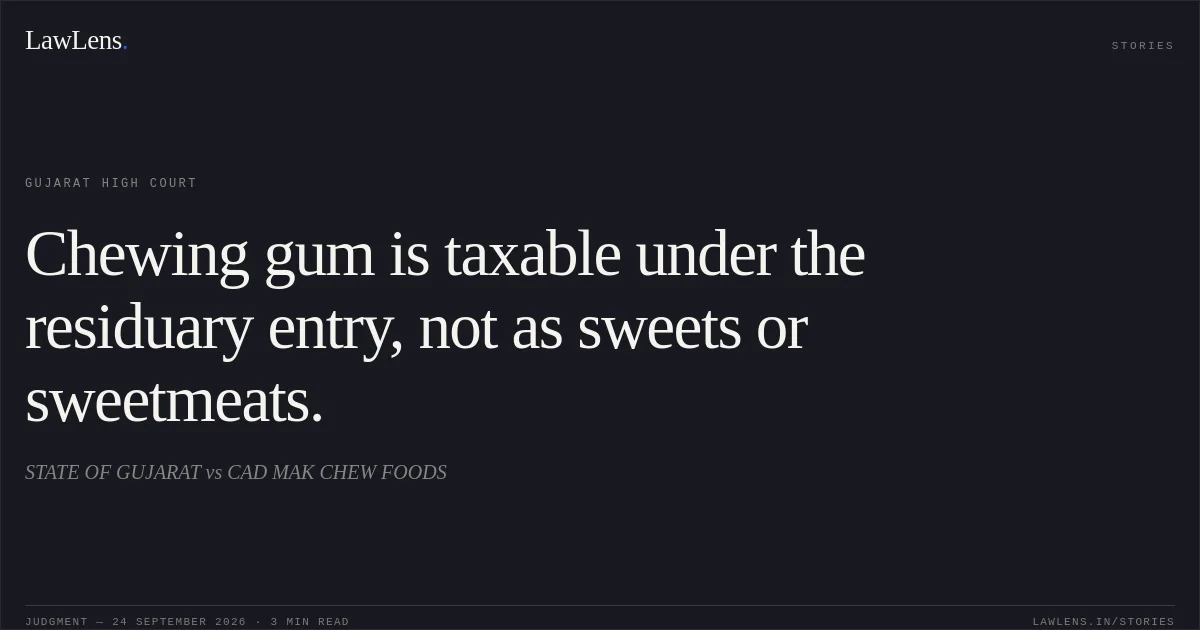
It held that chewing gum cannot be classified as “sweets and sweetmeats” under Entry 74A of Schedule II to the VAT Act and is instead taxable under the residuary Entry 87 at 12.5%.
Source reference: paras. 54–56The Tribunal’s order granting classification under Entry 74A and deleting the consequential interest and penalties was set aside.
Source reference: paras. 56–57The State’s tax appeal was accordingly allowed and disposed of.
Source reference: paras. 56–57Acts & Sections Cited
5 provisions across 2 statutes referred to in this judgment. Each provision opens on LawLens.
Gujarat Value Added Tax Act, 2003.4
Drugs and Cosmetics Act, 19401
Original Court PDF
STATE OF GUJARATvsCAD MAK CHEW FOODS
Click to open original judgment
Original judgment, available to read, download and summarize on LawLens.in